Full article about Alquerubim: Clay Strips, Limestone Bones & Coffee Steam
Cobbled lanes, chapel quoins and €5 pilgrim beds above the Aveiro plain
Hide article Read full article
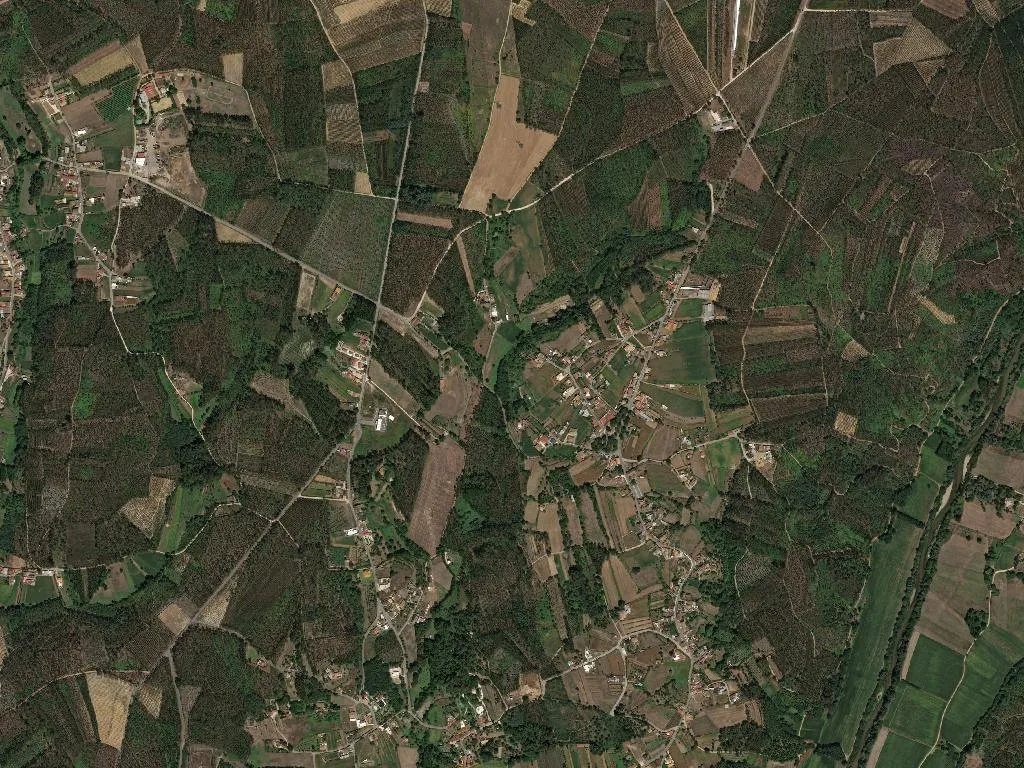
The cobbles click beneath your shoes at an unpredictable tempo, each stone dished by a century of clogs, wellies and Sunday leather. Alquerubim sits sixty-four metres above the Aveiro plain, a rectangle of clay fields that the locals still divide into narrow faixas—strips just wide enough for a single tractor pass. Morning fog rolls up the Vouga valley and blurs the hedgerows; by mid-afternoon the same sky turns merciless, bleaching the orange roof-tiles to the colour of dried saffron.
Stone that endures
Only two buildings carry Portugal’s “public interest” seal: the Casa de Fontes, a late-nineteenth-century manor wedged between eucalyptus and allotments, and the chapel of Nossa Senhora das Dores, whose limestone quoins gleam like wet bone against whitewash. Both are built for Atlantic damp—walls half a metre thick, eaves deep enough to shelter a cart. There is no ornament beyond a discreet date-stone or a scalloped capital; the architecture speaks the language of threshing floors and grain lofts.
The parish measures 15.4 km²—roughly the size of a small English common—yet holds only 2,233 souls. Density is so low that neighbours recognise the cough of each other’s Renault 4. New breeze-block villas sprout beside nineteenth-century gateposts of rotting chestnut, but the human scale remains: a primary school with 259 pupils, a chemist that doubles as post office, a café where the espresso machine is older than the barista’s father.
Pilgrims’ detour
Since 2012 the Central Portuguese Route of the Camino de Santiago has cut across the parish along the EN528. Walkers emerge from the pine tunnel east of the Vouga, refill bottles at the republic-square fountain, then shuffle on towards Oliveira de Azeméis. Five households—no hostels, no hotels—let spare rooms: ironed sheets, a thermos of chamomile, a stamp of the credential for five euros. The rhythm is familiar now; dogs barely lift their heads.
What lunch costs
Gastronomy arrives without fanfare. Rosa & Filhos grocery, trading from the same corner since 1953, sells doce de ovos in cork thimbles—two yolks, sugar, cinnamon, a recipe Rosa took to her grave. In domestic kitchens the soup is whatever the garden offers: pumpkin leaves, courgette stalks, a knuckle of chouriço smoked over last winter’s oak. The only restaurant, O Moinho, occupies a former water-mill on the Lobo stream; twelve tables, roasted kid ordered by telephone on Thursday for Sunday lunch. No menu, no card machine.
Evening settles in layers: first the gold of low sun on maize stubble, then the copper of smouldering vine-prunings, finally a violet stripe above the eucalyptus. A dog barks once, twice, then thinks better of it. Somewhere a tractor coughs into silence, leaving only the wind searching the poplars and the squeak of a gate as someone closes the day. Alquerubim offers no spectacle—just the granular texture of a life still paced by daylight, rainfall and the slow turn of seasons.