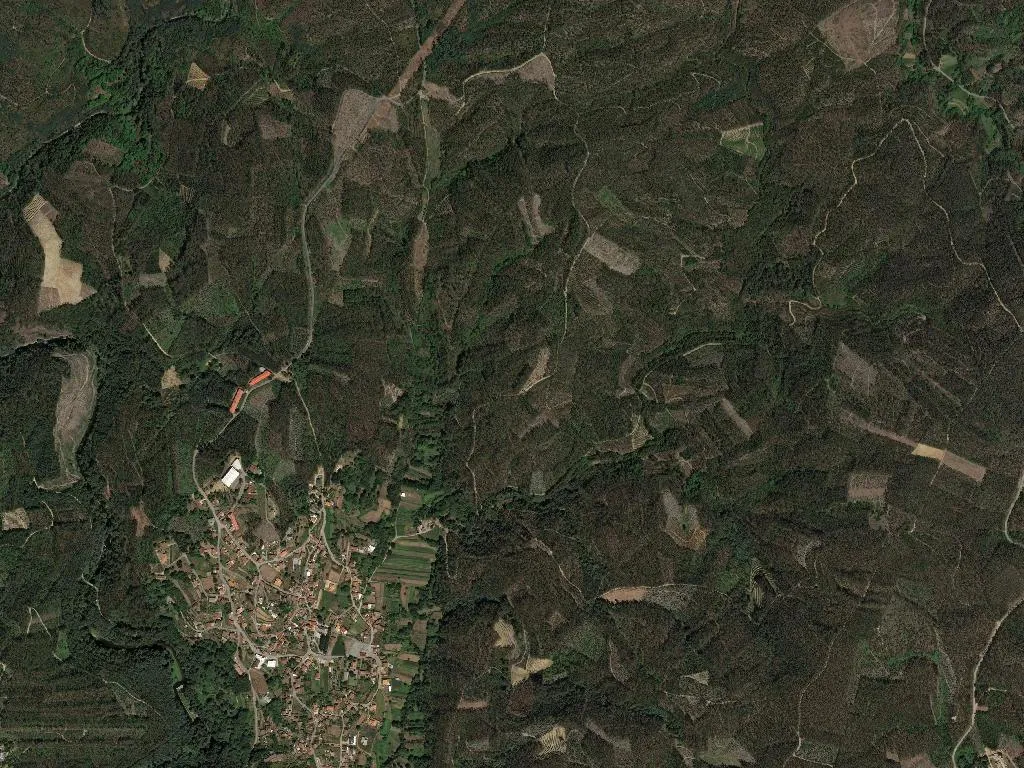
Full article about Ribeira de Fráguas: mist, mills & mossy silence
Walk granite-ledged levadas past spinning watermills in Ribeira de Fráguas, Albergaria-a-Velha
Hide article Read full article
Granite, mist and mill-wheels
Boot-heels clack on loose cobbles between bare granite walls, the sound swallowed almost immediately by the hush of Ribeira de Fráguas. At 199 m above sea-level the stream still spins the paddles of two restored watermills; the rest survive only as ivy-clad stumps. When Atlantic mist lifts off the valley the busy EN1 vanishes within fifty paces, muffling even the night-time lorries that otherwise carry clearly on the breeze.
The thread that carved the land
The rivulet rises near Sever do Vouga and slips quietly into the Caima. An eight-kilometre way-marked footpath begins at the thirteenth-century Ponte de São João and ends at the weir of Moinho da Roda—two unhurried hours if you resist stopping to photograph every kingfisher. Dry-stone levadas once fed three separate mills—Moinho do Meio, Côvo and the diminutive Levadinha—and their courses are still readable as pale seams across the hillside. Beside the chapel of São Sebastião the bridge lost one arch in the winter floods of 1978; villagers wedged an oak beam into the breach, and it holds to this day.
Pilgrims and silence
The parish is an obligatory waypoint on the Caminho Central, the interior route that links Lisbon to Santiago. Hikers drop off the tarmac, cross São João’s bridge, then climb the cobbled Rua do Calvário towards the next ridge. Behind the parish church the only potable spring gushes from an iron spout set into granite; its flow never falters, even in August. With just nineteen inhabitants per square kilometre, the loudest conversation is usually between chiff-chaffs.
Feasts in the farming calendar
The Igreja Matriz unlocks only for Sunday mass at nine. At other times ask for Dona Albertina in the blue house opposite; she keeps the key between her flowerpots. On 24 June the village celebrates São João with grilled sardines in the sports hall (€8 with wine) followed by folk dances led by the gaita-driven Gaitanços de Albergaria. Mid-winter brings the romaria of São Sebastião: thirty locals, a sack of chestnuts and a bottle of aguardiente to thaw frozen fingers.
Tastes of smoke and water
Eel stew is served solely at Restaurante O Moulho (tel. +351 234 541 223; closed Tuesdays). The eels are lifted from the stream at dusk with hand nets, then simmered with corn-bread baked in a wood-fired oven at Couto bakery (open 7 a.m.–1 p.m., shut Saturday afternoons). Vale de Cambra supplies the leitão—order 24 hours ahead from Zé Manel’s stone oven. Goat’s cheese from Quinta do Pêro costs €12 a kilo, vacuum-packed because the farm lacks retail certification.
Walkers’ notes: granaries and grey herons
Oak-waymarked posts carry QR codes, but the signal drops behind Moinho do Côvo, at Ribeiro de Cima weir and inside Pinhal do Lobo. Bring water—there are no cafés. Five stone granaries punctuate the route: three wooden, two mortared; Quinta do Pêro’s still stores corn for the horses. At dusk grey herons settle on the Moinho da Roda weir—binoculars will also pick out the white-throated dipper from the robin-sized common redstart.