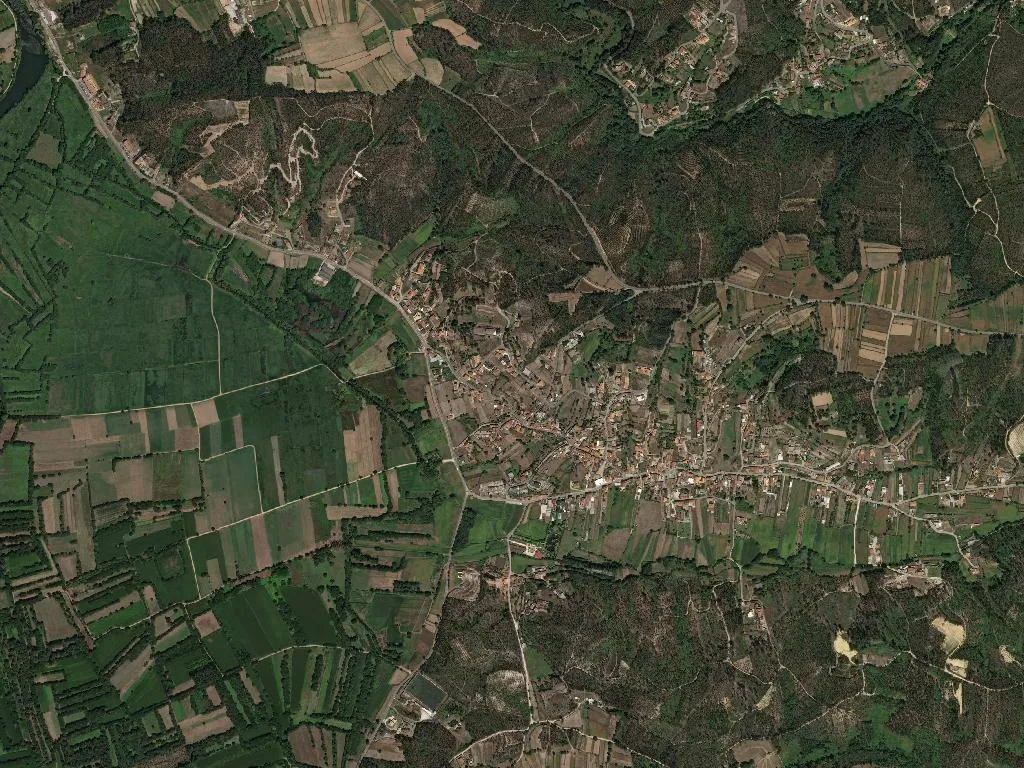
Full article about São João de Loure e Frossos
Granite lanes, royal charters and plane-tree shade bind two hamlets that time forgot
Hide article Read full article
Six o’clock and the fields remember
The bell of São João Baptista strikes six and the note rolls across the flat green chessboard of the Aveiro plain, losing itself only where the plane trees meet the sky. Granite setts in the lanes still carry the polish of medieval boots—Way of St James traffic that has funnelled through here since the 12th century. Wood-smoke drifts from chimneys at dusk, braiding with the raw scent of newly-turned earth. Between the hamlets of São João de Loure and Frossos, time is measured by sowing, harvest and the annual round of saints’ days rather than by clocks.
Two villages, one ledger of power
Frossos once outranked its neighbour. A royal charter from Dom Manuel I in 1514 raised it to vila status and seven centuries of independence followed, a dignity still asserted by the weathered pillory stone that stands in the centre like a exclamation mark. The hamlet was then known as Faroços and sent its own representative to the Cortes. São João de Loure, meanwhile, was an annex of Angeja until the 1836 liberal reforms shunted it into the new municipality of Albergaria-a-Velha. Both parishes had long answered to the wealthy Convent of Jesus in Aveiro, which appointed priests and collected tithes from the 15th century onward. Administrative logic caught up with history in 2013 when the two parishes were merged; in January 2024 the parish council unanimously voted to separate again—paperwork now languishes at town hall.
Stone, faith and plane-leaf shade
Bell towers map the settlement: São João Baptista to the south, São Paio to the north. Between them, 18th-century granite crosses mark the old footpaths—way-markers for souls as well as travellers. Inside the whitewashed chapels of Santa Ana and São Miguel, candlelight throws soft shadows across limewashed walls. Yet the place is no open-air museum. The Parque dos Plátanos, planted beside the primary school in the 1990s, throws cool shade over summer picnics, while Frossos’ Boca do Carreiro park loops around a stream where marsh marigolds glow in April. The village well, opened in 1923, still draws the occasional nostalgic bucketful.
Paths that pre-date GPS
The Central Portuguese Camino cuts straight through parish territory. On misty mornings modern pilgrims in neon gilets emerge like ghosts between eucalyptus trunks, following yellow arrows stencilled on barn walls. Every October the parish trail-running event repurposes these lanes into a 14-km circuit of sweat and skylark song. At the western edge, the 18th-century Quinta das Vinhas de Bocage—its name a nod to the poet who once owned land nearby—reminds walkers that every vineyard ridge was drawn by generations of tenant farmers.
River and field on the same plate
Eels caught in the Caima and Marnel rivers—both within a five-kilometre cycle—become caldeirada, a tomato-and-coriander stew that tastes of reeds and slow water. Roibacos (river-bream) appear grilled at weekend lunches; carolos, a coarse cornmeal porridge, still fills field hands before dawn. Pork is king at festivals: shoulder slow-roasted in a wood oven, or belly stewed with turnip tops. Winter brings sweet pumpkin papas, spooned from earthenware bowls while Atlantic rain drums on roof tiles. Aveiro is only 25 km away, so no celebration ends without a tray of Ovos Moles—delicate communion-wafer shells filled with egg-yolk cream and stamped with maritime motifs.
When the saints go marching in
24 June, São João: bonefires crackle beside the mother church, grilled sardine smoke competes with gunpowder from improvised fireworks, and the square stays alive until the first swallows fly. 24 August, São Bartolomeu: Loure’s residents shoulder their saint in procession, then dance pimba in the churchyard. Our Lady of Deliverance is honoured twice—15 August and the following Sunday—her statue carried beneath a canopy of white hydrangeas. January opens with São Silvestre, May brings São Paio, and 29 September closes the cycle with São Miguel. In municipal-election years every festa doubles as a campaign rally: candidates hand out roast-chestnut coupons and promise tarmac for the lanes.
The morning fog lifts to reveal red roofs and the twin silhouettes of bell towers. In the Parque dos Plátanas, leaves rustle like parchment while hikers tighten laces and head northward. Behind them the bell settles into silence, the soil releases its peat-dark perfume, and the parish resumes its compact with the seasons—an itinerary rather than a destination.