Full article about Moita: Walking Where a Town Forgot Its Name
Pine-scented trails thread granite hamlets, 17th-century bells and vanished courthouses of Anadia’s
Hide article Read full article
Ferreiros: the former heart of the municipality
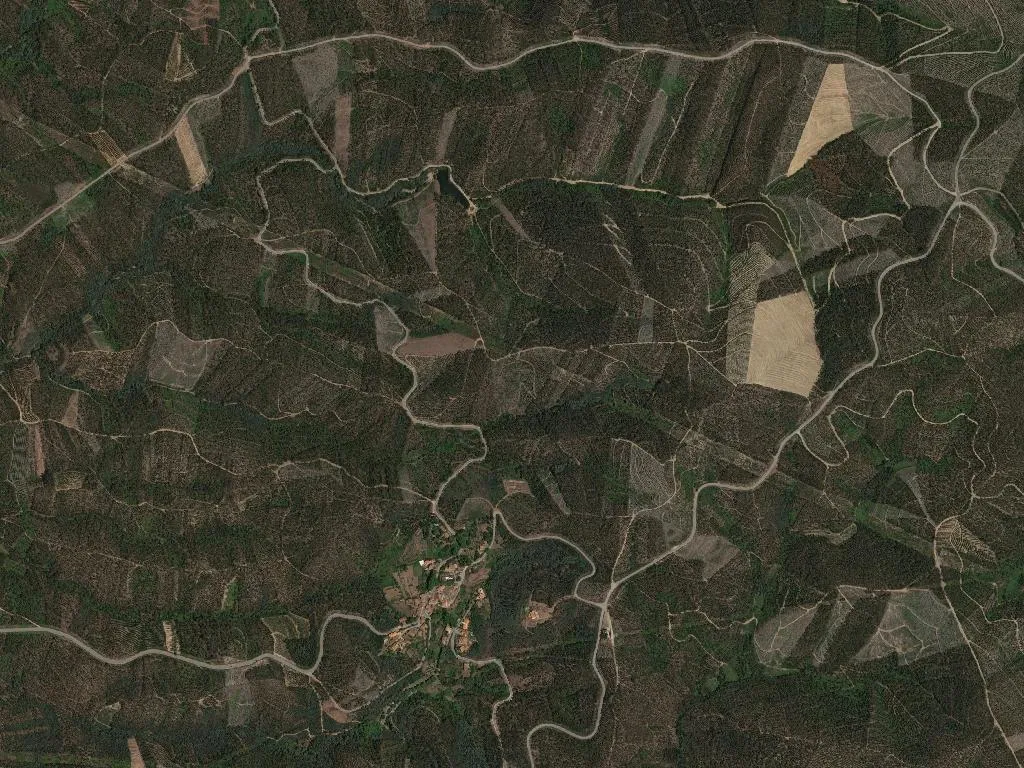
The single strike of São Tiago’s bell rolls through the pines clothing the ridge above Moita. At 225 m the air is cool with Atlantic drift; resin and leaf-mould rise from the forest floor, sharpened by the last threads of dawn mist. Between the straight trunks of maritime pine, clearings open where the parish’s namesake shrub—moita, a thorny evergreen broom—sprawls in untidy hummocks of green and umber, changing colour with the rainfall.
Moita covers 34 km² of Anadia’s northern upland, the largest parish in the council yet home to only 2 206 souls. That is 64 inhabitants per square kilometre—room enough to walk for an hour and meet nothing noisier than a jay. Scattered hamlets—Ferreiros, Póvoa do Pereiro, Vale de Avim—lie strung along granite tracks that were already old when the first railway reached nearby Oliveira do Bairro in 1889.
When Moita was a town
Ferreiros, a loose knot of stone houses 2 km west of the church, once gave its name to a whole municipality. A royal charter of 1210 raised the settlement to vila status, and until the early 19th century it governed itself, collecting taxes and dispensing justice from a small courthouse that no longer stands. Ask 84-year-old António Mateus, kneeling among his Baga vines, and he will point to a barn: “The courtroom was there. We even had a judge who drank more than the defendants.”
The 17th-century São Tiago church, rebuilt after a lightning fire in 1661, still houses the territory’s conscience. Inside, limestone saints carved in the 1500s—stiff, geometric, almost Flemish—survive the damp. A 1628 wayside cross tilts in the graveyard, its shaft chipped by Napoleonic skirmishers in 1811. Behind the altar, the slate tomb of the Borges family recalls minor rural nobility who financed the rebuilding and demanded, successfully, that the priest pray for their souls in perpetuity.
Across the lane, Casa dos Carvalhais keeps the restrained manners of the 1720s: rectangular windows, a coat-of-arms eroding into the granite, and a balcony where the tax collector once stood to read edicts aloud. No one lives there now; the keys sit with a cousin in Mealhada, and swallows nest in the drawing-room cornice.
Baga, cattle and pine smoke
Moita belongs to Bairrada’s wine country. On south-facing slopes the red Baga grape, stubborn and late-ripening, produces tannic, age-worthy reds and a brisk pet-nat that locals drink from litre bottles at household temperature. “It bites first, then sings,” says Domingos Costa, pouring a glass the colour of bull’s blood in an unlabelled bottle that once held Fanta.
The same pastures fatten Carne Marinhoa DOP cattle, mahogany-coloured beasts that graze year-round on wild clover and meadow-sweet. Their meat, dense and almost gamy, appears on weekend tables as chanfana—a clay-pot braise sealed with red wine, garlic and bay, then left to murmur in a bread-oven until the bones soften.
Pine resin still earns pocket money. From February to April resinadores scar the bark with V-shaped cuts, slotting tiny tin gutters that drip oleoresin into smoked clay jars. The harvest ends when the first cicada sings; the raw resin travels to chemical plants in Leiria to become turpentine, varnish, the base note of eau-de-cologne.
A mirror of water in the trees
The Gralheira reservoir interrupts the forest like a dropped sheet of sky. Built in 1958 to irrigate lower-lying vineyards, the lake now serves as the parish’s summer sitting-room. Families from Aveiro city arrive with folding chairs and portable barbecues; children leap from the pontoon while grandparents debate whether the introduced perch are safe to eat. There are no buoys, no attendants, no admission fee—just a warning sign nailed by the parish council: Não haverá salva-vidas. A responsabilidade é sua.
Three picnic clearings—Vale de Mó, Saidinho, Carvalhais—supply stone tables and cold-water taps fed by a spring that once power a fulling mill. Walk any track uphill and you re-enter the pine silence, the reservoir’s glitter replaced by cathedral gloom and the iodine smell of sun-warmed needles.
The paths are not waymarked, but they are easy to read: follow the stone walls that divide the bocage, or the grooves left by ox-carts hauling resin barrels. If you lose direction, stop; within minutes a farmer in a dehydrated-blue boiler suit will appear and walk you to the nearest lane, refusing thanks with a shrug: É o que se faz.
By late afternoon the sun slants through the trunks in latticed gold. Resin vapour thickens; a dry branch cracks under the boot like a pistol shot. Somewhere a dog barks once, then thinks better of it. The moita shrub keeps its obstinate hold on the granite, roots wedged into fissures older than the charter that once made this quiet scatter of farms a town. Nothing here asks to be discovered; it simply continues, indifferent to maps, content with its own slow pulse of vine, cattle, pine and bell.