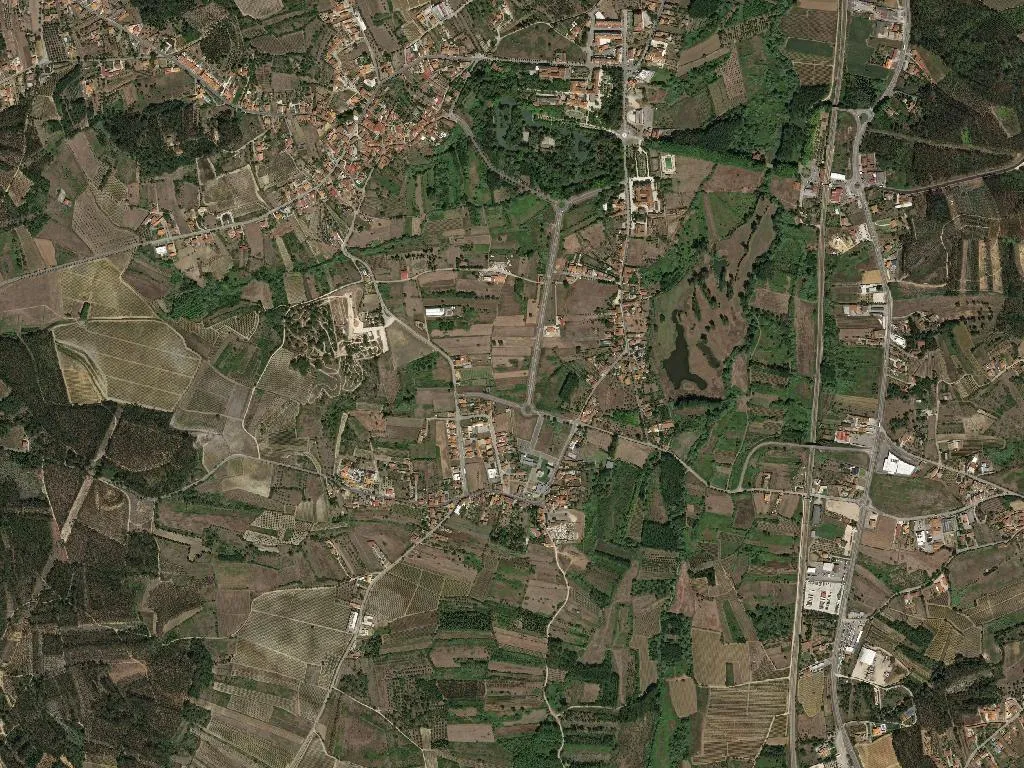
Full article about União das freguesias de Tamengos, Aguim e Óis do Bairro
Hear the 7 o’clock bell, taste wood-oven leitão, trace Roman slabs in Anadia’s trio of hamlets
Hide article Read full article
The bell that orders the day
At seven o’clock sharp the bell of Igreja Matriz rings out across the vineyards, exactly as it has done since Father Américo Sousa wound the clock for the first of 42 years. By late afternoon the low sun throws the shadows of box-edged beds across the white-plastered walls of the 1579 Chapel of São Sebastião, declared a public-interest monument long before Unesco jargon existed. Inside Quinta do Encontro’s wood-fired oven, a suckling pig has been turning since 4 a.m.; the scent drifts down Rua Direita and mingles with the smell of wet stone after rain. In Aguim and Óis do Bairro the only sound is the stream that carries Caramulo mountain water through the vines.
Three villages, one collective memory
Parliament created the civil parish in 2013, yet the three hamlets were braided together centuries earlier. King Dinis granted Tamengos its first royal charter in 1281, and the modern road still rides the spine of the Roman route that once linked Conímbriga to the Atlantic port of Cale—paving slabs with Latin inscriptions were lifted here during 1988 drainage works. Aguim fought for administrative independence until 18 June 1989, when a petition started in 1974 finally triumphed; 456 signatures, every one counted. Óis do Bairro left the neighbouring council of Mealhada on 5 October 1928, the very day the First Republic celebrated its seventh birthday. The name mutates across parchment: “Uguis” in a 1258 royal donation, “Óis” by 1756. Each hamlet keeps its procession: Tamengos honours St James on the Sunday nearest 25 July; Aguim greets St John at dawn on 24 June with fireworks and coffee laced with aguardiente; Óis do Bairro blesses loaves after the 10 a.m. Mass of St Lawrence every August.
Baroque towers and plague chapels
Rebuilt between 1756 and 1761 after the Lisbon earthquake, Tamengos’ mother church wears a pediment of honey-coloured Ançã stone carved with the coat of arms of Bishop D. Frei António de Guimarães. The 1873 bell tower holds four Lamego-foundry bells; the heaviest, 365 kg, tolls only for funerals. The tiny Chapel of São Sebastião went up during the 1579 plague as a vow for survival; its granite font baptised the earliest Aguim families before their own church existed. Aguim’s 1938 campanile, the work of master-builder Joaquim da Fonseca, is built of wire-cut bricks from the Oiã kiln and carries a single bell audible three kilometres away when the wind swings north.
Roast pig and Marinhoa beef
António Pedreiro fired his first pig in 1968; the brick oven, still in daily use at the restaurant that bears his nickname, was built with refractory tiles shipped from Ílhavo shipyards. The rub—two cloves of garlic per kilo of pig, never more—has not altered in half a century. Further up the hill Carlos Marinho finishes two Marinhoa DOP steers a month from his own pasture, aged 48 months and hung for 21 days at 2 °C. When the local prior grew tired of pork in 1983, the chef at “O Tamengos” invented “Senhor Prior’s cod”: onions cut into half-moons, ripe tomato and cooperative olive oil from Oliveira do Bairro. The district’s other edible heirloom, amores-da-curia, were dreamt up by Palace Hotel pastry cook Alice Santos in the 1920s—snow-white meringue shells glued with egg-yolk jam, sold to spa guests seeking the Curia’s sulphurous waters.
Vineyards and rag-doll ateliers
The Bairrada wine route threads 14 signed kilometres between Mogofores and Sangalhos, yellow-and-white waymarks guiding walkers through a chequerboard of vines and umbrella-shaped cork oaks. Two hundred metres from Tamengos church Lurdes Fernandes still cuts 1954 cardboard doll bodies and dresses them in off-cuts of regional costume fabric—leftovers from a textile cooperative that closed in 1998. Four hours of hand-stitching, €35 a doll. The thermal spa at Curia is 4.2 km away: seven minutes by car, 45 along the dirt track beneath the nineteenth-century iron bridge of the Lisbon–Porto railway.
The sound of an ageing afternoon
Of 3,252 residents, 1,184 are over 65. Tamengos primary school shrank from 234 pupils in 1994 to 67 today. The health centre opens only in the morning; Dr Susana Castro looks after 1,856 registered patients. Twenty-eight of the 35 legal lodgings are private homes letting spare rooms through booking platforms. Four trains stop daily at Tamengos station—opened 17 October 1887—two to Aveiro, two to Coimbra; the last departs at 20:17. By 21:30 the streets are empty save for the sacristan Manuel Costa, who pulls the bell rope at 21:45 on Tuesdays and Fridays, continuing a duty he inherited from his father in 1998.