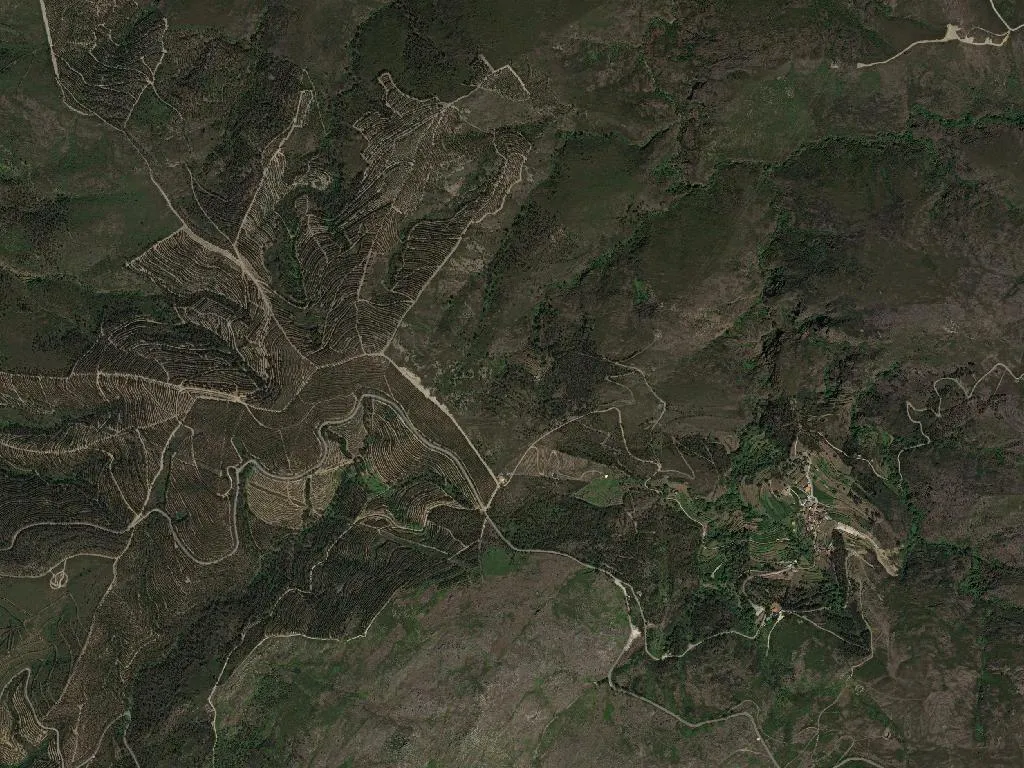
Full article about Drave’s shadow: Covelo de Paivó & Janarde above the fog
At 1,000 m, granite teeth, tungsten scars and a 171-g gold bracelet outnumber the 171 souls
Hide article Read full article
The cold that sharpens granite teeth
The morning air snaps like a loaf left overnight to crust. At 626 m the fog clogs the valley floor the way a pipe-washer blocks a tap. Between broom and heather on the Serra da Arada, granite nubs jut out—old men’s teeth that never fell. Spread across 44 km² are 171 souls, fewer guests than you’d find at an Algarve wedding once the cake has been cut. The only soundtrack is the Ribeira’s hush and the 18th-century bell of S. Pedro, the lone parish church in Arouca’s municipality that still answers to Viseu’s bishopric, a clerical loophole kept folded like a love letter in a blazer pocket.
Tungsten scars & Roman gold
During the Second World War the hills around Regoufe staged their own neutral theatre: British and German teams dug for wolfram five kilometres apart—one camp in Regoufe, the other in Rio de Frades—while Europe burned. Today their spoil heaps stand like unwanted heirlooms in an attic: too heavy to move, too awkward to display. In 1946 a farmer ploughing a terrace unearthed a 171-gram Roman gold bracelet—exactly one gram for every resident now living, as though the land were quietly balancing its books. The torque is kept in Arouca’s Sacred Art Museum under lock and key normally reserved for a father-in-law’s best vintage.
Covelo de Paivó first appears in a 1069 charter as part of the medieval comarca of Paivó—“everything this side of the stream is ours”. Only in 1917 did the parish swap allegiance from S. Pedro do Sul to Arouca, a late-season transfer worthy of football. Janarde was stitched together in the 1700s from five hamlets—Carvoeiro, Telhe, Póvoa, Bacêlo and Meitriz—forming a federation that still signs its name collectively.
The village that lost its shadow
The dirt lane to Drave narrows faster than a paper streamer at a village wedding. At a thousand metres the schist settlement appears to have been set down absent-mindedly—spectacles left on the fridge. No pylons, no antennas, no café: only smoke curling from meat-curing huts says anyone is home. Visibility stretches until the eye gives up; silence is so complete you hear your own pulse, the way you notice your heartbeat when the phone is forgotten on the dresser.
Goat, rye and honey in no hurry
In local kitchens Cabrito da Gralheira IGP rules—kids raised on mountain pastures flavoured by blackberry and dew. Carne Arouquesa DOP, matured on wild herbs, yields to a butter-knife; even a Lisbon dentist approves. Mel das Terras Altas do Minho DOP is harvested late, the beekeeper’s equivalent of arriving at the dance for the last song. At winter pig-killing every scrap is choreographed as in grandmother’s day: lard into clay jars, crackling into seed jars, the scent clinging to clothes like an ex’s perfume. Threshing bees and rye-beating still mark the calendar; for the twelve youngsters who remain, the rhythm is entertainment enough.
Saints against subtraction
On 29 June the São Pedro romaria packs the churchyard tighter than a Visayan market day. Seventy-one year-round residents swell with returning emigrants, toddlers slung on shoulders. Queen Saint Mafalda, Senhora da Laje and Nossa Senhora da Mó serve as holy placebos against emptiness: colour, lager, a weekend that feels longer than August. Four inhabitants per km² is thin even by British upland standards, yet faith clings like runner beans on a fence, rooting in any crack it finds.
Dusk hands the stage back to Regoufe’s derelict cuttings: split stone, rusted rails, the weighted silence of a story fully told. The mountain keeps the accounts, unpaid and unforgotten, waiting for someone still willing to climb and audit the years.