Full article about Moldes
Bee-scented baroque church, gorse-lit lanes, 377 m of quartzite solitude in Arouca Geopark
Hide article Read full article
The bell of São João Baptista strikes five times, its bronze note rolling uphill between granite cottages roofed in mossy slate. May has set the gorse alight—yellow sparks along every dry-stone wall—while woodsmoke drifts from chimneys still lit against the dawn. A single dog barks somewhere out of sight; beneath it runs the Ribeiro da Aldeia, cold enough to numb a wrist, hurrying down to the Paiva gorge.
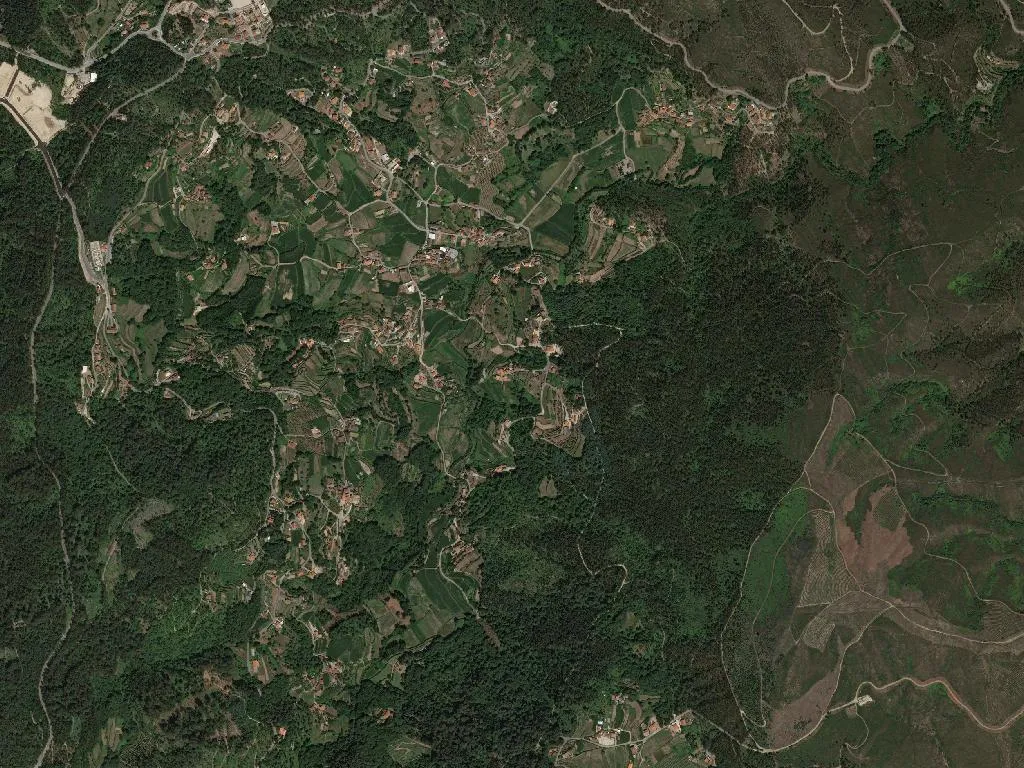
At 377 m above sea-level, Moldes occupies 28 km² of the Arouca Geopark, a UNESCO-stamped slab of Ordovician quartzite where fewer than 40 people share each square kilometre. The settlement pattern is medieval: thick-walled casais—pairs of houses sharing a central partition—edge the lanes, their doors barely 1.6 m high, wooden grain stores propped on mushroom-shaped staddles to keep the mice out. Cattle of the local Arouquês breed graze slowly, red-brown hides against wind-combed pasture; above them, patches of oak give way to maritime pine and broom as the slope rises.
A calendar set by a 13th-century queen
Moldes was shaped, both spiritually and fiscally, by Arouca’s Cistercian nunnery eight kilometres away. Queen Saint Mafalda, the convent’s most famous abbess, is still the organising principle of civic time. On the first weekend after 1 May her statue is shouldered through cobbled gradients, silver crown catching the sun, to the baroque parish church whose gilded altar she paid for in 1257. The rest of the year the building keeps a lower profile: inside, beeswax and incense have seasoned the air for three centuries, and 18th-century gilt carving twists like frozen surf across the nave.
Summer brings barefoot pilgrims to the hilltop Capela da Senhora da Laje for a candle-lit mass followed by dancing in the courtyard. Later, the Festa de Nossa Senhora da Mó fills the sports pavilion with the thump of bass drum and accordion; tables buckle under papas de sarrabulho (blood-rich pork stew), cabidela rice and bottles of local red that stain the tongue violet.
High-country flavours with papers to prove
Here, provenance is legally binding. Cabrito da Gralheira IGP arrives crackling-skinned from a wood-fired oven, scented with hill-rosemary; Arouquesa DOP beef, matured on upland grasses, needs only salt and a grill. Winter demands chanfana—goat braised overnight in an earthenware pot with a whole bottle of red until the sauce turns tar-black. Meals finish with conventual pastries: ovos moles turned into thin communion wafers, sugar and yolk reduced to marzipan-like intensity, a technique the nuns sold to pay for church roof repairs in 1710.
Footpaths that predate the map
Walking trails start behind the church, waymarked only by occasional yellow dashes and the confidence that someone has walked this route for 800 years. They cross stone bridges whose single arches are built without mortar—each block hand-chipped to a keystone fit—then dive into oak groves where midwinter storms have toppled trunks across the path, obliging you to climb. Higher up, pine needles muffle footsteps and the Paiva valley opens westwards, its river glinting like a dropped bracelet. Look back and the village shrinks to a granite ripple on the hillside, the bell tower a single raised finger against the quartzite ridge.
Dusk arrives suddenly. Slanting light ignites the mica in cottage walls so that every house appears studded with powdered glass. A last toll drifts across the slope, echoing between escarpments until it becomes indistinguishable from the wind. Somewhere a latch clicks; a fire is fed; tomorrow the gorse will still be yellow.