Full article about Sunset Bells & Green-Apple Wine in Real, Castelo de Paiva
Chestnut ridges, stone hamlets and sharp Vinho Verde pour across this 33 km² royal parish.
Hide article Read full article
The bell of São Miguel strikes 6.30 pm and its bronze voice rolls down the valley, caroming off hills quilted with chestnut groves and narrow terraces of vines. June light, low and buttery, gilds the granite walls of Real’s oldest houses while the Sardoura stream mutters unseen under oak branches. The parish covers just 33 km² of ridge and fold at an average 327 m above sea level, yet stone, water and vine conspire to make the landscape feel larger than it is.
From Crown estate to parish
Royal archives first mention the place in 1258 as Villa Rial – literally “Royal Town” – a Crown estate recorded again in the 1532 “Livro das Posturas”. The House of Braganza held it until the liberal confiscations of 1834, and for centuries its administrative punch outweighed its size: in the 1700s the municipal court and lock-up sat at Nojões, one of Real’s four hamlets, and until the 1940s the only three-day fair in Castelo de Paiva was held here on 8–10 June. Old timers still recall livestock clogging the lanes and brandy cups passed between deals.
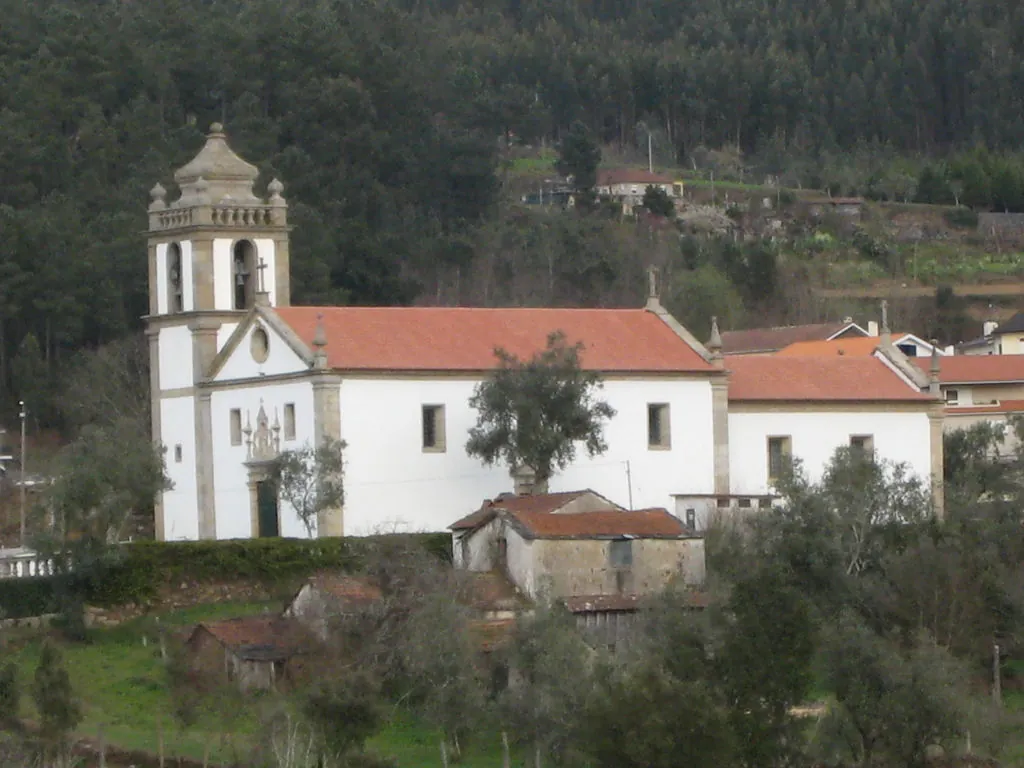
The mother church, dedicated to St Michael, keeps the memory of Arouca Monastery’s one-time seigneurial rights – a 1902 deed in Aveiro’s district archive lists the parish under the commandery of São João de Rei. On the 640 m crest of Santo Adrião, which forms the boundary with Arouca, Jorge de Alarcão identified pre-Roman Castro remains in 1980; from the summit the Paiva valley unfurls in pleated green terraces that catch the late sun like polished jade.
Spring water, vines and Arouca beef
The Sardoura begins as a mossy seep at Lugar do Seixo, gathers volume through alder and ash, and slips into the Paiva by the old Várzea bridge. Way-marked footpaths stitch the settlements together, skirting schist walls where vines are trained low against the wind. Real lies within the Paiva sub-region of the Vinho Verde demarcation; the resulting wines are whistle-clean, with a sharp green-apple bite best tasted straight from the tank at a family quinta. Neighbouring pastures supply Carne Arouquesa DOP, a marbled beef that forms the backbone of arroz de sarrabulho (a rich, blood-spiked rice) and rojão à moda do Minho (cumin-scented pork and liver). Both dishes appear, without fanfare, at O Alpendre in Nojões, where the wood-fired oven is lit at eleven each morning. Finish with bolo de São Miguel, a September spice cake sweetened by Mel das Terras Altas do Minho DOP.
Midsummer fires and granite silence
On 24 June the Festa de São João sets bonfires blazing in Real and Nojões; the local brass band strikes up and processions wind through lanes strewn with rosemary and wild lavender. For three nights the parish recaptures the bustle of its vanished cattle fair. The rest of the year it subsides to the tempo of 1 194 inhabitants – a density of barely 36 per km², which explains the hush that drops after 10 pm when even the dogs observe a courteous curfew.
Nine licensed properties – four flats, five cottages – offer shelter to walkers tracing the PR2 “Caminhos do Sardoura” up to Santo Adrião, or to anyone content to sit in a chestnut grove and listen to the Paiva rush below. There are no blockbuster sights, no postcard miradouros. Instead you get the rasp of granite under fingertips, the chill of wine drawn straight from the talha the weekend after harvest, and the knowledge that, each June, embers are still lit in Nojões for a fair that lingers only in local muscle memory.