Full article about Santa Maria de Sardoura
Vinho-Verde hamlets, chestnut ridges and 13th-century civic pride on Castelo de Paiva’s Douro bank
Hide article Read full article
A stream that refuses to hurry
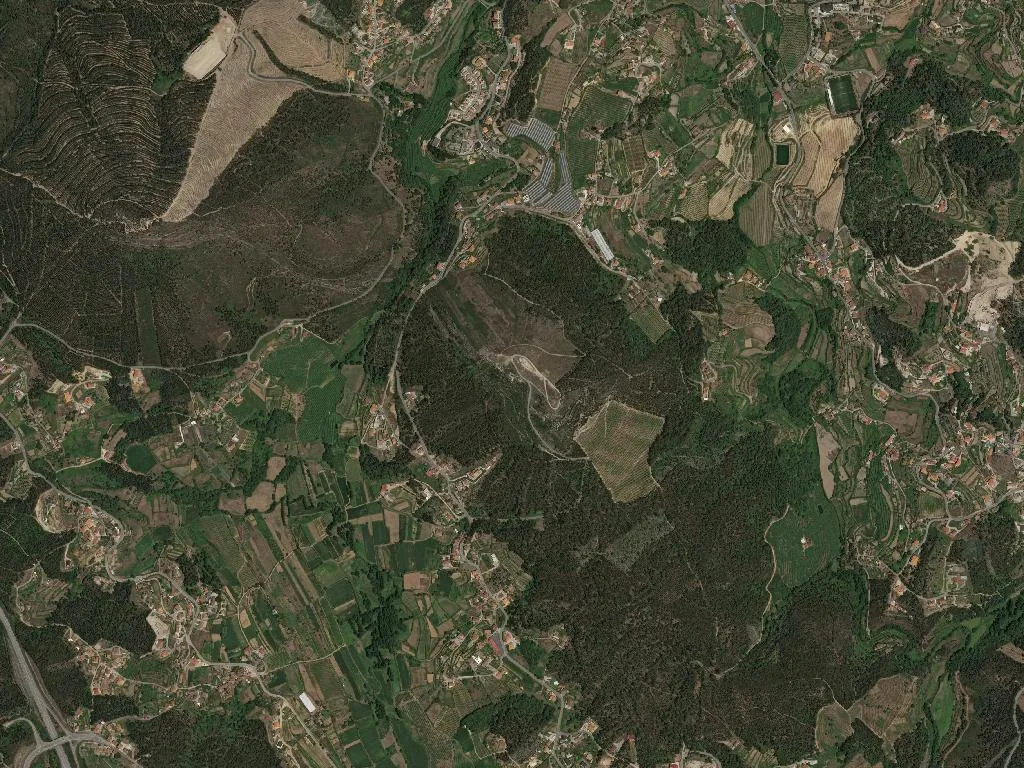
The Sardoura twists like a silver needle through seams of schist, looping back on itself as if reluctant to meet the Douro. Arabs charted this hesitation centuries ago — sardoura, “to go round” — and the name still fits. Each fold of valley cradles its own micro-climate: one slope terraced with century-old vines, the next shaded by chestnut, the bottom given over to vegetable plots the size of tennis courts. Four kilometres south-east of Castelo de Paiva, the civil parish of Santa Maria de Sardoura spreads across barely ten square kilometres on the Douro’s left bank, averaging 294 metres above sea-level. Nothing here demands attention; the land simply offers itself, a quiet arrangement of gradients and water.
Two hamlets, one parish charter
A single parchment from 1258 merged the hamlets of Santa Maria and Sardoura under one parish council. For the next seven centuries the rhythm was immutable: prune in February, plant maize in April, harvest grapes in September, distil bagaço before Christmas. The settlement was finally upgraded to vila status in 2003, just as Portugal’s interior began to hollow out. Yet Santa Maria de Sardoura still counts 2,274 residents and, more remarkably, delivered a 79 per cent turn-out at the last local elections — one of the highest rates in the country, proof that civic muscle has not yet atrophied.
Where the wine is green and the beef is blonde
Drive the lane that drops into the Vale de S. Gens at dawn and you’ll see why the Portuguese call it vinho verde. The Atlantic’s morning breath condenses on the vines, keeping the grapes taut and tart. Between the estuaries of the S. Gens, S. Paúl and Vale de Sá, 140 smallholders still train their vines on granite posts or up poplar trees, creating a patchwork recognised under the Vinho Verde PDO.
Every September the Largo do Fundo Adro, a sloping square beside the 17th-century church, is cordoned off for the Festa do Vinho, Gastronomia e Atividades. Forty stalls, one generator-powered bandstand, three nights of concertinas and bass drums. Producers pour the new vintage from enamel jugs; grandmothers sell toucinho-do-céu almond slabs wrapped in grease-proof paper; teenage boys linger at the assador waiting for skewers of blonde Arouquesa beef, a PDO breed that grazes the same upland meadows the vines can’t reach.
A care home that keeps the village alive
Behind the primary school, the Santa Maria de Sardoura Social Centre employs 130 people — astonishing for a parish this size. Part care home, part sheltered workshop, it includes the district’s only vocational rehabilitation unit, teaching joinery, horticulture and catering to adults with disabilities. The payroll underwrites the café, the mini-market, even the parish’s Wi-Fi contract, turning social provision into local GDP.
Walks that follow water, not way-markers
There are no signed trails, no Rota-approved distances, yet the geography invites you in. Park by the church, descend the cobbled calçada past the last house and you are instantly between hedges of hydrangea and fig. Thirty minutes later the path spills onto a river beach of bleached stones where the Sardoura finally yields to the Douro. In winter the air smells of wet slate and wood smoke; in late April the slopes flare yellow with broom. Turn back at dusk and the terraces glow like copper plates, the vines catching the low sun that also gilds the square’s single café. Inside, they are already decanting the first bottle of the evening — a pale, slightly spritz white that tastes of apple skin and the Atlantic’s distant swell.