Full article about Espinho: where Atlantic mist seeps into neoclassic tiles
Ride the 1870 railway to a low-rise town of fish-market azulejos, dawn surfers and iodine air
Hide article Read full article
Espinho, where salt seeps through the walls
The first thing you hear is the hiss of a train braking on rails still slick with Atlantic mist. Step through the 1870 neoclassical station – the same one that appeared in Portugal’s first talkie, A Canção de Lisboa – and the air changes: iodine-laden, slightly metallic, it settles on the skin like a second, invisible tide. Espinho sits only five metres above sea level and behaves accordingly; the ocean is not a view but a roommate, dictating the light, the lungful of every breath, the milky diffusion that softens shadows and gives continental Portugal its narrowest annual temperature range – a statistic meteorologists still mutter about over coffee.
The town took its name from the thorn. Before planners arrived with compasses and casino chips, the dunes were upholstered with spiny-creepers – spinus in Latin – and little else. Deep-sea fishing and subsistence farming kept a handful of families alive until 1870, when the railway from Porto arrived carrying the first bathers, the first parasols, the first inkling that salt water could be leisure rather than labour.
Stone, tile and the ghost of salt cod
Walk north along Rua 19 towards the sixteenth-century Igreja Matriz and you pass through two centuries of rebuilding: a baroque gilded altar smuggled inside a sober granite shell, 1700s cobalt panels telling the story of Saint Peter in the kind of blues that later inspired Hockney’s swimming pools. Drop downhill to the working harbour and the eighteenth-century Capela de Nossa Senhora da Boa Viagem keeps its doors open to diesel and seaweed. On the first Sunday of August fishermen shoulder the statue of their patroness down the wet sand in the Romaria da Boa Viagem, hymns mixing with gull-cry and outboard motors.
Detour first to the 1915 Mercado Municipal. Jorge Colaço – the same artist who tiled São Bento station in Porto – covered the façade with miniature schooners hunting Newfoundland cod; under strip-lighting the ceramic waves look ready to break. Inside, eels from the Ria de Aveiro are flash-fried to order, eaten standing with a glass of Loureira, the most aromatic of the Vinho Verde grapes.
Cornbread, sardines and slow smoke
Espinho’s kitchen is governed by two larders: the Atlantic and the lagoon. The Ria’s eel stew – potatoes hand-chopped, coriander collapsing into the broth – simmers for hours, but summer belongs to sardines grilled over charcoal, their oil soaking into dense northern-corn broa. During July’s Festa da Sardinha the fishermen’s quarter becomes a tunnel of white smoke; back-garden grills balance on oil drums, and the only punctuation is the crackle of skin. Finish with ovos moles – the local wooden-barquillo version of Aveiro’s famous egg-yolk sweet – and you’ll still be licking sugar from your fingers when the fireworks start.
Eight kilometres of sand and one Victorian golf course
The beach runs for eight uninterrupted kilometres, fine quartz certified Blue Flag. At low tide the foreshore is so wide the surf arrives muffled, as if heard through a floorboard. ISA-accredited surf schools colonise the northern break where sandbanks shape dependable waves; southwards, the protected dune system between Espinho and Ovar shelters sea daffodil and prickly saltwort. The 12-km Fishermen’s Trail (PR2) threads through pine and dune, pausing at hides where you can clock migrating Kentish plovers or the occasional purple heron.
An unexpected footnote: Portugal’s first golf course opened here in 1890, a bona-fide Scottish links laid out on Quinta da Barca farmland; the turf is still cut by Atlantic wind rather than irrigation. Nearby, the 1950 Casino de Espinho remains the only gaming house north of the Mondego, its roulette wheels spinning to the distant thud of the same surf.
Boardwalks, pilgrims and copper sunsets
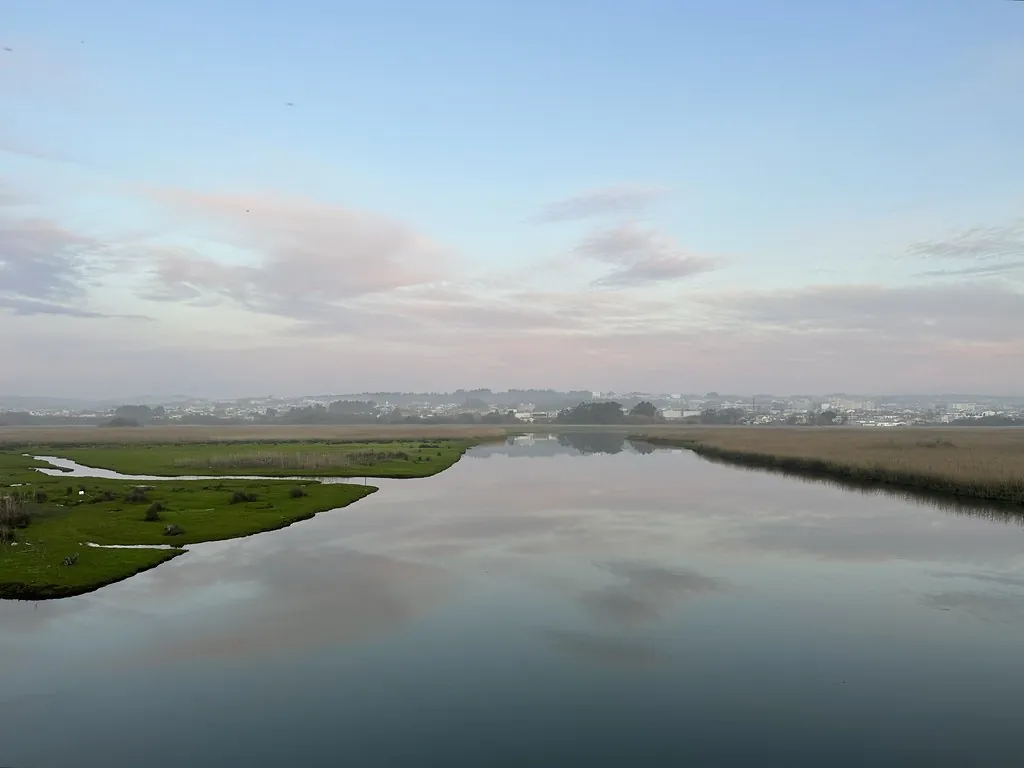
Espinho sits on the coastal variant of the Camino de Santiago; cyclists and hikers share the waterfront cycle path that runs twenty kilometres south to Esmoriz. The 2020 seafront park added an elevated bird-watching platform and stitched the nineteenth-century Passeio Alegre gardens to a new timber boardwalk over the lagoon. At dusk a moliceiro – the high-prowed boat designed for seaweed harvesting – turns the water to molten copper; the only sound is the oar’s drip and the occasional flip of a grey mullet.
On the painted benches of Passeio Alegre the ghost of Sunday sardine lunches lingers, and children still chalk pastel squares for hopscotch, a ritual half a century old. Mário Sacramento – physician, dissident and native son – once wrote that in Espinho “every current of air is a biography”. Look up from the promenade and you’ll see the 1906 Villa Myosótis, a Belle-Époque tower house whose turrets remind you that coming here was once the height of coastal chic.
What remains after the foam recedes
More than ten thousand people are packed into barely two square kilometres – a density to make a London borough blush – yet at dawn the harbour reverts to a pre-industrial stillness: nets spread on damp sand, salt-rimed hands folding mesh, the slow iodine sigh of rotting bladderwrack rising from the dark beach like the ocean breathing in its sleep.