Full article about Guetim: Atlantic breeze lost above Espinho’s plateau
Granite setts, muted radios, 5,688 neighbours—sleep in the only guest bed
Hide article Read full article
Guetim, where the plateau exhales above Espinho
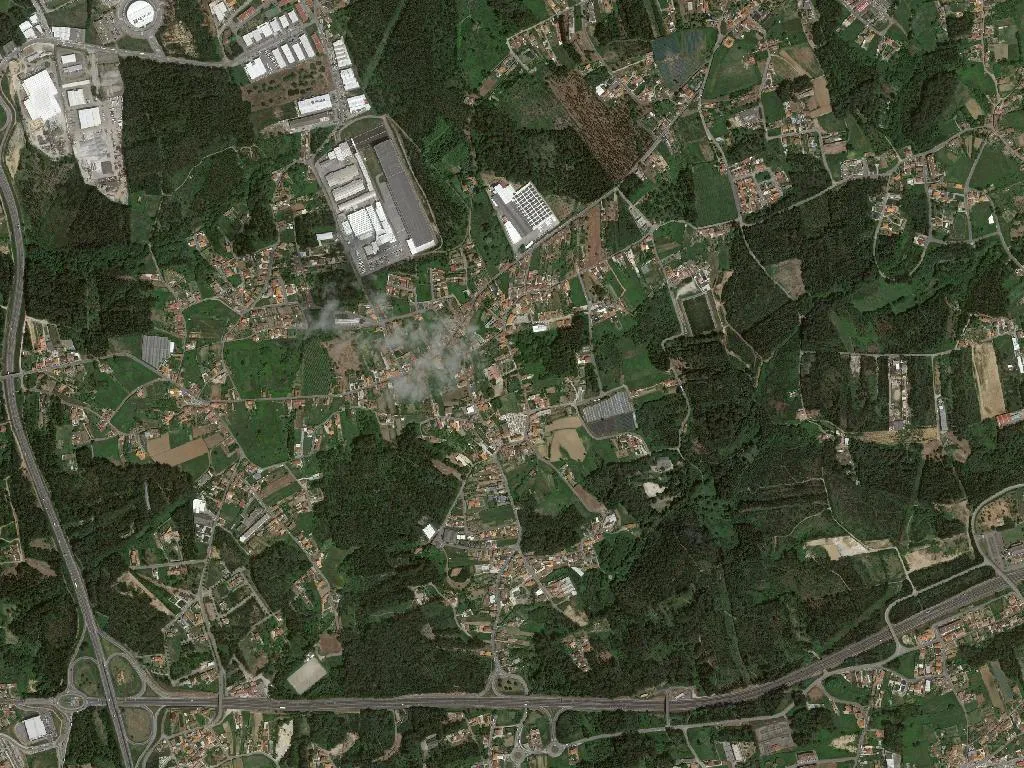
The Atlantic wind arrives, but it no longer tastes of salt. At 87 m it has shed the ocean’s iodine, rolling instead across low walls and back gardens where washing hangs motionless, too heavy for the faint breeze. Guetim never announces itself. There is no belvedere, no postcard vantage. Asphalt simply surrenders to patches of granite setts, and mid-morning silence is broken only by the distant diesel of the AVIC bus or a dog testing the air.
5,688 neighbours, one guest bed
Density here is arithmetic, not spectacle: 1,416 inhabitants per km² squeezed into 1.94 km² of level ground. Yet the life is turned inward—converted garages doubling as bicycle-repair shops, three generations negotiating the same rectangle of land. Census figures show 1,591 residents over 65; just 629 under fifteen. The ratio colours the rhythm: short steps along Rua da Igreja, shopping bags parked on the Minipreço wall while greetings are exchanged, the pharmacy and Café Central opening and closing with metronomic reliability.
For the traveller, accommodation is almost hypothetical—one suburban house on Rua do Lameiro listed for short lets. You spend the night here by deliberate choice, not convenience, seeking the negative of Espinho’s casino-and-surf bustle 3.5 km away.
A pilgrim’s breather
Guetim sits on the Coastal Route of the Camino de Santiago, though you would not know it. No hostel, no scallop-shell fountain—only a yellow arrow where Rua das Dores meets Rua do Cemitério. Walkers in trekking shoes file past tiled two-storey houses built flush to the pavement, grateful for shade after the cliff climbs of the littoral. The arrow reminds them that every flat footfall at this elevation is a kilometre closer to Santiago.
When St Peter strikes up the band
For three days around 29 June the parish council wires coloured bulbs across the streets, the Hunters’ Club fires up its sardine grills, and the local cover band Os Diferentes plug into a generator outside the 18th-century chapel. The demographic tide reverses: grandchildren return from Porto, emigrants fly in from France, and the square in front of the church becomes a living bar graph of 5,688 bodies. By midnight the temperature still lingers at 24 °C; the walls radiate the day’s heat like storage heaters.
Between ocean and interior
Guetim’s plateau is a geographical comma—neither beach nor back-country. At 87 m the Atlantic humidity has thinned, yet on clear evenings the western sky keeps a marine luminosity, a pearly haze unknown to the granite villages of the eastern hills. The land is table-flat, inviting a slow reading of details: the exact blue of hydrangeas spilling over a wall on Rua do Castanheiro, the negotiation of public and private marked by a single step or an improvised hedge of laurel.
Leave the camera in the bag. What lingers is corporeal—the feeling of effortless pavement after five kilometres of coastal dunes, the weight of still air in June, and somewhere just below hearing, the metallic tap of spoon against coffee saucer at Café Snack, repeated at every outdoor table, a percussive signature of a parish that lives its life without asking to be noticed.