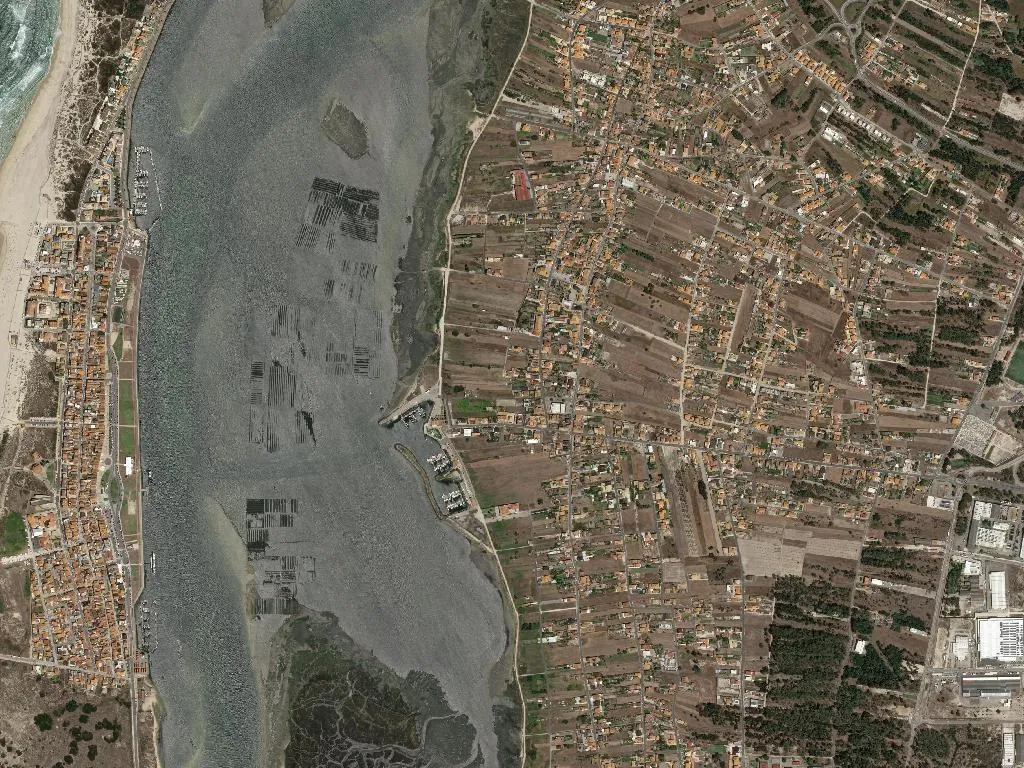
Full article about Gafanha da Encarnação
Gafanha da Encarnação packs Atlantic fog-coded fishermen’s houses, Portugal’s tallest lighthouse and salt-pan stories into one low-lying Portuguese village
Hide article Read full article
Gafanha da Encarnação: where altitude is measured in salt and millimetres
The first thing you notice isn’t the Atlantic – it’s the draught. A steady, briny exhalation that rattles the timber boards of the striped houses on Costa Nova, shaking flakes of ox-blood red, bottle green and yolk-yellow paint into the air. At barely two metres above sea-level, nothing interrupts the light; it ricochets off the lagoon, the dunes and the whitewashed calçada like a photographer’s reflector, leaving colours so saturated they feel almost wet.
A code painted for fog
Those candy-stripe façades, listed since 1982, were never a seaside whimsy. When the southerly fog folds in and visibility drops to the bow of the boat, a fisherman needs to know which shack is his. Each chromatic sequence once mapped to a surname: red-yellow-green for the Silvas, blue-white-red for the Pereiras. Built originally as reed-thatched grain stores, the palheiros gradually swapped corn for nets, then deckchairs, then Airbnb keys. In January more than half their shutters stay bolted; the only sound is the slow clap of herons landing on the tidal channel.
Storm-borne real estate
“Gafanha” derives from the Arabic al-gafâna, an ironic label for a place that is barely more than a ripple in the lagoon. Systematic settlement began when 16th-century monks from nearby Vagos drained the marshes and Philip II of Spain (I of Portugal) offered tax breaks to anyone willing to sink a spade here. A single November tempest in 1572 sealed the Barra inlet and re-drew the peninsula for good; dunes became real estate, salt pans became wages, and the Atlantic became landlord. Until the road bridge arrived in 1933, the parish council met in wellingtons – at spring tide the only reliable highway was a dory.
The lighthouse that out-towers Big Ben
At 62 m, the iron-and-stone Farol da Barra is still Portugal’s tallest lighthouse – 291 cast-iron steps corkscrew to a Fresnel lens that runs on its original clockwork counterweights. From the gallery the ocean looks close enough to touch, until you descend and realise the surf is still a tramble away across moving sand. Ten minutes east through the dunes, the single-nave Capela de Nossa Senhora da Saúde hosts the first Sunday-in-May water-borne procession: wooden images ferried down the estuary on painted punts while the congregation keeps pace along the boardwalk. In August the same chapel fills with bass voices for the Missa do Mar, an a cappella rehearsal before the cod-fleet leaves for Newfoundland.
Lunch that tastes of tide and incense
Eel stewed so slowly with tomato and parsley that the bones dissolve, shellfish rice thickened in a copper cataplana, salt-cod roasted over vine-stump embers until the skin blisters like parchment – the parish menu is essentially brine with olive-oil punctuation. Dessert is the local IGP ovos moles: yolks and sugar sealed inside wafer the thickness of a communion host, moulded into clamshells and barrels, dissolving on the tongue like holy icing. Order them at Pastelaria Satélite (open since 1962 on the corner of Rua dos Pescadores) with an italiana – Aveiro’s short, bitter espresso – and you’ll understand why nuns once smuggled the recipe out of the convent in their sleeves.
Pedal through pink water
The six-kilometre Ria-Mar cycleway threads salt-pans and abandoned salinas, where depth decides colour: pewter when shallow, flamingo-pink where brine shrimp bloom. Pause at the bird-hide on Trilho do Esteiro and you’ll see avocets stitching the mud with upturned bills; stay for dusk and migrants touch down in arrow formations. Traditional moliceiro punts still glide past, though the seaweed they once hauled to fertilise inland fields now serves mainly as ballast for sunset selfies. Cyclists on the Portuguese Coastal Camino use the track as a flat palate-cleanser before the hills of central Portugal resume.
September smells of gunpowder and processions
The parish festival, honouring Nossa Senhora da Penha de França, fills the second September weekend with a riverine procession, brass bands and fireworks that detonate twice – once in air, once in lagoon mirror. A month later, the Cod Festival turns every tavern into a pop-up cookery school: blackened grills, salt-cod fritters, competition plates judged by grandmothers who measure parsley in pinches and memory. Permanent residents number 5,318; 1,053 are over 65, 749 under 15. They share the same low horizon, the same unfiltered light, the same gamble against the next storm that might redraw the map again.
The souvenir you take home is not a fridge magnet; it is the metallic echo of 291 iron steps as you spiral down the lighthouse, the Atlantic still hammering the bar outside, and the salt that has dried into your sweater and will flake onto London Underground seats three days later, a faint whiff of lagoon and grilled eel travelling north with you.