Full article about Ílhavo’s salt-crusted bells ring across the Ria
Low roofs, golden altars and eel stew perfume the Atlantic haze of São Salvador
Hide article Read full article
Where the estuary breathes between whitewashed walls
At ten o’clock sharp the bell of Igreja Matriz swings, and its bronze note slips across a pancake-flat horizon only twenty-three metres above the Atlantic. Nothing throws it back; the sound simply thins, swallowed by the briny haze that drifts up from the Ria de Aveiro. Walk south along what locals still call “a estrada” – the old EN109 now rebadged Rua Dr Alberto Pimenta – and you realise Ílhavo does not rise, it unfurls: long, low houses with terracotta roofs laid out like scales on a fish, all under a pearly light that photographers describe as “one enormous soft-box”. The ria shapes everything here – the air you breathe, the rice that grows a kilometre inland, the eel-rich stews that appear on lunch menus, even the tempo of conversation which, like the tide, is never in a rush.
Stone centuries, salt bills
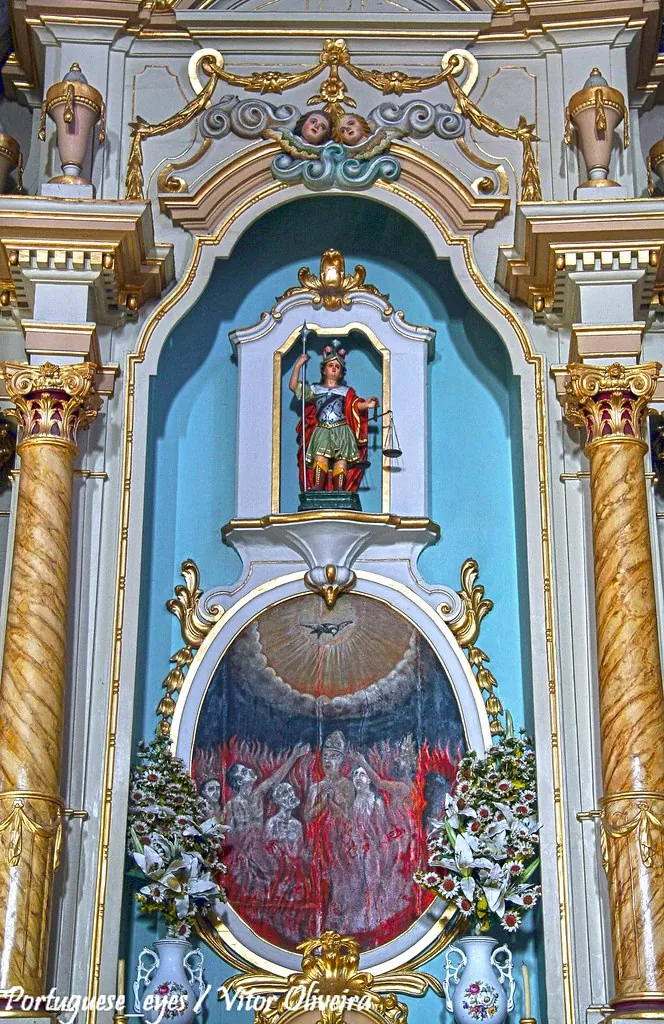
The parish name is a medieval headline: São Salvador do Mundo – Holy Saviour of the World. Royal charters of 1185 and 1248 granted fishing privileges to what was already a sizeable community, but the present church is a late-Renaissance rebuild paid for by the salt tax collected at the lagoon. Work began in 1598 under Bishop Diogo Correia Valente and finished sixteen years later; the façade is deliberately austere, almost Andalusian, so the golden carved altarpiece inside arrives like a burst of sunlight. The 1836 municipal reform stripped Ílhavo of its medieval charter, yet the townsfolk simply re-invented themselves: on 24 October 1910, three days after the Republic was proclaimed, the civil parish of São Salvador was officially created. Its 110th birthday in 2020 was marked by a polyphonic mass sung by the University of Aveiro chamber choir and a birthday cake sliced in Jardim Oudinot while fishermen in rubber boots looked on.
August processions and boot-sale time-travel
Festivities for São Salvador begin on the Sunday closest to 6 August, when the parish priest carries the empty platform through the streets to “fetch” the saint. Between the 6th and 9th the procession covers exactly 1,380 m, a route measured once with a surveyor’s wheel and never altered. Forty-eight years ago the festival committee bought 120 m of coloured sawdust matting from a factory in Vagos; the same rectangles are still unrolled from a storeroom on Rua dos Combatentes, smelling faintly of pine and mothballs. You do not have to wait for summer: Feira dos 13, held in the Vista Alegre china factory courtyard, takes place on the second Sunday of every month (even when the month has no 13). The weekly Mercado da Terra occupies Largo da República every Wednesday morning – a growers’ market started in 1998 after the old fish market was turned into a car park. And on the first Sunday each month the Intermarché car park hosts the Feira da Bagageira – literally “Boot-Fair” – where you can buy discontinued Vista Alegre egg-cups, first-press Xutos & Pontapês LPs and oil sketches by local painter António Augusto da Mota between the hatchbacks.
Convent pastry and lagoon stew
Ask for “ovos moles de Aveiro” here and you will be corrected: they are simply ovos moles. In Pastelaria Muralhas, Maria de Lourdes bakes the wafer shells with flour milled at Costa in Estarreja and water drawn from the convent cistern under her shop. The ratio – 18 g of wafer to 35 g of filling – was fixed in 1908 by Sister Maria de Jesus in the Convento de Jesus and handed down to her great-granddaughter. Move from sugar to salt at Maré Cheia, a family restaurant that has been ladling caldeirada de enguias since 1972: twelve ingredients, including sweet-spicy paprika from Aveiro and a splash of Bairrada white. Black scabbardfish is landed at 06:30 and can be on a lunch plate by noon, but the bigger obsession is bacalhau – A Pimenta spice shop shifts 400 kg of Icelandic salted cod a week, re-hydrated in ria water the way grandmothers insist produces the best flavour.
Flatland woods and pilgrims’ beds
Murteira is not so much a park as a wind-break conceived in 1953 by the regional rice-board: 3.7 ha of lime, poplar and eucalyptus planted to keep the briny Atlantic gales off the paddies. Each tree now wears a label put up in 2018 by local primary-school pupils who measured the trunks with pieces of string. Vale de Ílhavo picnic ground has eight wooden tables – six carved by carpenter Armando Silva in 1997, two replaced by his son in 2021 after storm damage, the family signature visible on the underside of every bench. The Eco-Trilho is a 4.2-km figure-of-eight that begins in Jardim Oudinot, crosses the São Roque canal and finishes at Cais da Ribeira where storks clack on the telegraph poles. If you are following the Caminho da Costa to Santiago, Ílhavo appears at kilometre 312.2; three small albergues and two campsites will take you in, though most walkers push on to the lighthouse at Barra for the sunset.
A 1937 fire engine and 13,000 cigarette butts
The “Lion of the Flames” is a cherry-red 1937 Chevrolet fire engine bought second-hand in 1941 for 28,500 escudos – roughly thirty monthly wages for a fisherman of the time. It lives in the volunteer fire-station museum on Rua Dr Francisco Sanches and is rolled out only on 1 May and for São Salvador, when every child in the parish is lifted aboard for a photograph. Civic pride also takes digital form: scan any of the 1,847 QR codes on the cemetery headstones and you pull up a biography written by the family – a living archive curated by the parish council. In 2022 secondary-school pupils collected 13,487 cigarette butts from the streets, weighed them (2.3 kg) and turned the data into an installation now displayed in the library foyer. The combination of inherited ritual and quiet innovation gives São Salvador its texture: not an open-air museum but a working parish that inventories its own stories, one sawdust mat, one QR code, one collected butt at a time.
Side-chapel silence
Capela de Nossa Senhora dos Campos sits 1.2 km from the centre on a lane where the only soundtrack is lark-song and the faint slap of water against a distant sluice. Rebuilt in 1942 after the 1909 earthquake cracked its medieval walls, the chapel faces open paddies that shine like polished steel in winter. Stand by the low wall with an ovos moles still warm from Pão de Ontem – the bakery that opens at 07:00 to serve workers from the porcelain factory – and you understand the parish for what it is: a place that accrues, layer upon layer, from the 1185 charter to the cigarette filter picked up last night at 21:30 by the council clean-up team. Nothing is spectacular, everything is specific, and the sum is quietly unforgettable.