Full article about Ossela: Where Church Bells Ring Over Granite-Walled Fields
Walk Santiago’s quiet Portuguese route through schist, eucalyptus and slow-roast Arouquesa beef.
Hide article Read full article
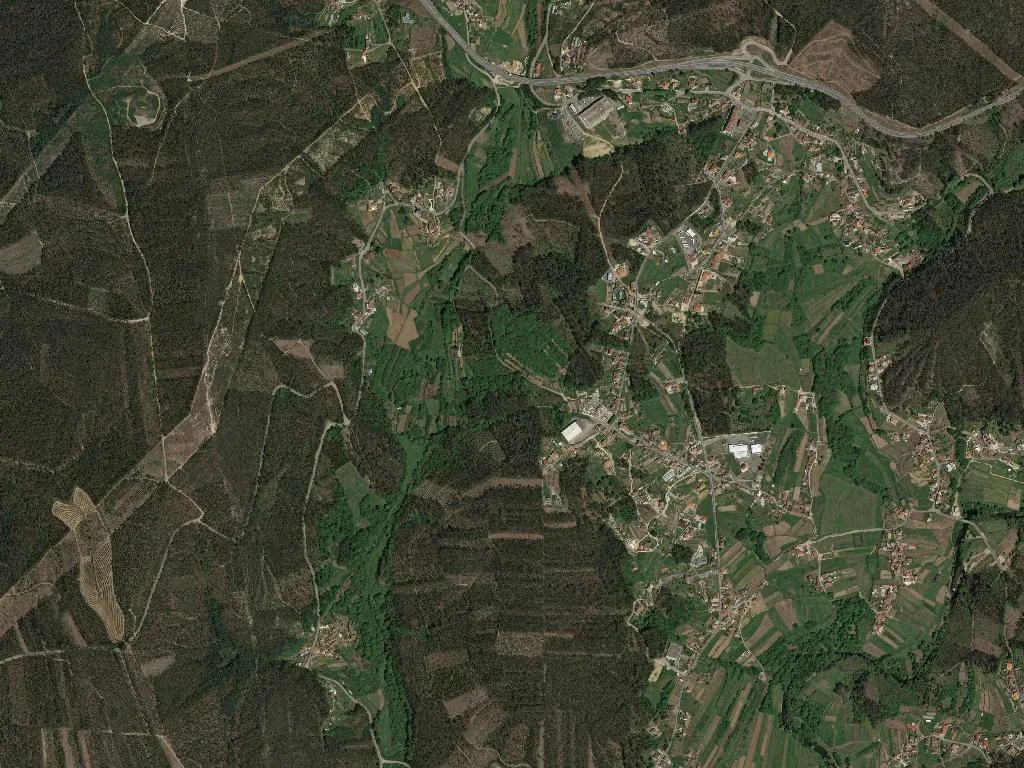
The bell of Igreja da Nossa Senhora da Assunção strikes eight, and the sound rolls downhill over a patchwork of smallholdings stitched together by granite walls. Those walls date from the 1976 land-reform maps that followed the Carnation Revolution; the church itself was re-erected in 1723 after the 1755 earthquake shook the valley even here, 90 km north-east of Lisbon. From its 221 m perch, the view is a textbook of Portuguese rural geology: outcrops of grey schist on the upper slopes, blocks of granite forming the footings of the oldest houses in Lugar do Casal, one lintel still carrying the inscription 1742. When Atlantic rain loosens the soil, the air smells of turned earth and wet quartz; when the norte blows, it bends the cork and eucalyptus planted on the commons after the 1935 afforestation drive.
Where Pilgrims Cross
Since 2012 the Central Portuguese Route of Santiago has been way-marked with yellow arrows along the EN224, funnelling walkers across Ossela’s 17.8 km². They pause at the Fonte da Pipa, an 1897 cast-iron fountain, to top up bottles before the stiff haul to the chapel of São Roque. Density is low—108 people per km²—so the soundtrack is still the low of Holstein-Friesians from Quinta do Outeiro or the diesel throb of the John Deere belonging to the agricultural co-op founded the year after the revolution. Of the 1,918 inhabitants (2021 census), 510 are over 65, a statistic visible in the rhythm of weekday afternoons: chairs appear on balconies, conversations arc across yards where hand-dug wells still stand—redundant since mains water arrived in 1982.
Beef from the Hills and Smokehouse Larder
Ossela’s kitchen looks north, not west. Arouquesa DOP beef comes down from the Serra da Freita 35 km away, slow-reared on small, unfenced pastures. At O Cacheno in Ribolhos, the Saturday roast is in the wood oven by 06h00; the meat arrives so fresh it still holds the morning chill. After November’s matanço, black-pork chouriços and paio (loin sausage) hang beneath chimney hoods, drawing relatives up from Porto and Viseu for the day-long ritual of salt, smoke and gossip. Local honey disappeared when the last apiary closed in 1998, but the village shop, “A Tia”, has stocked Mel das Terras Altas do Minho DOP since 2003—heather and rosemary notes that taste of Minho moorland rather than Aveiro valley.
Feast-Days and Emigrants’ Marching Bands
On 3 February the church fills for São Brás, patron of sore throats ever since diphtheria took 34 children in 1854. After the 11 o’clock mass, the priest presses two crossed candles against each parishioner’s neck and hands out blessed rolls, a rite formalised by Father Américo in 1962. September belongs to Nossa Senhora de La Salette, imported by migrants returning from France in 1958. The primary-school playground becomes a fairground on the 19th, where the filarmónica “Os Progressistas de Ossela” (founded 1897) pounds out marches and Zé Manel charges €3 for sardines grilled over cork-oak embers. Only twelve beds exist—six in the 2017 manor-house conversion Casa do Alpendre, six at Quinta do Outeiro’s agroturismo launched in 2019—so the party disperses before midnight, back to Porto or the scattered hamlets across the valley.
When the sun drops behind the Santa Justa ridge, the whitewashed walls glow briefly gold, a colour that lasts less time than it takes to finish a glass of the co-op’s vinho verde. No souvenir stalls, no queues, just the scent of pine resin drifting from the 1970s plantations and the sense that the year here is still measured by the apple harvest in October and the early potatoes lifted in June.