Full article about Esmoriz: Atlantic surf meets reborn reed lagoon
Ride the boardwalk above Barrinha’s mirrored marshes, spoonbills overhead
Hide article Read full article
Esmoriz: where the lagoon and the Atlantic share a pulse
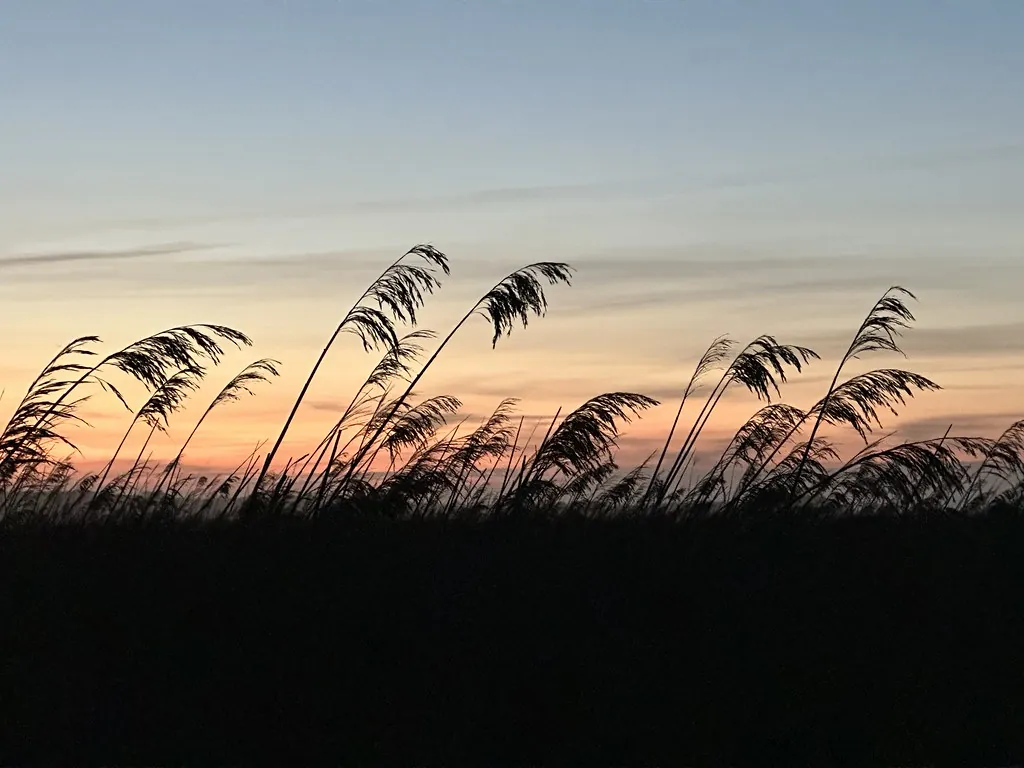
You hear the place before you see it. A low, viscous hush that is neither river nor sea but something caught between – a slow tidal breath that slips through a slit in the dunes and spreads across 400 hectares of slack water. The air tastes of salt and bruised reed, a scent you will not find again anywhere on Portugal’s northern coast. Walk ten minutes from the railway halt, step onto the new pine boardwalk and the horizon dissolves into a glassy plain where herons stand ankle-deep in black mud, as motionless as slipped plaster statuary.
This is the Barrinha de Esmoriz, and nothing about it suggests you are still inside a parish of almost twelve thousand souls shoe-horned into 9 km². Traffic hums behind a line of acacias; Alfa Pendolinos rattle north to Porto every hour. Yet inside the reed corridor the city’s white noise is filtered out by wind that rattles only the casuarinas.
A lagoon that came back from the dead
Until the early 1990s the Barrinha – officially Lagoa de Paramos – doubled as an industrial sump. Tanneries and sawmills pumped their effluent straight in; locals recall a slick the colour of burnt coffee and almost no birds. A EU-funded clean-up, co-managed by the municipality and the University of Aveiro, re-engineered the hydrology, tore out invasive eucalypts and re-planted 28 hectares of native marsh. In 1998 the lagoon was rammed into the Natura 2000 network; today 170-odd migratory species refuel here, from spoonbills to the erratic flamingo that rides in on westerlies from the Med.
The Passadiços da Barrinha opened in 2018: eight kilometres of untreated pine and azobé that hover just above the sedge. Early mornings bring Atlantic fog off the surf; water, sky and boardwalk bleach into one pewter room pierced only by bird call and the soft clap of your own footsteps. Two raised hides give north-facing views – bring binoculars in October when the wigeon arrive in low, whistling squadrons.
Iron rails and sandy trails
Esmoriz first appears in a 959 AD charter as ‘Sanctus Mauritius’ – probably a vanished Visigothic chapel to St Maurice. Romans left behind only a scatter of amphora shards along the River Vouga, but the medieval ridge-and-furrow fields are still visible from the IC1 flyover. The serious acceleration came in 1860 when the North Line punched through, shrinking the haul to Porto to 35 minutes. Weekenders followed, then Atlantic-front speculators, yet the place still feels like a settlement that the railway merely brushed rather than birthed.
Modern pilgrims on the Coastal Camino use the same station, swapping the platform for the lane that slips past the seventeenth-century Igreja Matriz. Inside, blue-and-white azulejos narrate the archangel Michael weighing souls; candles burn with the sweet, fatty smell of tallow rather than perfume. A side-chapel to São Sebastião, built during the 1598 plague, is barely wider than a railway carriage – proof that Counter-Reformation piety, like real-estate, is also subject to supply and demand.
Eels, fish stew and egg-yolk surrender
The menu is dictated by whatever swims in from the Atlantic that morning. Grilled eel glazed with garlic and paprika appears from April to June; winter brings caldeirada laden with monkfish and a splash of loureiro white. Rice-lovers should ask for arroz de marisco cooked the coastal way – soupy, almost risotto-wet, sharpened with coriander stalks. Inland flavours survive in the shape of chanfana, kid goat braised in red wine and black pottery, a dish that travelled down from the Serra do Caramulo with migrant farmworkers a century ago.
Look for two protected names. Carne Marinhoa DOP, from long-horned cattle that graze the Vouga meadows, turns up as slow-roast brisket with chestnut purée. The second is Aveiro’s famous ovos moles – brittle wafer moulds bulging with egg-yolk sugar paste that collapses on the tongue like edible sun-yolk. Buy them in the old railway warehouse turned confectioners on Rua 25 de Abril; they never taste as shamelessly sweet once you leave the district.
Buçaquinho, bikes and the last light
If the boardwalk leaves you hungry for more shade, the Parque Ambiental do Buçaquinho threads 11 hectares of pine and laurel behind the dunes – a favourite with local joggers and the occasional greater-spotted woodpecker. Rent a bike beside the station and you can freewheel 12 km south to Ovar along a traffic-free cycleway that kisses the sand for most of the way. Return at dusk and the Atlantic side glows amber; surfers trade last waves while night fishermen cast long leads for sea bass.
Esmoriz beach itself remains resolutely low-rise. Marram grass and sea thrift stitch the dunes together; only the lifeguard tower and a single beach bar interrupt the horizon. Accommodation runs from rented rooms above the bakery to timber cabins with outdoor showers – no multinational chains, no glass curtain-walls, just the hush of surf and the occasional freight train clicking past like distant castanets.
A mouth that opens on nature’s watch
Sometime between October and March, whenever the water table and the moon conspire, pressure ruptures the sand bar and the lagoon exhales into the ocean. Salinity, temperature, fish behaviour – everything recalibrates overnight. Engineers can predict; they cannot command. That is Esmoriz’s governing rhythm: not the commuter timetable but the slow systole of a lagoon breathing through a valve of its own making, opening and closing its sandy mouth like a salt-stung lung.