Full article about São Vicente de Pereira Jusã
Hear cocks, smell turned earth, spot the Ria glint—this Ovar parish still rules its own horizon
Hide article Read full article
A morning that still answers to the soil
The first sound is a cock, somewhere behind a low whitewashed wall. Then the metallic scrape of a farm gate as someone lets the cows out to graze. Moisture hangs in the air so thick you could bite it; it rolls off the fields and carries the smell of newly-turned earth. At only 126 m above sea level you wouldn’t call this high ground, yet on clear winter dawns the silver ribbon of the Ria de Aveiro glints between pine and oak tops. São Vicente de Pereira Jusã wakes like this—boots in the clay, no hurry.
The name that once ran a county
Say the full toponym aloud—São Vicente de Pereira Jusã—and you feel the strata shift. Saint Vincent locks the parish to its 16th-century faith, while the Pereira Jusã clan did something far more material: they lent their surname to an entire municipality that no longer exists. Until 1836 this parish was the seat of Pereira Jusã county, home to 8,000 souls, out-populating present-day numbers. When Lisbon’s administrative reforms struck, the territory was folded into Ovar; by 1852 the county had vanished. What survives is not resentment but a quiet hauteur: locals still say “here in the parish” with a finality that needs no atlas.
Eight years in the making, centuries in the staying
Igreja Nova de São Vicente rises at the top of Rua da Igreja with the unshowy confidence of something built to outlast its builders. Work began in 1756 and closed in 1764—eight slow years that left a façade almost austere, as if the masons knew ornament would be supplied later by weather and light. Golden rectangles from the side windows slide across the stone floor each afternoon; the silence inside feels weight-bearing.
Three hundred metres north, a granite cross from 1642 marks the site of the earlier church—lichen-darkened, arms blunted by four centuries of rain. Walk another five hundred metres south and a second cross repeats the gesture, creating a straight devotional axis that cuts across fields, cow tracks and the memory of a bell no longer rung.
Beef with a surname
Spread over 859 ha, the parish is less landscape than larder. The fields rear Marinhoa cattle, the breed that gives its name to Carne Marinhoa DOP—dark-fleshed, close-textured, rendered aromatic by long wood-oven roasting. In winter it is stewed for hours with local potatoes and onion until the sauce turns glossy enough to demand a final swipe of crusty bread. Pudding is non-negotiable: Ovos Moles de Aveiro IGP, those wafer-thin hosts filled with yolk-yellow sugar paste that seems to have captured every July sunset. Pair them at Pastelaria Central on Rua Principal with a sharp, light-bodied white from Ovar’s coastal vineyards and the sugar meets its match.
Footpaths that prefer tractors to tourists
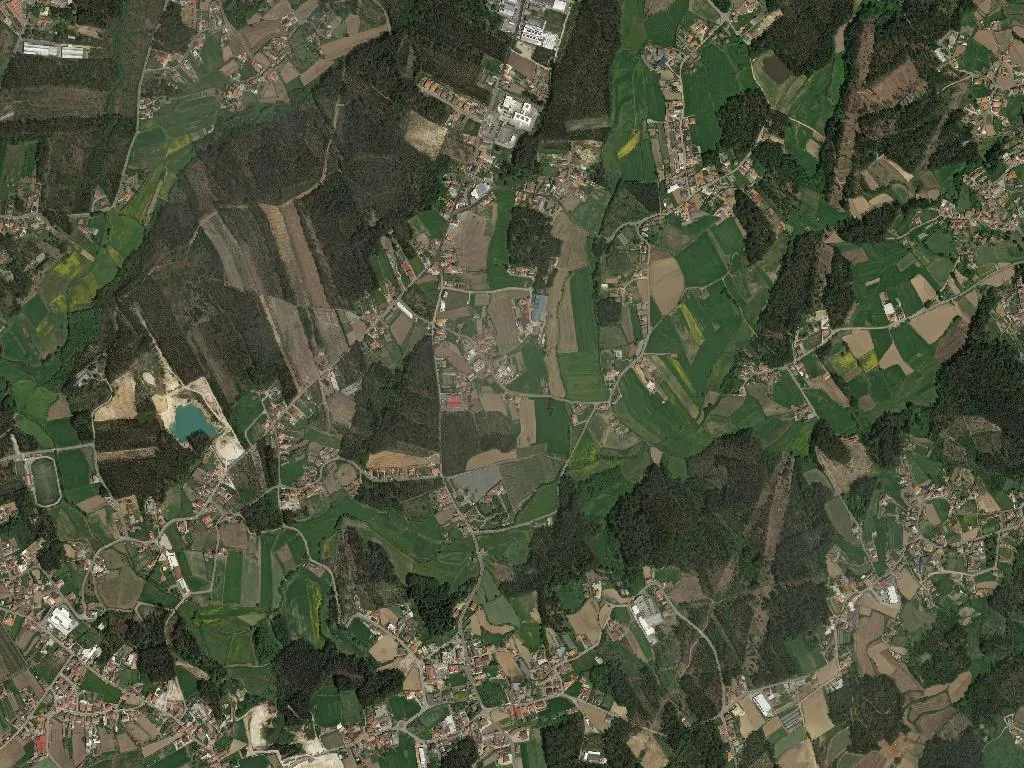
There are no summits or ravines here. São Vicente de Pereira Jusã works on a more intimate scale: ochre lanes that snake between smallholdings, moss-coated walls, orchards where fig and citrus trees grow as they please, and pockets of oak-pine scrub that sieve sunlight into green blades. With over 340 inhabitants per km² you would expect congestion, yet the rural circuit feels deserted—an unofficial grid where the only traffic is the occasional Massey Ferguson and a loping mongrel.
For coastal pilgrims on the Portuguese Camino da Costa the parish is the moment the route swaps Atlantic spray for the smell of turned soil, tarmac for foot-warmed clay. Two modest guesthouses—one a converted hayloft, the other a low-slung village house—offer beds without booking apps or buffet breakfasts. Guidebooks rarely list the stop; walkers remember it precisely because nothing demanded they should.
The ballast of damp earth
Take-away images dissolve; what remains is physical. The ballast of mud on your boot soles after a lane between smallholdings. The humidity that settles into cotton and refuses to leave. The aftertaste of Marinhoa fat hours after lunch. And the scent—an exact blend of fresh manure, pine resin and wood-smoke curling from chimneys at dusk—that, once inhaled, becomes the place’s olfactory fingerprint. São Vicente de Pereira Jusã does not need to announce itself; it simply clings to you, a little under the nails, until you understand you were never just passing through.