Full article about Paços de Brandão: Paper-Mill Hush & Beeswax Echoes
Follow the ghost-scent of pulp to a 17th-century manor, Arouquesa meadows and candle-scented fogaça.
Hide article Read full article
Where the smell of paper still lingers
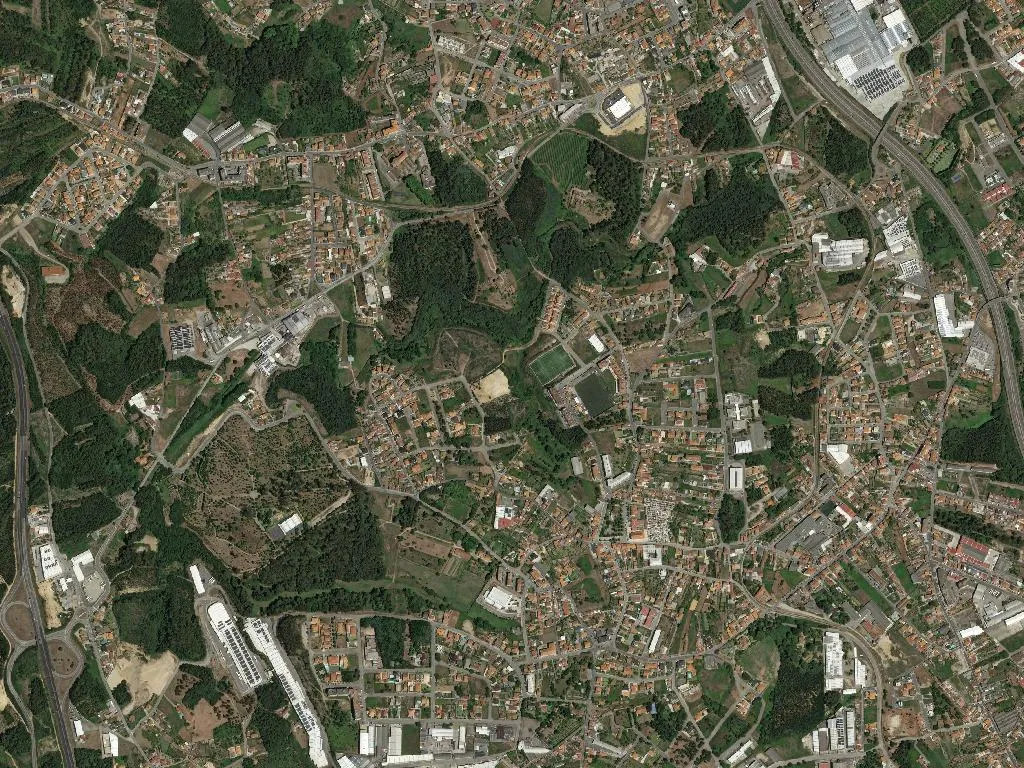
The air in Paços de Brandão still carries a faint note of boiled pulp, though the last paper mill shut its gates two decades ago. Four square kilometres, 4,775 souls, and an altitude of 78 m – just high enough, on a rinsed-blue winter morning, to catch a glint of Atlantic light above the acacia hedges. Cattle of the protected Arouquesa breed graze the northern meadows, butter-coloured ear tags glinting like tiny heraldic shields, oblivious to the A29 motorway humming two valleys away.
The manor that named the place
“Brandão” tracks back to the Norman knight Fernand Blandon, recorded here in 1110. “Paços” signals a noble estate with administrative clout; the building in question is Casa da Portela, a granite house on Rua da Igreja whose 17th-century doorway is still surmounted by the original coat of arms. The parish was created in 1240 by merging two medieval hamlets, yet it waited until 1985 to be promoted from “village” to “town” – the moment Santa Maria da Feira’s council realised more than half its rate-payers commuted beyond the old boundary. Inside the 16th-century mother church, the baroque retable gleams with guilt-tinged gold leaf; the bell tower has kept its silence since 1923, when the clockwork was flogged to pay for a new primary-school roof.
Five candles on the shield
The municipal arms show five golden candles because, between 1880 and 1960, two local factories turned regional beeswax into altar sticks that lit half of northern Portugal. Electricity killed the trade, but the memory is rekindled every 20 January at the Festa de São Sebastião: 11 a.m. mass, 3 p.m. procession, then squares of fogaça – an oval, orange-scented sweet bread with IGP status – handed out after the parish anthem. Bakeries sell it year-round for €2.50 a loaf.
Lamb, blood-rice and yellow-tagged beef
There are three places to eat. O Conguense will braise kid in a black clay pot, but only if you order 24 hours ahead. At Solar de Paço, Friday is arroz de sarrabulho day: pork-blood rice thickened with cumin and smoked sausage, usually gone before 2 p.m. The beef that appears on both menus is Arouquesa, pasture-raised north of the EN 224 and identifiable by its yellow ear tag. Locals drink vinho verde from the Lima valley; there are no vineyards this close to the coast.
Between the college and the tennis club
The Escola Profissional trains teenagers in electronics and IT; second-year students are cherry-picked by nearby manufacturing plants. Four red-clay courts make up the Clube de Tênis; annual membership is €35 and guests are welcomed with a nod. For a walk, follow the municipal road towards Carril: 3 km of empty tarmac past the chapel of São Bento and open-sided cattle sheds where oxen lift their broad heads to watch you pass. Marked trails stop at the village edge; for forest you’ll need to drive 12 km to the wooded slopes of the Serra de Santa Justa.
The last AV Feira 513 bus leaves for Santa Maria da Feira at 6.30 p.m.; miss it and the Transdev 9 to Espinho adds an hour to the journey. Wi-Fi that actually works can be found in Café Central or Café Progresso on the main square; the ATM, next to the pharmacy, shuts at 8 p.m. sharp.