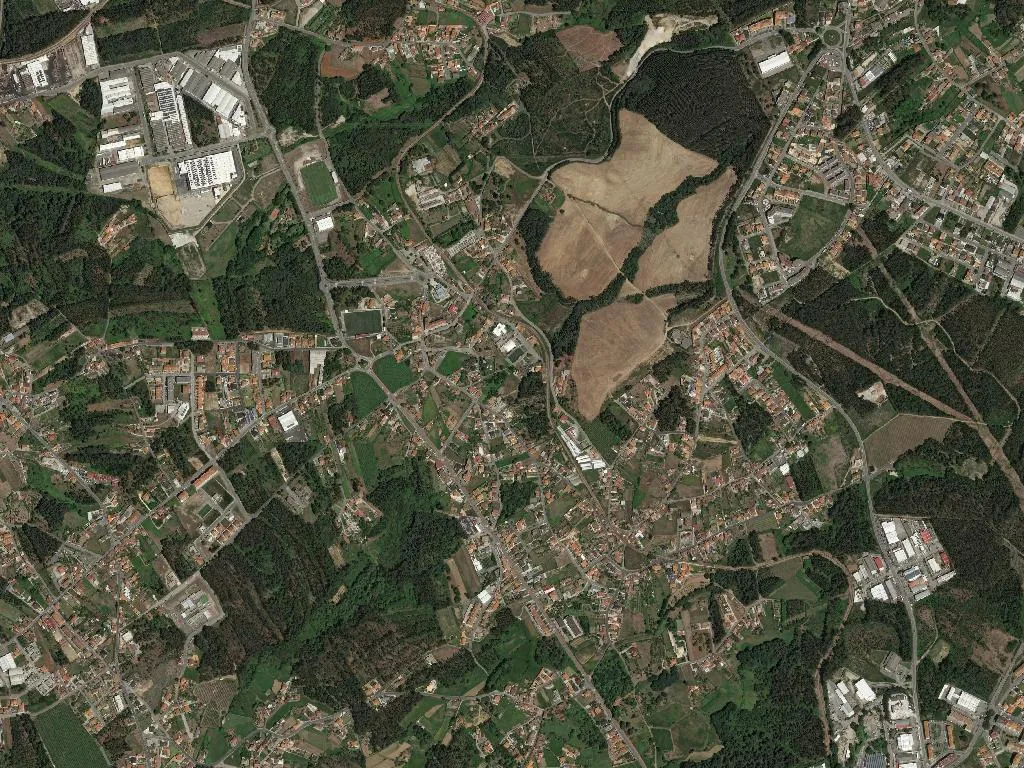
Full article about São João de Ver
Brick lanes, July fogaça smoke and 300 °C devotion in Santa Maria da Feira
Hide article Read full article
São João de Ver: where the village bakery still sets the clock
The smell finds you first. A slow drift of sweet dough proving, sugar turning to brittle caramel in ovens that never quite go cold. On winter mornings it mingles with woodsmoke sliding from chimneys along a ridge 165 m above the Atlantic plain. Only then do you notice the houses – low, tiled, shoulder-to-shoulder – and realise you have arrived in São João de Ver, a parish that prefers to introduce itself by scent rather by signpost.
A name that swore it was the real John
The place was already on the map in 1254 when a royal charter recorded it as Sanctus Joannes Verus – “the true Saint John”, as though other Johns were counterfeit. The suffix stuck, and eight centuries later the 11,000 residents still live under the promise of authenticity. Granite is scarce here; the building material is brick and determination. Space is measured in bread ovens, not hectares, and the nearest city, Porto, feels a universe away even though the A1 motorway is barely five minutes down the hill.
January bread in mid-summer
Every year on the third weekend of July the village performs its communal act of remembrance: the Festa das Fogaceiras. At dawn the wood-fired ovens behind the parish church are stoked until the thermometer nudges 300 °C. By 10 a.m. the first conical loaves – fogaças – emerge, their crusts blistered to the colour of burnt umber. Women in white shirts and scarlet skirts balance the still-warm crowns on straw-lined trays and step into a procession that moves as slowly as rising dough. Firecrackers snap, a brass band keeps metronomic time, and the fragrance of yeast drifts through the narrow high street like incense. The loaves are carried to the square of São Sebastião, patron of plague survivors, then auctioned for the parish fund. No one leaves without a shard; to refuse would be small heresy.
Protected by EU law and grandmothers
The Fogaça da Feira has enjoyed Protected Geographical Indication status since 2003, a bureaucratic way of saying the recipe belongs to this slope and nowhere else. Flour, eggs, pork lard, lemon zest and a shot of aguardiente are kneaded for twenty minutes, left to swell, then coaxed into a tall mould that gives the bread its volcano silhouette. The crust must shatter under pressure; the crumb should taste like a buttery panettone that has done a stint in the gym. Attempts to industrialise have failed – the dough sulks outside a five-kilometre radius, or so local bakers insist.
Beef that tastes of heather and altitude
Lunch is a two-act play. First, Carne Arouquesa DOP, beef from the long-horned, auburn cattle that graze the Serra da Freita 30 km to the east. The meat arrives at Restaurante Oceano on Rua da Igreja almost black from dry-ageing, then is grilled over bagasse from the neighbouring sugar-beet factory. The flavour is iron and heather; the texture holds up to a 2008 Quinta do Crasto. Dessert is the fogaça itself, torn open while still warm, its centre cloud-soft, the sugar forming a brittle strata that dissolves on the tongue like seaside rock.
Five places to lay your head, none with a spa
Tourism is present but not intrusive – five licensed guest-houses, the largest a converted manor with four rooms and a persimmon orchard. Visitors tend to be Portuguese families returning for the festa, or cyclists tracing the Ecopista do Vouga, a converted railway that passes within earshot of the church bells. Check-in is informal: front-door key under a terracotta pot, breakfast at the café where the baker’s aunt adjudicates the strength of your bica with a single glance.
A manor house no one remembers owning
The parish’s only listed building is the Palacete de São João de Ver, a 1900 neo-Baroque manor whose last resident departed in 1974 and took the archives with him. The façade is bubble-gum pink, the windows boarded, the garden colonised by giant bird-of-paradise plants. Local boys insist the attic was once a Masonic lodge; elderly women recall gala evenings when a string quartet played on the marble terrace. Both may be true. Restoration funds appear and vanish with each change of municipal government; for now, the house remains a dignified hostage to bureaucracy.
The sound after dark
Long after the procession has dissolved and the band has packed its brass, a small percussive crack can be heard from kitchen tables: the crust of a fogaça being broken open, the crumbs brushed onto a plate, the loaf quartered for tomorrow’s breakfast. It is a private sound, yet it carries eight centuries of certainty – the audible proof that São João de Ver never needed to proclaim itself the real Saint John. The scent, the flavour and the quiet snap of crust say it for her.