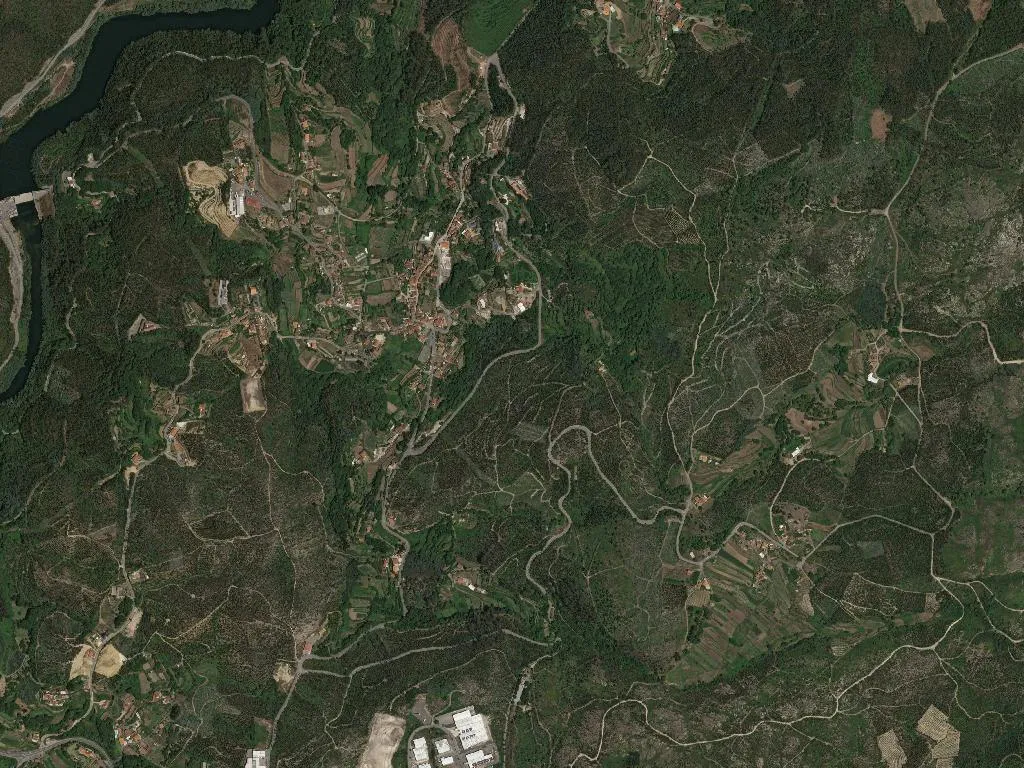
Full article about Cedrim: Minigolf Echoes & Goat Stew Smoke
Granite granaries, seven stone bridges and slow-braised chanfana scent Sever do Vouga’s hill hamlet.
Hide article Read full article
The Concrete Thwack of a Minigolf Ball
The ball ricochets off concrete — no AstroTurf affectations here — sending a sharp report across the clearing. At Cedrim’s single-track minigolf course, laid out in 1993 by villagers who preferred DIY to idleness, children chalk tallies on up-cycled pallet obstacles. When a neon sphere drops into the twelfth hole, the Serra do Sul suddenly feels closer than its modest 470 m.
Stone That Talks
Sixty granite granaries — someone really did count — stand between houses like sentries from the era when maize out-priced the euro. In the churchyard the Baroque stone cross is cupped at the centre; guidebooks claim the hollow collects holy rain, yet older parishioners know it doubles as a witch deterrent. On the first Sunday in May the procession of Nossa Senhora da Saúde glides downhill in silence; women scatter white rose petals that boys later press behind their cap brims for luck.
The Estrada dos 7 Arcos is a three-kilometre gamble: seven back-to-back stone bridges, each narrower than the last, their granite rubbed glass-smooth by decades of tractor tyres. Below, the tributaries of the Rio Sever race even in August. At Poço da Broca teenagers dare one another to leap from the highest schist ledge — but only after a father has shown it’s survivable.
Goat Stew That Refuses to Hurry
At O Moinho, António lights the burner at nine; chanfana (slow-braised goat) is served at half-past one and not a minute sooner. The trick, he insists, is Lafões red from the local co-op: “if it isn’t theirs, it’s worthless.” The meat collapses into paprika-stained gravy whose smoky note comes from the colourau his grandmother hauled back from Viseu market. On Fridays the dish is eel: boys set wicker traps at dawn, and by late afternoon the fish are pickled in vinegar, lined up on the bar in swing-top jars ready for takeaway suppers.
Circular Walk to Nowhere in Particular
Trail PR4 starts behind the church, climbs through gorse and eucalyptus, and finishes — five kilometres later — behind the same church. En route you’ll glimpse the Brandão water-mill where Manel still grinds last year’s corn; an irrigation levada now hijacked by bracken and tree frogs; and a “secret” viewpoint whose Sunday occupation by courting couples is universally denied. In winter fog the path dissolves: you walk by ear, praying the next step isn’t the river.
The Ones Who Stayed
António de Sousa Lopes spent his life painting the view from his kitchen window: the Vouga bending below, the eucalyptus his father planted in the 1930s, the baker’s wife shaking sheets in the yard. The canvases hang in Aveiro’s museum, but grandchildren keep A4 reproductions Blu-tacked to their fridges — “so we don’t forget,” though no one can recall his face. Father Joaquim chronicled Cedrim for forty years; the manuscript, 800 pages long, moulders in a shoebox marked “too much for a book.” Dr José Pereira vaccinated half a generation against TB with a glass syringe sterilised in vinegar water; faded cards stamped in black ink survive in kitchen drawers.
On 20 January bonfires flare beside the chapel of São Sebastião. Women carry trays of dry cake draped with chintz; men feed pine logs that spit resin sparks. When the last ember dies each household smuggles a coal home to ward off lightning. It is one of the few nights the entire parish gathers, and if the cold bites someone always slips a cake to the neighbour too frail to leave the fireside.