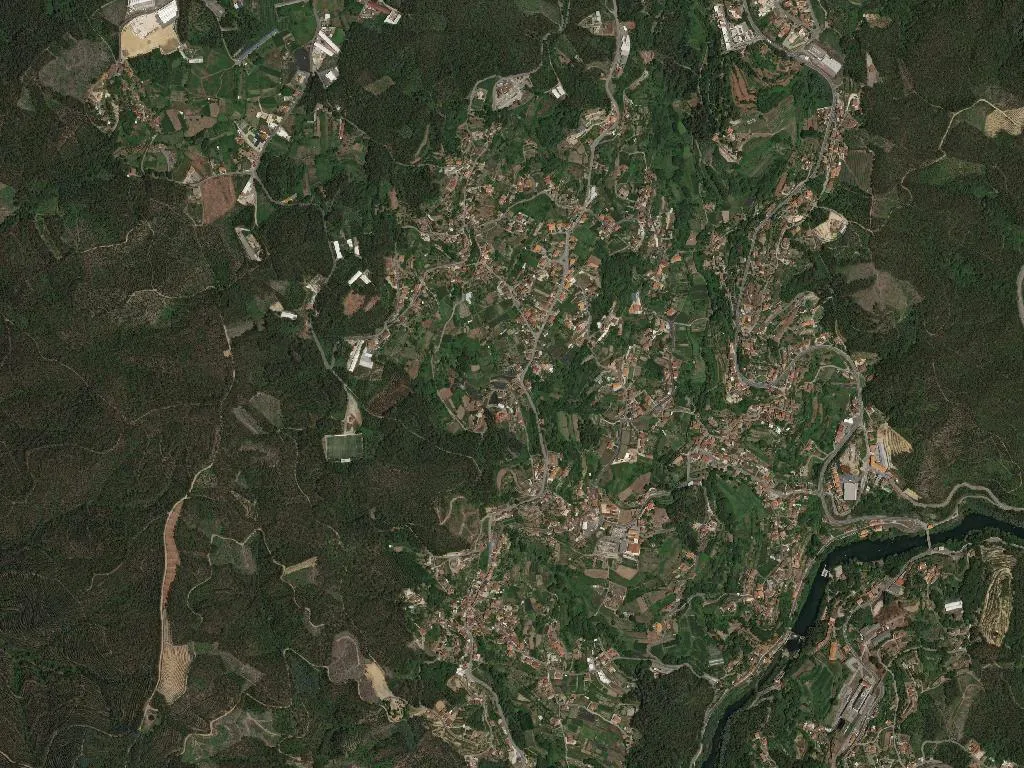
Full article about Pessegueiro do Vouga: where rails rust into river
Sleepers sprout ferns, lamprey stew simmers and the Vouga river reclaims its valley
Hide article Read full article
Where the river keeps the clock
The Vouga Historical Train no longer whistles through Pessegueiro, yet its absence is almost audible. Granite arches carry ferns instead of rails, sleepers have become mossy stepping-stones, and station platforms are reduced to loose boards that creak like empty tavern doors. Beside them the national road, tarmacked in the 1930s over what was once a dirt track hacked through gorse, sweeps past a valley of dozing hills and marshland that still tries, year after year, to creep back into the river.
The river that sets the rhythm
For nine lazy kilometres the Vouga slides along the parish boundary as though time were a burden it refuses to carry. Alder and willow overhang the water; in places the current stalls and sand builds up in three-metre dunes that nibble at the tarmac and send the municipal bulldozer back every spring. This is fishing country—lamprey in winter, barbel in summer—where stews are still simmered in unglazed clay pots and an escabeche of shad will keep for a week. Canoes drift downstream between pinewoods and clouds that duplicate themselves on the glassy surface.
The name Pessegueiro—"peach tree place"—records slopes that once wore a quilt of blossom. A foral charter from the thirteenth century already lists the settlement, and in 1740 the bishops of Viseu carved out the neighbouring parish of Paradela, leaving 28 hamlets—Bouço, Chã, Chão de Além, Sóligo, Ribela—each with its chapel, stone cross and bell that tolls when sundials fail.
Bridges, chapels and everyday monuments
Show visitors the Ponte do Poço de S. Tiago, a single railway arch that used to carry the narrow-gauge line and now hangs in mid-air like a thought it hasn’t finished. At dusk the granite glows, shadow falling on the water as cleanly as sheets shaken out over a clothesline. Cyclists on the ecopista that links Pessegueiro to Rocas do Vouga brake here for the obligatory photograph; herons, mallards and the electric-blue flash of a kingfisher compose the foreground.
The chapels are small, white-washed, intensely proportioned: bead-sized windows, eaves built to throw rain clear of walls, doors low enough to make a tall man remember his manners. Nothing is grand, everything is exactly where it should be, built from whatever the hillside yielded and designed for the tempo of days measured by church bells and river murmur.
What the grill smoke tells you
Three breeds matter on local menus: Arouquesa and Marinhoa cattle, both DOP-protected, and Lafões veal with its IGP pedigree. Oak-brake barbecues send curls of smoke across the road; the meat arrives on wooden boards with cornmeal broa so hot it demands a respectful juggle. From the river come fish soups thickened with potato, onion, coriander and mountain olive oil. Dessert is still the convent classics—sugar, egg yolk and cinnamon turned into ovos moles-style custards that taste of thrift and ingenuity.
The art of arriving slowly
The Vouga Ecopista is engineered for cyclists who refuse to be overtaken by their own pulse. It borrows the old tow-path and threads the tunnelled canopy of eucalyptus, oak and acacia. Stations survive as open-air galleries of fading timetables and stork nests; Arouquesa cows graze the surrounding wetlands without lifting their heads as you freewheel past. In Sóligo and Ribela the courtyards smell of freshly split logs. Beside the irrigation channels families spread blankets on the grass, unpack anonymous wine and local cheese, and let the afternoon settle around them like a shawl.
The train is gone, but the valley keeps its cadence: the parish bell counting the hours, the river translating sunlight into rippled Morse. Stand on the Poço de S. Tiago bridge when the afternoon light strikes the stone and the reflection completes the missing arch beneath, and you realise some human work is eventually adopted by landscape the way a host pours a glass for the friend who has finally come through the door.