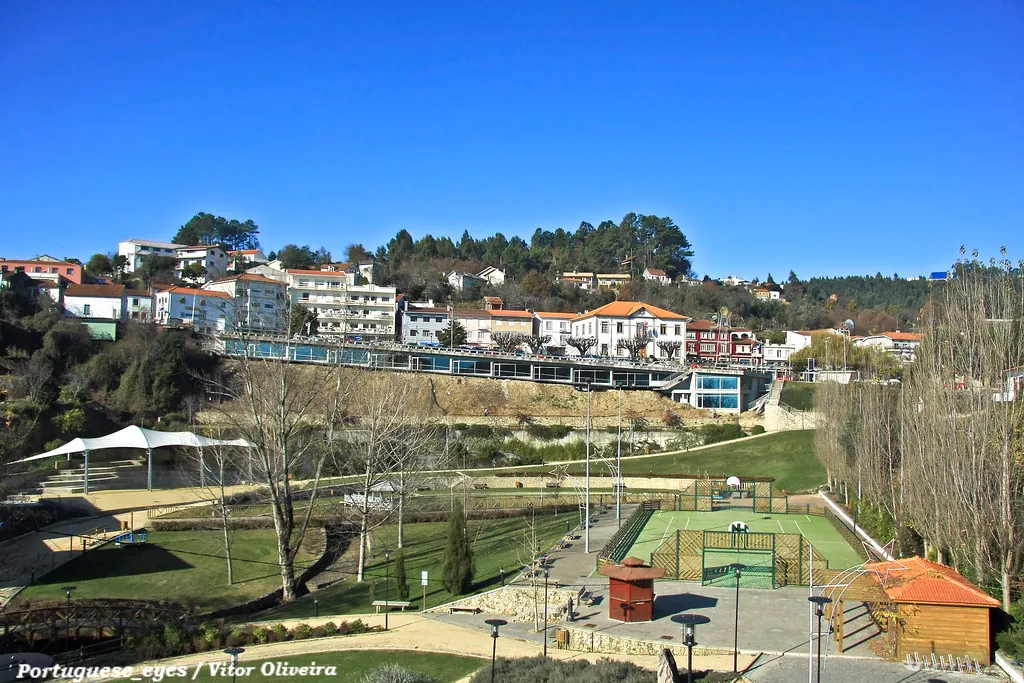
Full article about Sever do Vouga: Oak-Smoke & Echoing Tunnels
Cycle disused rails, taste fire-kissed Arouquesa beef and greet locals who still say “se faz favor”.
Hide article Read full article
Tarmac, Tunnels and the Taste of Oak-Smoked Beef
The asphalt of the ecopista still carries dawn’s dew when the first cyclists coast into the tunnel. Inside, tyre hum turns into a bass-line – deeper, louder, almost live. You emerge with helmet hair plastered flat and jersey glued to your back, but the whole of the Vouga valley is waiting: pine-green slopes, schist-grey crags, the river below working like a silver reflector strip.
Sever do Vouga was raised to parish status in 1314; the name is said to echo the Latin severus—serious. The river certainly is. In spate it requisitions entire riverbanks, yet the locals refuse to hurry. Strangers are still addressed with a polite “se faz favor” and a measured smile.
Bridges, Tunnels and Left-Over Railway
The Ponte do Poço de Santiago behaves like a family elder who refuses to miss a gathering. It has seen ox-carts, pilgrim processions, scouts singing in the rain, couples whispering in the dark. Now it shoulders the greenway, stone vaults perfectly intact. Six railway tunnels follow; each has its own reverb. The one at kilometre three is pure sub-bass, the seventh sounds like evensong in an empty church. Ten kilometres of disused track have become a calorie corridor and a gossip exchange.
At the picnic clearings the air is always tinged with wood ash and rendered pork fat—signature scent, not flaw. Order Arouquesa, Marinhoa or Lafões beef; the breed stamp matters less than the smouldering oak embers and the corn-bread you mash into the juices. Bring your own skewers and the ranger will happily source you a “neighbour-price” bottle of tinto.
Hills That Haven’t Given Up
The settlement spreads across 309 m of undulating ground between the river and two ridges—Salgueiros to the north, Escaiba to the south. Plantations of maritime pine still dominate, though the 2023 fires left a few slopes deforested. Gorse and broom are already restocking the sterile patches; nature here is stubborn. The Mills’ Trail is the perfect walk for quiet monologuers: stone ruins, moss-lined levadas, toppled millstones that look ready to turn again. Pack water—coffee appears only if a vending machine has been installed at the trailhead.
Census figures list 683 elders and 358 children among 2 715 souls. Translation: walking sticks outnumber balance bikes, yet you will still hear playground shrieks at four o’clock. Eleven local lodging units—apartments and detached houses—are enough for anyone who wants to wake to the wrong kind of cockerel (your alarm clock it is not). There are no blockbuster sights; instead you get silence, a riverside cycle path, impeccable beef and a river that, even when it whispers, never stands still.