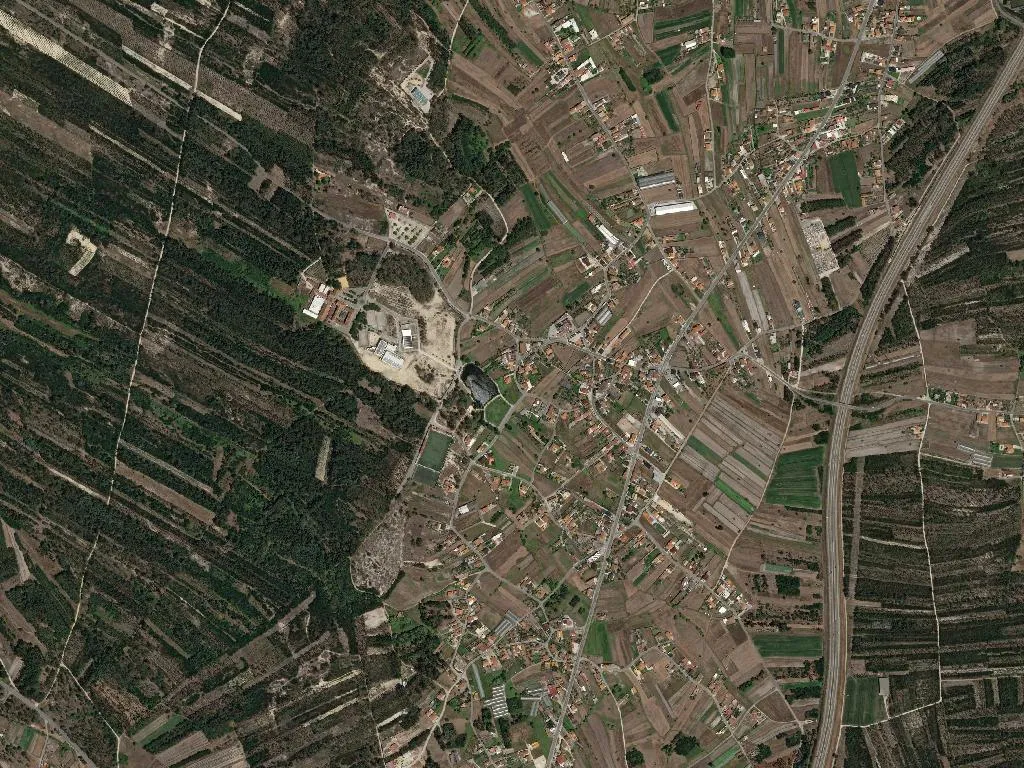
Full article about Calvão: Where the Vouga’s Mist Dresses Terra-Cotta Roofs
Dawn mist, 1673 church bells and ox-cart-glossed cobbles define this Vagos parish.
Hide article Read full article
The Vouga glides, almost soundless, past water meadows that flush green even in October. At dawn the river exhales a cool, mineral mist that smells of wet shale and bruised nettles; it drifts across the maize stubble and settles on the corrugated roofs of Calvão like a damp tablecloth. Eight o’clock strikes—one, two, eight bronze notes—and the single bell of Igreja Matriz sends a shiver through the swallows under the eaves. Nobody hurries. A farmer in kelley-green wellingtons ambles up the cobbled slope to the church, the same stones his grandfather’s ox-cart polished into glossy ruts you can still trace with a fingertip.
A name with no echo
Type “Calvão” into any Portuguese postcode finder and you get one result only. The place-name first surfaces in King Afonso III’s 1258 royal survey, spelled “Calvam”, a corner of the Vagos hunting reserve. Linguists trace it to the Latin calvus—“bald”, probably a jab at the sheer, vegetation-free schist banks where the Vouga once braided itself across the valley before 20th-century channelisation pinned the river into a single sleeve. The parish belonged to the Cistercian house of Santa Maria de Vagos, founded in 1135 by Portugal’s first king, and remained monastic property until the 1834 dissolution of religious orders. Calvão, Ponte de Vagos and Calvão de Cima were welded into one civil parish in 1855, when the Liberal government redrew the map of Portugal.
Stone and candle-smoke
The parish church, completed in 1673, is a rectangle of bare white plaster and granite cornerstones that looks heavier than it is: local craftsmen mixed river sand into the lime mortar, giving the walls a pale oatmeal colour. Inside, the gilded high altar (1723) preens like a single piece of frozen flame, paid for by parish priest Manuel de Sousa who traded two oxen and a boatload of pine boards to commission it. A 1689 terracotta image of Nossa Senhora do Rosário, shipped from Lisbon up the Vouga on a flat-bottomed barge, occupies her own side-chapel; every Wednesday the votive candles here are snuffed and relit so often the marble step is blistered into a shallow depression. On the first Sunday of October the statue is shouldered downhill to the 1784 granite cross, a 300-metre procession that still halts traffic—meaning two tractors and a baker’s van—for twenty minutes. Good Friday draws a quieter crowd to the Senhor do Calvário hermitage (1742) where neighbours recite the Stations of the Cross beneath cypresses planted in 1932, their boots powdering the loose ochre earth the colour of uncooked terracotta. Of the four water-mills that once levered the river’s power, only Moinho do Penedo keeps its walls upright; inside, the 5.3-metre walnut waterwheel has not turned since 1963, its paddles petrified into a rigid, open fan.
What the river puts on the table
From January until April the Vouga’s lampreys squirm upstream, and the Carvalho, Silva and Ferreira families wedge wicker traps into the deeper bends. Grandmother Albertina’s clay pot—thick as a encyclopaedia and blackened on the outside—simmers with the catch: lamprey stewed in Quinta do Outeiro red from neighbouring Oiã, sharpened with a home-grown chilli that stains the sauce the colour of sealing wax. When the air turns cold, Zé Mário at O Vouga restaurant slides his sister Lurdes’ milk-fed lamb into the wood-fired oven, the same one that bakes the bread at dawn; the resulting ensopado arrives at table with the meat almost candied and the gravy tasting faintly of eucalyptus smoke. Calvão’s signature sweet was born in 1958 when pastry cook Joaquim Gomes folded local egg-yolk jam inside puff pastry and cut it into precise 8-centimetre triangles; the pastelaria still sells them as fatias de Calvão, best paired with a glass of “Calvão Bruto” sparkling wine that Américo Ferreira has been bottle-fermenting at Quinta das Herédias since 1987.
Yellow arrows and kingfishers
In 2016 the parish council painted the first yellow scallop shell on the churchyard wall, folding Calvão into the coastal branch of the Camino de Santiago. Pilgrims now follow the waymarks for 14.2 km northwest to the Rio Certima, the first third of the route tracing farm tracks between irrigation ditches loud with frogs. The same markers double as the Trilho do Vouga, an 8-km out-and-back nature walk created by Vagos town hall in 2008. At kilometre three a wooden platform overlooks the 1952 weir; stand still and a grey heron will lift like a slate-coloured umbrella, while kingfishers ricochet past at eye level. Winter brings shy great crested grebes and the occasional otter print in the mud. The elevation gain is a mere 35 m—no more than climbing a medium-sized English hill—yet after rain the basalt slabs beside the weir glaze over; walking poles suddenly seem a sensible idea.
The sound that stays
Evening light skims the maize fields and turns the river the colour of old pound coins. In the hamlet of Corgo, 92-year-old Rosa Antunes sits by her open window listening for what she calls “the same water that carried my father’s boat.” Beneath the 1874 stone bridge—engineered by Miguel Pais, whose initials are chiselled into the downstream parapet—the Vouga exhales a low, continuous syllable, a sound somewhere between a sigh and a page being turned. Rosa’s neighbour, 87-year-old Amândio, claims that in the 1950s you could cross the river on the backs of lampreys without wetting your boots. Both know the tally has shrunk: only three professional fishermen still set nets today. Yet the murmur continues, indifferent to spreadsheets and census forms, carrying its own archive of oar-splashes, cattle bells and Sunday hymns downstream toward the Atlantic.