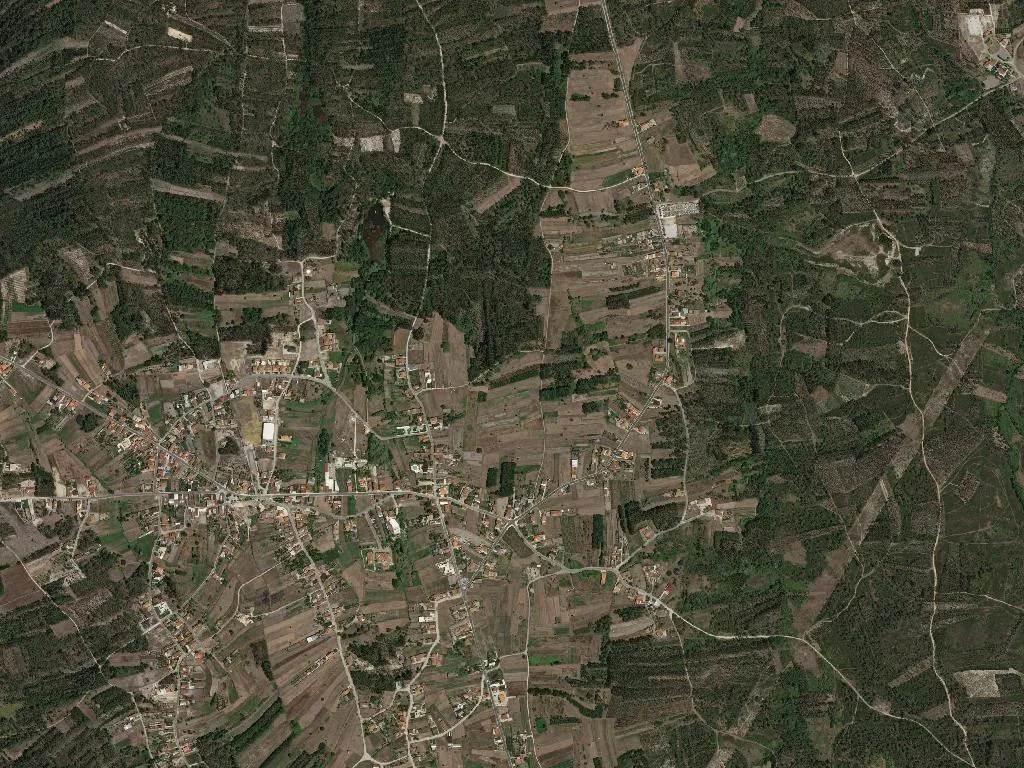
Full article about Covão do Lobo: Dawn over Baga vines & wolf-trap hollow
Where tractors hum across 180 ha of vines and a 1259 charter still echoes
Hide article Read full article
Morning light and wolf traps
The first sunbeams thread through the Bairrada vineyards, throwing short shadows onto the schist and slate that carpet the valley floor. At 54 m above sea level, the plateau is flat enough for a single tractor engine – Zé Mário’s – to carry across the entire parish when it coughs into life at 07:30 sharp. The trailer behind it is loaded with compost for the family’s three hectares of Baga; the sound ricochets off the low hills, then everything falls still again.
Covão do Lobo is little more than a crossroads amid 180 ha of vines, 42 of them planted with Baga, the rest with the white Maria Gomes. The 2021 census logged 1 008 souls, 37 per cent already past retirement age. Yet the place-name is older than the nation-state: a 1259 charter of King Afonso III records “Covoão do Lobo”, a hollow where packs of wolves were driven and snared. The last pelt was tallied in Vagos in 1762; the depression in the ground and the name remain.
Lime-washed walls and a single bell
The parish church of São Lourenço, finished in 1954 to the blueprint of engineer Joaquim de Sousa, is built of exposed brick and rises only as high as its modest belfry. The bell still summons worshippers for 11:45 Sunday mass; on 10 August the procession leaves the side door at 16:30, turns down Dr. José Morgado Street, loops along the municipal road and is back in the churchyard by 18:00 after a pause at the bandstand where, half a century ago, the first announcement of the Carnation Revolution was read aloud.
A five-minute walk away, the tiny 1867 chapel of São Bento shelters a 1732 stone cross inscribed “RA” – Rosário de Aveiro – its base scalloped by 300 years of Atlantic weather.
Bubbles, suckling pig and eel stew
Bairrada lives by the grape. At Quinta do Albano (Largo do Rossio 3) the cellar door opens on Saturday mornings; €3 buys a glass of 2018 brut nature, the second fermentation carried out in bottle for 24 months. Lunch is a matter of timing: in the one-room tavern A Parreira (Rua Principal 17) the pig is lowered onto a eucalyptus-wood fire at 12:30 and is usually sold out by 14:00. Half a portion, with Mira potatoes and house paprika sauce, costs €14.50.
Eight kilometres west, the Ria de Aveiro delivers salt water and silver eels. At Marisqueira o Pescador on Cais de S. Roque in Ovar, a clay tureen of caldeirada for two is €18, the pot hand-thrown in nearby Molelos. If you are passing the bakery before 10:00, secure a trouxa de ovos – a golden, yolk-heavy parcel – for €1.20; they rarely survive the commuter rush.
Yellow arrows and a vanished river
The coastal branch of the Caminho de Santiago slips into the parish at kilometre 17.4, where a yellow arrow is painted on the wall of the primary school that closed in 2009. From here it is 4.2 km to Ovar, crossing a 1958 timber bridge over the Caima that replaced the 18th-century stone arch swept away in the 1951 floods. Between May and September the stream is no more than a chain of reed-scented pools; the rest of the year it remembers it is a river.
Back in the vineyards, the 5.3 km PR1 “Vinhos do Covão” loop climbs to the Casal do Penedo lookout at 92 m. A hand-painted sign tallies the view: 180 ha of vines, 14 quintas, one 1932 watch-tower built to scare off grape thieves.
When Zé Mário’s tractor is finally parked at 19:45, Covão do Lobo returns to its ordinary soundtrack: a dog barking along Rua do Cemitério, the squeak of a cooperative gate whose hinge broke in 2020 and was never welded back. At 20:30 the sodium lamp above the churchyard flares on; below it, eucalyptus leaves blown from the Fontanheira pinwheel across the tarmac like small, pale hands.