Full article about Gafanha da Boa Hora
Explore Gafanha da Boa Hora in Vagos: walk Camino arrows past resin-scented pines, sandy farms and Atlantic-lit cottages
Hide article Read full article
The horizon keeps its word
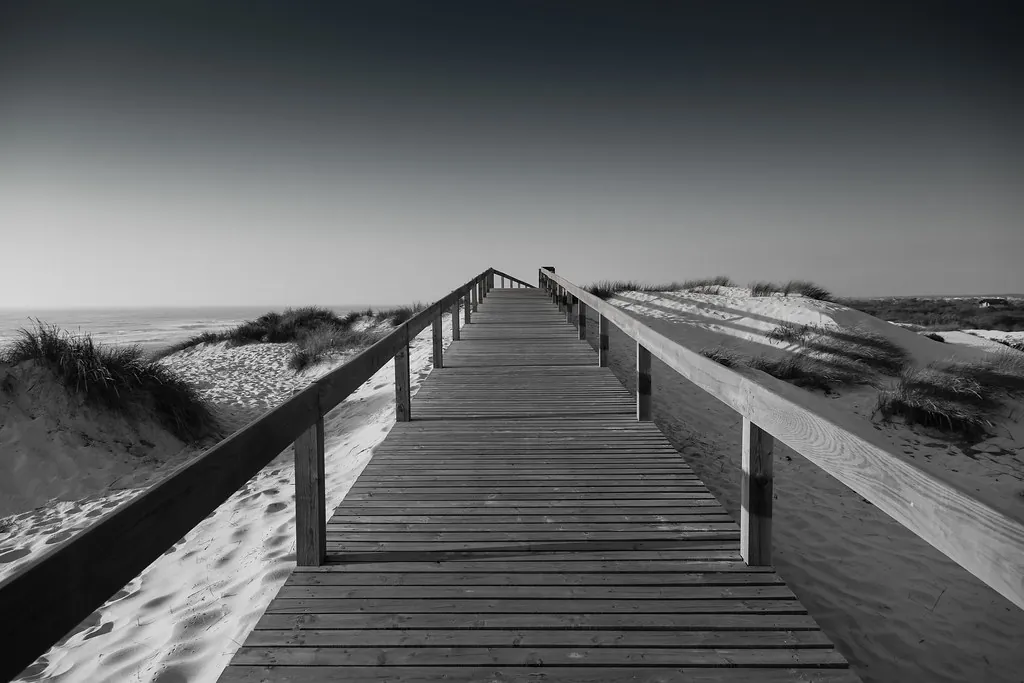
At 19.8 m above sea level the Atlantic light arrives already sifted, carrying salt that settles on pine needles and eucalyptus bark. Gafanha da Boa Hora occupies the narrow margin between Vagos’ farmland and the ocean’s weather machine; the soil is still damp with maritime dew at breakfast time and the wind never quite clocks off.
Thirty-seven square kilometres of level ground hold 2,848 people – a density lower than most English market towns – and the age pyramid is almost mathematically even: 435 children, 565 grandparents, everyone else somewhere in between. This is not a backdrop; it is a working parish whose tractors turn at dusk and whose Atlantic is a neighbour, not a view.
The geography of the everyday
The parish sits at the northern lip of the Bairrada wine region, yet the sandy littoral soils refuse the limestone grandeur found further south. Instead, forests of maritime pine grown for timber alternate with rectangles of lettuce, maize and onions, the geometry laid out for function, not photographs. When the engines stop the silence gains weight – broken only by a lone carrion crow or the faint diesel heartbeat of a New Holland on the next plot.
The light is time-tabled. At dawn a sea fret can slide two kilometres inland, erasing lane and hedge until the world is reduced to the sound of your own footsteps. By eleven the sun burns the curtain away, warming the sand tracks and releasing resin. At six the low sun gilds the single-storey houses, the white-rendered walls, the terracotta roofs, turning the place briefly into a negative of itself.
Way-marked footsteps
The coastal variant of the Camino de Santiago cuts straight through, way-marked with yellow arrows and the odd scallop shell nailed to a telegraph pole. Pilgrims usually press on; there is no baroque church or Roman milestone to force a pause. That, for some, is the attraction – a day of walking without selfie-sticks, exchanging nods with men repairing netting and dogs that bark from habit, not menace.
Beds are scarce: a handful of self-catering cottages, one house with two spare rooms. The Café Central on Rua da Igreja will fry eggs for walkers who stayed the night; anyone needing a wider choice drives ten minutes east to Gafanha da Nazaré where the lamp posts are taller and the supermarkets stay open past eight.
Salt on the tongue
O Leme, halfway to the beach, receives its fish from the Gafanha da Nazaré auction before the vans have cooled. Octopus roasted with olive oil and potatoes arrives in a cast-iron pan sized for two; the cod is topped with cornmeal and needs twenty minutes in the oven – just enough time for a draught beer drawn from the tap. There is no wine list; they ask “red or white?” and bring a tumbler, not a bottle.
The sound after the light
When the sun drops the visual world contracts and the audible one expands. Wind combs the pine crowns into a low, unending chord – a vegetal lullaby. On the back lanes your own footfall becomes percussion, and behind it, always, is the ocean you can’t yet see: you taste it on the air, feel it in the humidity, sense it as a horizontal presence waiting just beyond the headlights.