Full article about Santa Catarina
In Vagos parish, firecracker Sundays circle a barefoot-print legend and a lone gilded Catherine
Hide article Read full article
Morning light on limestone
The first sun of the day slips through the clerestory of Igreja de Santa Catarina and lands in exact, chalk-white slabs on the concrete floor. Inside, the air is cellar-cool, a deliberate counter-current to the July glare outside. At eye-level, a 15th-century polychrome statue of Saint Catherine of Alexandria stands sentry: gilded mantle faded to parchment, wheel of martyrdom shrunk to a crooked halo, yet her gaze still travels the single nave with the composure of someone who has seen worse centuries than ours. The building around her is 1982 – rectilinear, raw-plastered, almost Brutalist – but it stages the medieval carving the way a white cube gallery isolates a Renaissance panel: to keep memory from dissolving.
Footprints in stone
Local lore claims the saint paused on a rise just west of the present church and left the imprint of a sandal in the bedrock. Historians shrug; the story persists the way bindweed reappears after ploughing. The settlement belonged to the Knights of Malta long before Portugal’s 1842 administrative shake-up lopped it onto Vagos, and the parish itself was only rubber-stamped in 1987, five hundred years after the first chapel went up. The previous temple – a modest capela – has vanished; not even its stone was reused. What remains is the portable heritage: beside Catherine, a knot of popular saints – John the Baptist, doubting Thomas, the Sacred Heart, Our Lady of Fátima and Our Lady of Sorrows – each carrying their own feast-day traffic and candle-wax patina.
Calendar of firecrackers and brass bands
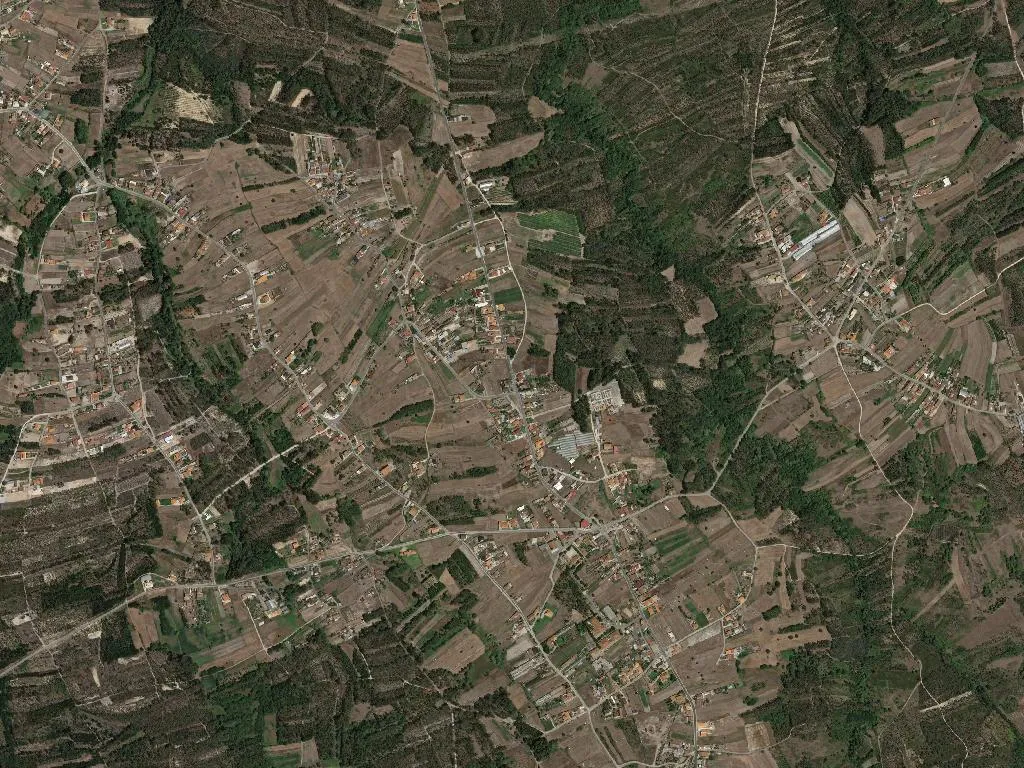
The last Sunday of July flips the village switch. Processions for São Tomé and Santo António spill out of the churchyard and into the two-lane road where tractors normally drone. Fire-crackers snap against whitewash; the philharmonic launches into a waltz that sounds suspiciously like a polka. Ten days later, on 25 November, the cycle rewinds for Saint Catherine’s proper feast – Mass at ten, roast-leitão lunch at one, bingo under the plane trees by four. Between times the 694-hectare parish reverts to hush: 216 people per km² on paper, yet you can walk the grid of lanes and hear only the staccato of a sprinkler on trellised vines.
The flat geometry of Bairrada
There is no vantage point here – 42.8 m above sea level is a statistical shrug. Vineyards roll out like graph paper: rows of Baga and Maria Gomes trained low against Atlantic wind, the soil thinning from granite to limestone as you drift west. The Caminho da Costa, the coastal variant of the Portuguese Santiago route, cuts across these fields; pilgrims appear as brief upright shadows, rucksacks bobbing, then dissolve towards the next horizon. No cafés offer compostela stamps; the parish council keeps a single rubber stamp in a drawer and hands it over with the same discretion a head-teacher lends a library key.
A fragile head-count
Of the 1,441 residents on the roll, 191 are under fifteen and 336 have already turned sixty-five. The primary school still runs two composite classes, but numbers are watched like barometric pressure. There is only one dwelling advertised for short-stay guests – a converted hayloft with wi-fi that works if the wind isn’t from the north-west. Visitors tend to be returnees: grandchildren of field-workers who emigrated to France in the 1970s, back for the festa and the roast suckling pig that tastes, they insist, of childhood. By late afternoon, when the sun hangs above the vineyards like a copper coin, the church door stands ajar again. Inside, the limestone saint keeps her five-century vigil while the new concrete bell tower rehearses the hour. Centuries collapse into a single, uncomplicated proposition: memory stays if someone bothers to switch on the light.