Full article about União das freguesias de Vila Chã, Codal e Vila Cova de Perrinho
União das freguesias de Vila Chã, Codal e Vila Cova de Perrinho, in Vale de Cambra, Aveiro, Portugal. Chestnut foothills, stone threshing floors.
Hide article Read full article
The scent of woodsmack drifts uphill before you see the sign. It climbs from kitchen yards, mingles with the Atlantic moisture that settles over these 300-metre contours, and insinuates itself into coat fibres. Cartographers bundled Vila Chã, Codal and Vila Cova de Perrinho into a single civil parish in 2013, yet each hamlet keeps its own clock, its own whitewashed church tower, its own afternoon hush.
Where the plain remembers the mountains
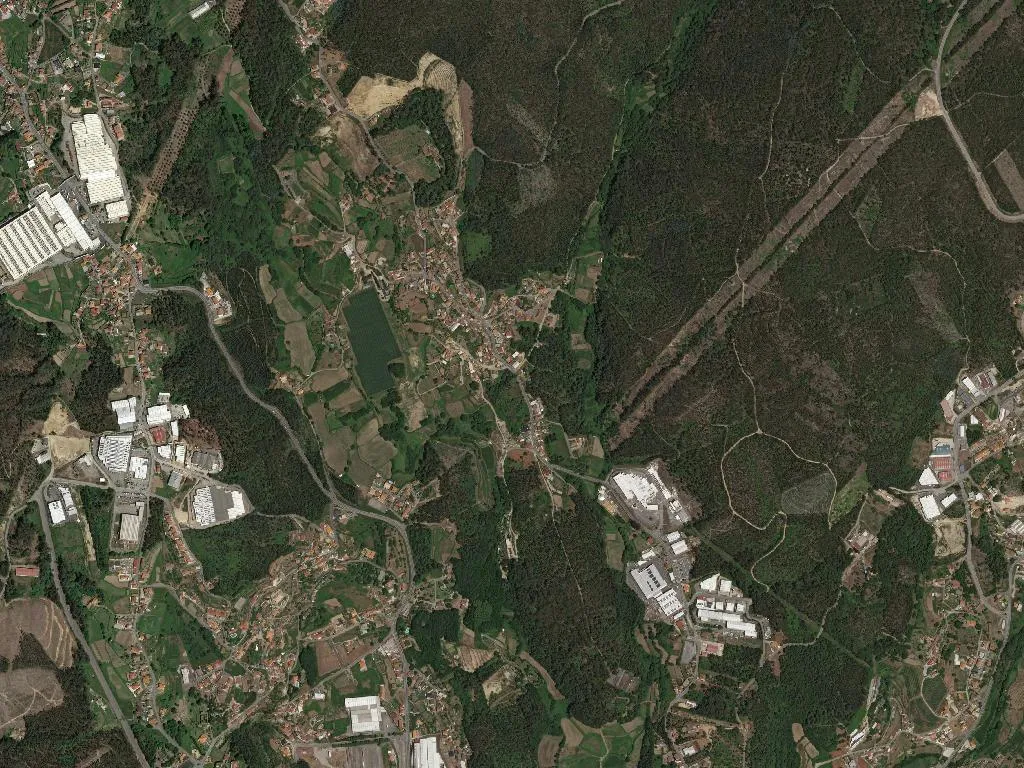
Vila Chã—literally “Flat Town”—earns the name for the first kilometre. Then the N337 tilts upward and the chestnut-wood foothills of the Serra da Gralheira muscle in. Within 13.4 sq km the road switches from vegetable plots to hedge-lined cattle lanes, from irrigation ditches still pulsing with winter rain to granite outcrops upholstered in moss. No nature reserve pins the view, yet the green is statutory: smallholdings stitched together by dry-stone wall and centuries-old threshing floor.
Granite, lime-wash and the sound of Sunday
Three mother churches, all 18th- or early-19th-century, share the same recipe: schist plinth, lime-plastered nave, rococo retable gilded inside like a reliquary box. Our Lady of Health, in Vila Chã, holds the prime site—an elevated rectangle of cobbles where the August pilgrimage unfurls. Between settlements, roadside crucifixes mark former rights-of-way; their carved dates read like marginalia in an agricultural ledger. No castle commands the ridge, no Roman bridge spans the Rio Caima—power here was measured in harvests and processions.
Festivals timed to the potato calendar
The Romaria de Nossa Senhora da Saúde turns the parish into an outdoor kitchen: oak-smoke, charred peppers, and brass bands ricocheting off granite. Santo António in June and São Pedro at the end of June extend the run of al-fresco nights. On those evenings the 5,348 inhabitants—thinly scattered across hamlets with populations smaller than a London bus—reconverge on streets barely two metres wide.
Kid in the wood oven, honey by the spoon
Cabrito da Gralheira arrives bronzed in a wood-fired oven, IGP papers guaranteeing its mountain upbringing. Arouquesa beef, stamped DOP, grazed within sight of the kitchen; the same cattle lend their casings to oak-smoked chouriço. Dessert is a high-risen pão-de-ló or egg-yolk sweets that began life in convent kitchens. Finally, Terras Altas do Minho heather honey—dark, resinous, scooped straight from the jar onto fresh queijo da serra.
Unmarked trails, definite arrivals
There is no “PR” way-marking, yet the paths are legible: stone-walled lanes that once carried maize to watermills, now carpeted in eucalyptus needles. A forty-minute climb gains a ridge that lets you triangulate Porto’s faint shimmer to the south-west and Aveiro’s lagoon to the west. Six rural houses take overnight guests—enough for silence, not for crowds.
When the low sun flares against Vila Chã’s church tower, the air fills with the same woodsmoke that greeted you at dawn. It lingers on clothes long after the valley has sunk behind the next hill, a reminder that some geographies are measured less in miles than in scent.