Full article about Messejana: Alentejo silence at sunrise
811 souls, iron gates, tail-less windmills—Messejana lives by wheat and echo
Hide article Read full article
Dawn on the ochre plateau
The low Alentejo sun slices through the holm-oak canopy, throwing ruler-straight shadows across rust-coloured earth. A skylark scatters notes over the plain; the only other sound is the groan of an iron gate at Herdade das Picoles as the farmhand leaves for the olive terraces. Messejana wakes reluctantly, as it always has—by the calendar, not the clock. At barely 125 m above sea level, and with eight inhabitants per square kilometre, the parish has room for every echo to finish what it starts.
The geometry of deep Alentejo
The name probably derives from the Arabic masjana—granary—an echo of the wheat that once filled Moorish silos. Scribbled parish records mention Messejana from the 16th century onward, tethered to wheat and sheep; the 20th-century pyrite boom at nearby Aljustrel briefly tipped the balance toward pick-axes and shift whistles. Today the census reads 811 souls, 293 of them over 65, and the economy has reverted to its original cadence: holm-cork rotations, free-range lamb, and olive groves that predate the Second Republic. Estates such as Picoles, Gago and Gralheira still punctuate the horizon with whitewashed barns and windmills worked by tail-less sails.
Whitewash and unshowy stone
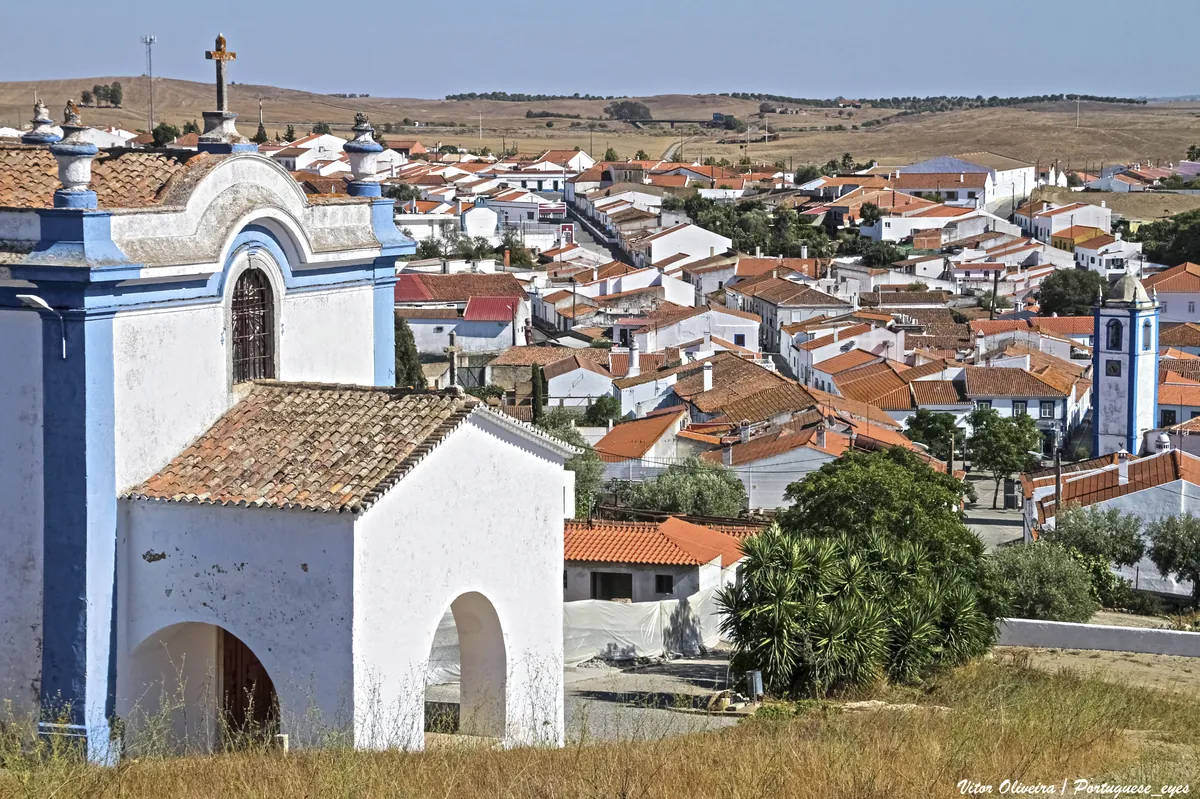
The parish church of Nossa Senhora da Conceição stands on Rua da Igreja with no more ornament than a chalky façade and a timber door split by sun and century. Gilded excess is an import the Alentejo never bothered with; here proportion is the aesthetic. Beside the EN261 a 19th-century stone cross marks the informal social hub: men lean against it at sunset, caps pushed back, debating rainfall and the price of ewes. Nothing is listed by English Heritage equivalents, yet the entire settlement is an exercise in rural design—house to porch to well to threshing floor—readable like a pattern book of Mediterranean self-sufficiency.
Lamb, ewes’-milk cheese and convent sweets
Dona Alda’s grocery, open since 1974, doubles as the parish kitchen. Migas—fried breadcrumbs—soak up lamb drippings in a wood oven; clay bowls of açorda give off cod-scented steam. Messejana sits inside the Serpa DOP cheese zone and the Baixo Alentejo IGP lamb demarcation: raw sheep’s milk is coagulated with cardoon flower at the village dairy, while lambs graze among rockrose and lavender until early autumn. In the bakery section, toucinho-do-céu—literally “bacon from heaven”—and queijinhos-do-céu follow 17th-century convent ratios of sugar and yolk. Table grapes ripen on unirrigated vines during August; the local co-op in Aljustrel bottles a modest red that turns up on every table without ceremony.
Calendars you can set your watch by
On 8 December the parish gathers for the Festa da Padroeira: procession from the church to the stone cross, open-air mass, then concertinas and the guttural two-line call-and-response of Alentejo cante. August brings evening dances at the 28 de Maio philharmonic hall and outdoor tastings in the church square, but the real social glue is labour shared: picking fruiting olives between October and December on Rogério Mestre’s land, the January pig kill, hand-harvesting vines in early September. Cante ao desafio—improvised challenge singing—still breaks out in the fields, Antonio “da Cova” leading verses about stubborn soil and even more stubborn affection. There are no tour buses, no selfie queues; visitors join in or watch quietly from the shade.
Saddles and boot leather
The 12 km Xerez trail loops through the parish, rideable by mountain bike or walkable in old walking boots. It corkscrews through holm and cork oak, century-old olives and pasture where Gralheira’s cattle graze unrestrained. Perennial rivers are absent, yet the seasonal Xerez stream and the Lama pond support wild boar, red-legged partridge and booted eagles wheeling overhead. The landscape is Mediterranean ecosystem in near-original condition—no nature-reserve signage, simply the expectation that you bring curiosity and silence. The route also forms part of the Iron Route, the decommissioned railway that once linked Beja to the pits of Aljustrel, now a greenway for touring cyclists who freewheel through without needing to change gear for kilometres.
Stone that keeps the day’s heat
By late afternoon the granite of the wayside cross still holds the sun’s warmth. Woodsmoke from Ti Augusta’s chimney drifts over eucalyptus bark and soil waiting for the first autumn rain. Messejana offers no epiphanies, no checklist sights—only the candid texture of an Alentejo that continues to live off what it always has, in no hurry to explain itself to anyone.