Full article about Vila Nova da Baronia
Sheep outnumber souls in this hilltop Alvito parish where olive oil drips into clay talhas
Hide article Read full article
Dawn on the Lime-Washed Walls
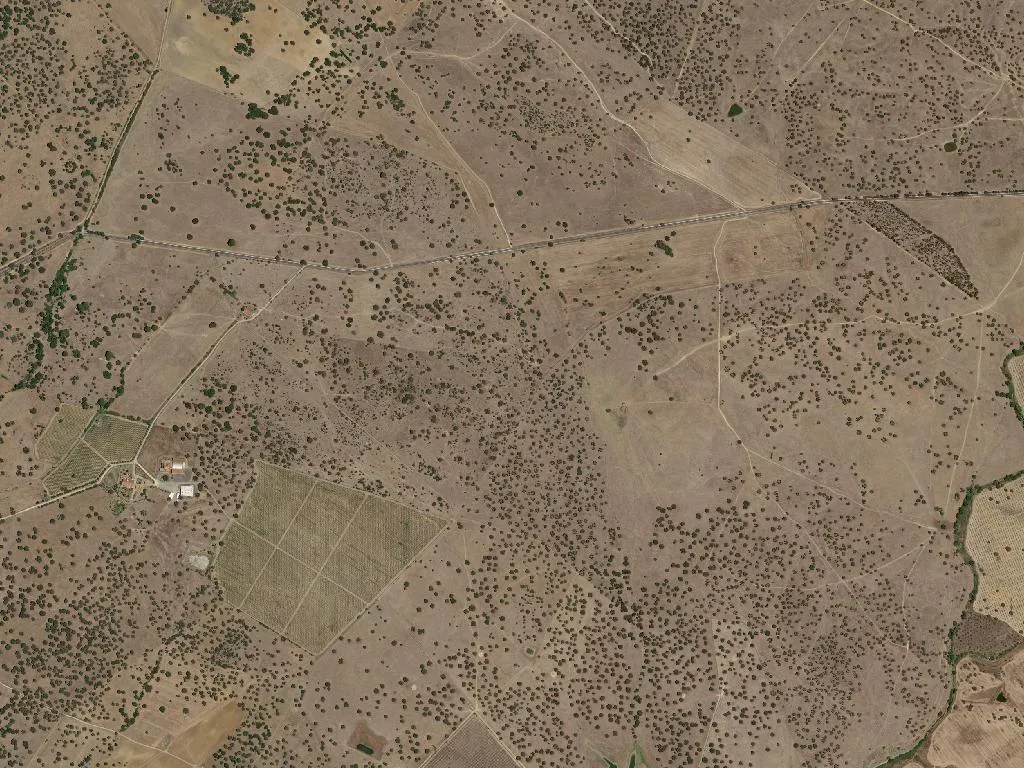
Morning sun warms the lime-washed walls, and the Alentejo silence is broken only by a dog barking somewhere beyond the olive groves. Vila Nova da Baronia sits 167 m above sea level on a gentle wrinkle of land halfway between Beja and the Spanish border, where wheat fields shimmer next to the matte-green of ancient oliveiras. Eight people per square kilometre is not a statistic here; it is the audible pause between one front door and the next, between one “Bom dia” and the reply that may not come until tomorrow.
Olive oil and curd
The parish spreads across 128 km² of rolling chalk plain, its 1 084 souls outnumbered by sheep. Inside the lagar, Azeite do Alentejo Interior DOP is coaxed from olives that survive both August’s furnace and January’s razor wind. In December the air is thick with the bruised-scent of fruit; green-gold oil glugs into clay talhas ready for labelling. A few kilometres away, wheels of Queijo Serpa DOP rest on pine boards, their buttery paste growing pungent for a minimum of 40 days. Meanwhile Borrego do Baixo Alentejo IGP lambs graze the montado, their flesh tasting faintly of rock-rose and rosemary that push up between the granite outcrops.
Stone that remembers
Three national monuments pin the village to its past: the 16th-century Igreja Matriz with its Manueline portal, the weathered pillory where municipal authority was once proclaimed, and the Paço de Vila Nova da Baronia, a petite manor house built over Visigothic foundations and later topped with a Baroque cornice. Alentejo grammar is written in these façades—whitewash, ochre trim, lace-work chimneys, stone door-frames rebated like picture mounts. Six further classified buildings keep memories that the dwindling oral archive can no longer carry.
Arithmetic of absence
The civil parish counts 324 residents over 65 and only 123 under 14. For every child kicking a ball down Rua da Liberdade, three septuagenarians sit in the shade of a jacaranda. Vila Nova’s primary school closed in 2017; Pardais’ had already shut six years earlier. Emigration has hammered the census—locked-up houses with warped green shutters, gardens where box hedges are losing a slow fight against wild fennel. Men still gather at Café Central or A Paragem for a game of sueca and a lament about wheat that grew too tall or rain that never arrived.
Where to stay
Eleven places will put you up, none of them fancy. Monte da Baronia and Herdade da Baronia are working farms where the night sky is unpolluted by anything brighter than a tractor headlamp. Quinta da Baronia offers two self-catering cottages under a coppery stand of cork oak. Check-in is a conversation with Zé, who pours a bica and tells you to drive up the lane beside the cemetery for sunset—the veiga of the Rio Alvito unrolls like a parchment all the way to the Spanish horizon.
Dusk settles; Dona Rosa sweeps her threshold exactly as she did in 1973, the broom’s percussion mixing with swallows returning to nests under the church eaves. Woodsmoke of holm-oak drifts from Sr António’s chimney—he still splits logs with his father’s axe. Tomorrow the sun will warm the same stones, and the plain will keep breathing at its own cadence—neither hurried nor forgotten, simply constant.