Full article about Castro Verde’s ruler-straight horizon hides baroque gold
Bronze dust, whitewashed walls and gilded altars in Portugal’s empty quarter
Hide article Read full article
A horizon drawn with a ruler
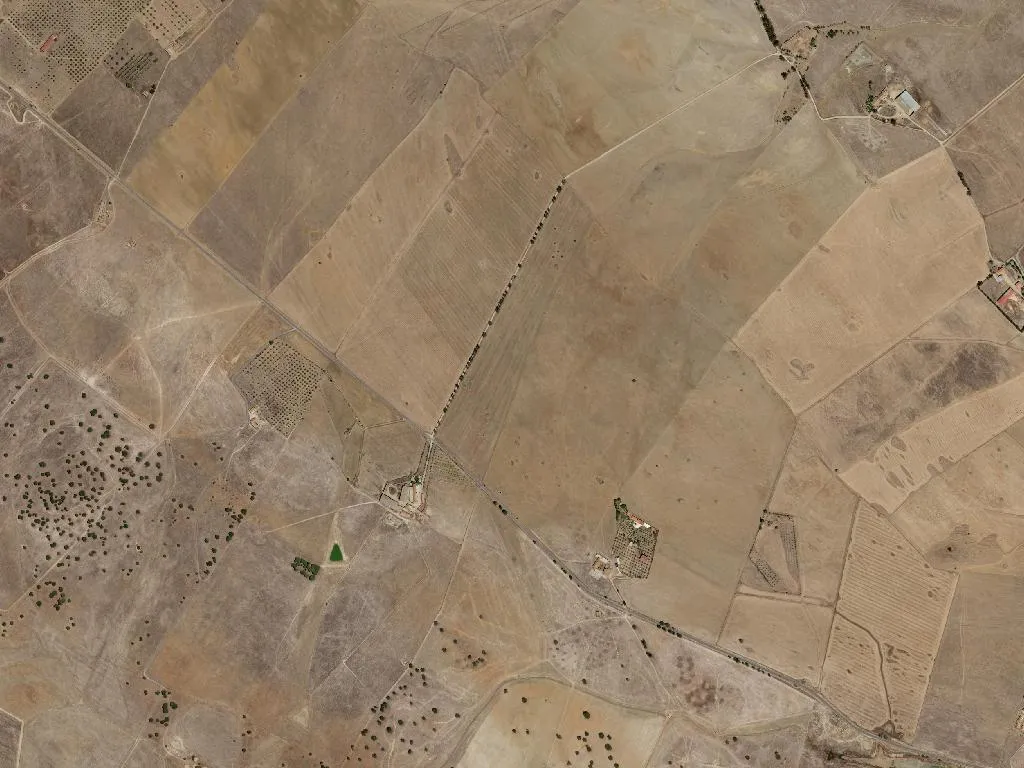
The wind arrives without warning and meets nothing in its way. It slips through olive groves, rasps the crowns of holm oaks, lifts a fine bronze dust that hangs in the morning light. There is no mountain to brake it, no valley to reroute it. At 251 m above sea-level, the Baixo Alentejo unrolls so flat that the horizon looks incised with a draughtsman’s set-square, ocre earth on one side, ultramarine sky on the other. Castro Verde sits dead-centre in this immensity—322 km² inhabited by 5 289 people. The arithmetic is brutal: fewer than twenty souls per square kilometre. Yet that scarcity gives every human presence ballast.
When “castro” still meant a watchtower
The town’s name remembers those who needed to see danger before it arrived. “Castro” signals a fortified hilltop settlement; in a landscape where you can spot a lorry ten minutes before it reaches you, the strategic advantage is obvious. “Verde” acknowledges the stubborn fertility of the soil—olive rows stitched tight as tweed, wheatfields that change colour like mood rings. Human layers lie one on another: Iron-Age defensive walls, Roman tesserae, Islamic irrigation channels, finally the slow-crystallised Alentejo identity. Casével, the other half of the 2013 parish merger, grew up along the Cobres stream, water being the only reliable compass for settlement. Together the two former parishes form a territory where history is read less in chronicles than in the lie of stones, the curve of a cattle track, the angle of a whitewashed house.
Gilded woodwork behind whitewashed walls
Castro Verde’s parish church is a deliberate double-take. Outside, the Alentejo restraint is intact—chalk-white plane, a rectangle, almost nothing that could be called decoration. Push the iron-banded door and gold leaf slams into the retina: baroque retables stacked like theatrical scenery, light pouring over carved cherubs and acanthus until it feels liquid. At 2.30 p.m. in February the sun sidles through the south-side windows and every scrollwork shadow deepens to 3-D. One of only four listed monuments in the municipality, the building is an accidental metaphor for the region itself—frugal on the outside, flamboyant within. Casével’s Igreja da Conceição keeps to humbler lines, walls a metre thick that stay refrigerator-cool even when the mercury nudges 42 °C. Scattered across the wheatfields are tiny pilgrimage chapels—Nossa Senhora de Mércules, for instance—white punctuation marks that once governed the rhythm of rural festas.
Great bustards and the silence they invoice
Campo Branco, the sweep of cereal steppe and cork oak around Castro Verde, is one of Europe’s last refuges for the great bustard, a turkey-sized bird whose males perform balloon-chested displays each spring. Seeing one demands patience and withheld breath. The bird-watching trails run between wheat stubble and sheep pasture; the loudest sound is dry grass snapping in the heat, occasionally the guttural bark of a red-legged partridge. At the Campo Branco Interpretation Centre you learn why this pseudo-steppe exists at all: it is a human artefact, dependent on low-density farming—sheep grazing, cereal rotation, cork harvesting. Abandon the land and scrub swallows it; lose the bustard, the little bustard, the stone-curlew. The area is stitched into the Natura 2000 network, meaning Iberian lynx have been filmed padding along the oak fringes and black vultures ride the thermals overhead.
Lamb, thistle-rennet cheese and bread that refuses to leave the table
The local table is built around what survives drought and time. Borrego do Baixo Alentejo IGP, milk-fed lamb reared on these pastures, arrives either as a stew thickened with mint and garlic-soaked bread or simply roasted with potatoes and local olive oil whose bitterness recalls green tomatoes. Queijo Serpa DOP, coagulated with cardoon stamens, comes to the table still damp, its paste sliding from buttery to flaky depending on age. Açorda alentejana—stale bread, coriander, garlic, olive oil and a poached egg—turns scarcity into velvet. Conventual sweets (toucinho-do-céu, queijinhos-do-céu) are yolk-heavy, sugar-dense legacies of the nuns who once occupied the town’s small Franciscan convent. Even the bread itself, a dense country loaf, is baked in wood-fired ovens that never fully cool, giving the crumb its faint smoke line.
Walking until the path forgets its purpose
Seventeen small guest-houses—converted haylofts, village houses, a former primary school—give you licence to stay longer than an overnight. Staying is the point: the lanes between Castro Verde and Casével tunnel for kilometres under cork oak shade, the red earth releasing a perfume of rockrose and hot dust. At dusk the plain turns amber, holm-oak shadows stretch to infinite lengths and the sky vaults unspoiled by light pollution, a side-effect of depopulation. It is then, when the air is still warm but no longer aggressive, that you hear the signature sound of the territory: nothing. A mineral silence, dense enough to feel, broken only by the distant wing-beats of a bustard heading to roost. The place has nothing left to prove.