Full article about Vila Alva: Silence Seasoned with Acorns & Olive Oil
Cuba’s whitewashed hamlet breathes slow amid cork savannah, wood-fired lamb and 1948 stone presses.
Hide article Read full article
The sun is already high when Vila Alva falls quiet. Not the hush of absence, but a different register of sound: a cock crowing two lanes away, a chair leg scraping across terracotta, the dry Alentejo wind scudging across 255 m of plain. At the northern lip of Cuba municipality the light slams straight onto whitewash and heat pools slowly in the basalt cobbles of Rua 14 de Abril – the single thoroughfare that stitches the village side-to-side in an eight-minute stroll.
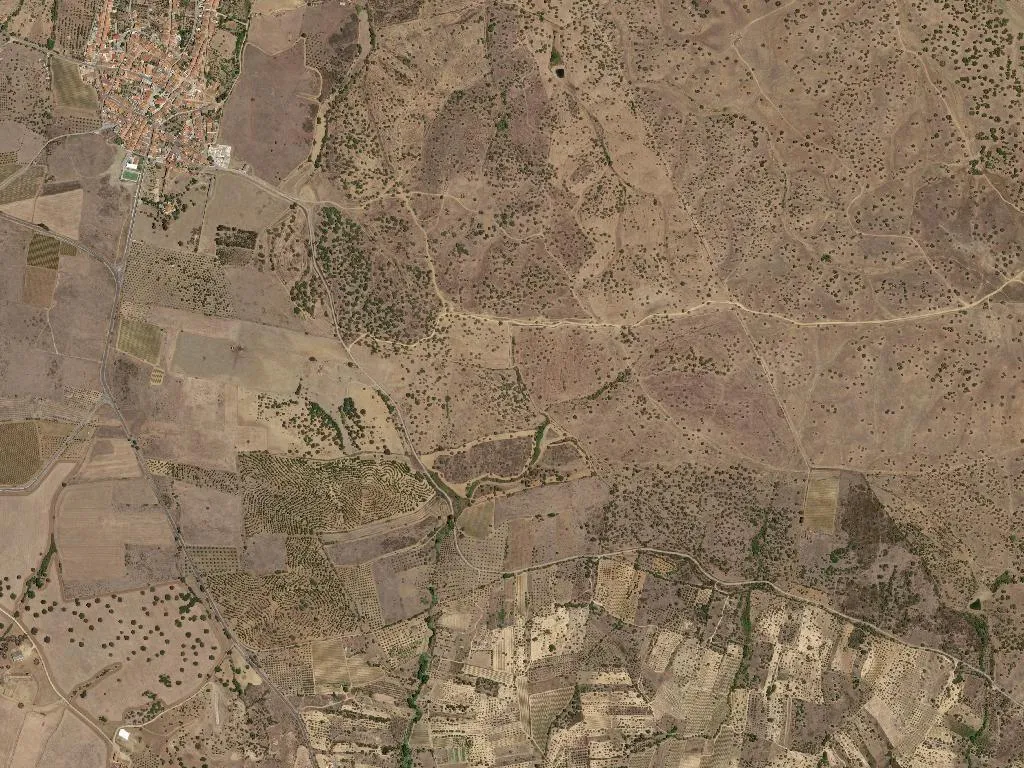
Thirty-seven square kilometres of rolling cereal plateau, patched with olive green and biscuit gold, house 416 souls (2021 census). One in three is over 65; the primary school, edged by a dirt football pitch, educates 35 children. Eleven inhabitants per square kilometre translates to horizon on horizon, and time measured in seasons, not seconds.
Where the land exhales
There are no rivers, no sierras. Instead, the 1,200-hectare Herdade da Corte offers classic montado: open cork and holm oak savannah where black pigs graze acorns from October to March. On the northern boundary, Quinta do Arroz’s centenarian olive grove yields 30,000 L of DOP Alentejo Interior oil each year. The farm’s stone lagar still squeezes fruit through twin 1948 wooden presses; visit in November and the air is viscous with new oil and bruised olives.
Grocer-café “O Pescador” has been under the same family since 1972. Dona Amélia brings wheels of Serpa DOP – cave-cured, butter-yellow – every Friday morning; buy the whole three-kilo truckle and it’s €14. Spring lamb marked Borrego do Baixo Alentejo IGP arrives from Aljustrel at dawn. By 09:00 Maria João has her oven steady at 180 °C; by 13:00 the village is eating roast leg scented with erva-doce and mountain thyme.
The geometry of stillness
Seven holiday houses are scattered through the warren of lanes, but no signage gives them away. The one on Largo da Igreja is kept by D. Rosa next door – ring, and she’ll appear with an iron key the size of a hand. Tourism here is knowing the bakery sells its last pão de trigo at 08:00, and that Sr. Aníbal’s lettuces are bundled by 10:00 after a 06:00 start in the fields.
The parish church of Santo Aleixo, rebuilt after the 1755 earthquake, was listed in 1986. Inside, 1783 gilded carving remains unrestored – splinters of cedar and pine still bright where the gold leaf has slipped. Two kilometres south, the sixteenth-century Capela de São Brás keeps frescoes photographed by the heritage squad in 2019. The key weighs half a kilo and lives in the vestry; ask at the presbytery and the priest will cycle over to unlock it.
Late afternoon, when the light softens and shadows stretch, Vila Alva’s silence gains density. Carrying rosemary and wood-smoke on the breeze, it drifts across the plain until, at 18:00, the church bell tolls – and nobody hurries.