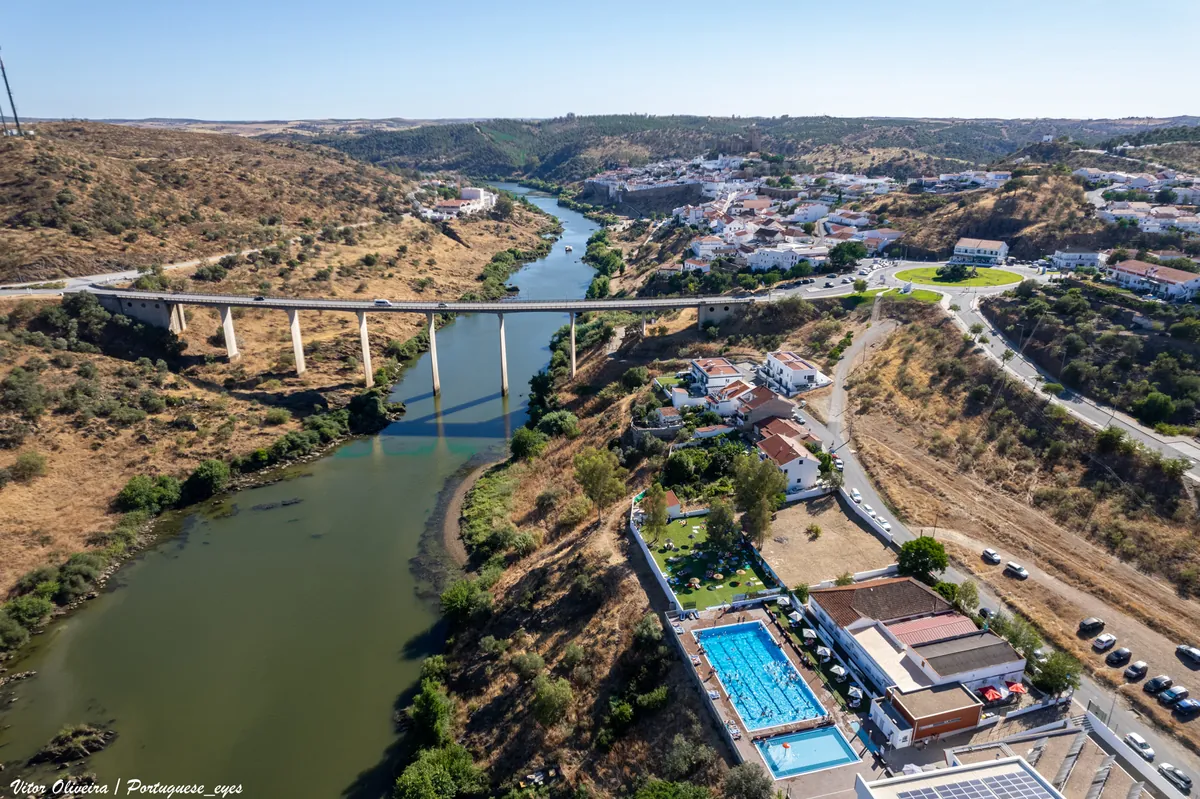
Full article about Mértola: Adhan crackles from 12th-century mosque loudspeaker
White lanes cork-scented, river lazes below, castle doubles as phone mast
Hide article Read full article
The hill, not the tower, still calls
The summons doesn’t ring from a minaret—there hasn’t been one since 1532. Instead, at noon exactly, the park ranger presses a button on a tinny loudspeaker bolted to the old mosque’s wall and a pre-recorded adhan crackles across the white roofs of Mértola. Inside, the only remaining Moorish prayer niche in Portugal is now flanked by a Baroque altar; the air tastes of sun-baked limestone and candle smoke. Visitors shuffle in, snap the obligatory selfie in front of the mihrab, shuffle out. Faith has become a twelve-second audio file.
A river with too many names
Below the cliff the Guadiana stops being a working waterway and turns into a sluggish mirror. Kayaks slide across it at €15 an hour, rented from a man called Zezé who sets up a striped tent each July and vanishes when the easterly wind arrives. Downstream, the gorge known as Pulo do Lobo—Wolf’s Leap—looks dramatic on the brochures, yet most locals reach it by 4×4, spreading picnic rugs on the schist shelves rather than risking the paddle. Archaeologists have fenced off a neat rectangle of earth by the old Roman mole: you peer through the railings at layers of brick, read a bilingual panel, then notice the archaeologist’s sun umbrella still wedged in the trench like a forgotten cocktail stick. Time here is not layered; it is boxed, numbered, stored.
Castle with a signal
King Dinis’s keep, rebuilt in 1292, now doubles as a mobile-mast in fancy dress. Antennae sprout between the crenellations; on the roof a German hiking club argues over waypoints. The view is worthwhile—rolling swells of cork oak that fade from sage to bruise-blue according to the dust load in the air—but the gates shut at seven, so any stargazing is done from the village lanes where streetlights are still considered decorative. The Sierra that frames the horizon was once a Moorish frontier; today it is simply the place where phone reception drops to one bar.
What the day tastes like
Wednesday means lamb stew at O Brasileiro, thick enough to stand a spoon in, served with bread that shatters rather than tears. On other days the menu retreats to frozen-cuttlefish feijoada. The cook will ladle you a bowl of pennyroyal soup only if April has been unseasonably wet; otherwise it is supermarket gazpacho brightened with her mother’s vinegar. The river’s modest gift is boga, a palm-sized silver fish sold out of a chilled van every Friday morning—already scaled, ready for the pan. Olive oil comes in five-litre cans from the cooperative in Serpa; the peppery scent lingers on fingertips for hours. Cheese arrives from Ascensão, cured in a breeze-block hut beside the road: soft centre, gritty rind, unmistakable whiff of wet fleece. Eat it with the local honey-cake—factory-made, individually wrapped, yet willing to collapse into the bitterness of a bica coffee.
Paths that fade
The signposted Mills’ Trail climbs, drops, then surrenders in a dry watercourse. Paint flakes from the arrows; take water because the holm-oak shade is miserly. Zezé’s nautical club is seasonal, staffed by his nephew when the thermometre hits 35 °C. The Grande Rota do Guadiana exists on OpenStreetMap as a confident green dashed line; on the ground it is a sheep track that dissolves into cistus and knee-high thyme. Walkers who persist need GPS, or at least a tolerance for thorns.
Fair days and feast days
May’s street fair commandeers the single traffic-calmed high street: four food stalls, two craft tables, a stage hired from an events firm in Beja. Cante Alentejano polyphony starts at ten, but the audience is inside the café watching Benfica. On Assumption Day the procession needs half an hour, two brass-band drummers and a child with a standard to circumnavigate the parish church. Afterwards the priest dispenses cinnamon cake and firewater in the churchyard; there is always surplus.
The loudspeaker on the old minaret is still waiting for a bulb replacement since Christmas. Down on the quay the river reflects a sky the colour of oxidised copper. Footsteps echo up the cobbled incline; the recorded call is silent, and no one appears to miss it.