Full article about Moura’s Whitewashed Hush: Alentejo Time Stands Still
Feel the slow pulse of southern Alentejo in Moura and Santo Amador: sun-bleached walls, oak-grazed lamb, Serpa cheese aged in stone dairies.
Hide article Read full article
White lime, fifteen centuries of stillness
By eight o’clock, even in high summer, the heat already has weight. Whitewashed walls bounce the light like polished steel; the eaves cut shadows so sharp they look ruled. Moura wakes reluctantly—one rattling shop-shutter, a distant tractor, then the hush that defines this southern rim of the Alentejo.
Fifteen bookmarks in stone
Fifteen classified monuments are scattered across 290 km². One enjoys National Monument status, nine are officially Protected. Population density: 28 souls per km²; historical density: the inverse. Trace the urban fabric and you read a palimpsest: an Arab citadel, elbows of medieval lanes, ramparts surviving only as sudden changes in level. Streets knot tight on the ridge, then snap into the ruler-straight grids of later expansions—architecture dictated by whoever last feared attack.
Flocks and thistle-rennet
The lambs that become Borrego do Baixo Alentejo IGP graze the open montado oakland beyond the city. In stone dairies inland, thistle heads are crushed to coagle milk for Serpa DOP cheese. Cutting it at the precise moment—when the centre sighs into thick cream—requires the patience of someone who has grown up with thermometer skin.
There are no slick tasting lounges, just raw material, climate and centuries of practice.
Eight thousand and thirty-nine
2021 census: 8,039 residents. 1,301 under fourteen; 1,952 over sixty-five. Plastic chairs outside front doors outnumber bikes against walls, yet the mood is not the shrug of the deep interior. Twenty-three legal lodgings—apartments, cottages, small guesthouses—cater for a trickle of visitors who prefer their stay undecorated.
The plain as architecture
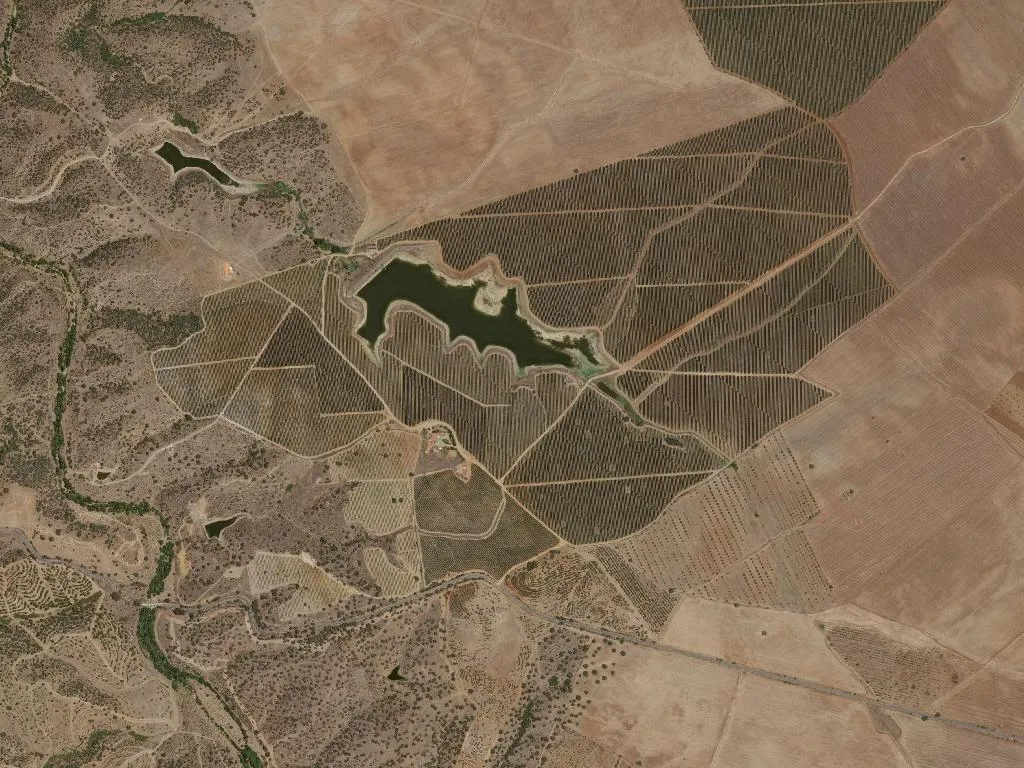
Beyond the last house, 290 km² of apparently flat land rolls away. Average elevation 152 m disguises gentle swells, winter watercourses, sudden shale outcrops. For a few weeks after New Year the country flares an almost violent green, already bracing to vanish. Santo Amador, the rural half of the civil parish, dissolves into this immensity; silence is the default acoustic, broken only by a herd dog or the low gear of a John Deere.
Where the paint dries before the brush is laid down
Moura does not perform. No mountain drama, no Atlantic dazzle. It simply continues—daily gestures framed by fifteen listed monuments and two millennia of habitation. On the road out, a half-whitewashed wall: the second coat abandoned, brush balanced on the bucket. The lime has already set under the sun—faster than any human intention.