Full article about Póvoa de São Miguel: silence measured in cork and dust
Wander 187 km² of Alentejo plain where 761 souls keep time by bakery steam and church bells
Hide article Read full article
Dawn grammar
The sun arrives sideways in Póvoa de São Miguel, sliding across whitewash and warming terracotta before the day has even decided to begin. Four kilometres east of Moura, the parish unfurls across 187 sq km that shelter exactly 761 souls – a demographic whisper that translates to four people for every square kilometre of cork oak, olive and dust. Silence here is not absence but acreage: you can walk the length of the main lane and hear only your own soles scuffing calcite.
How the land sentences itself
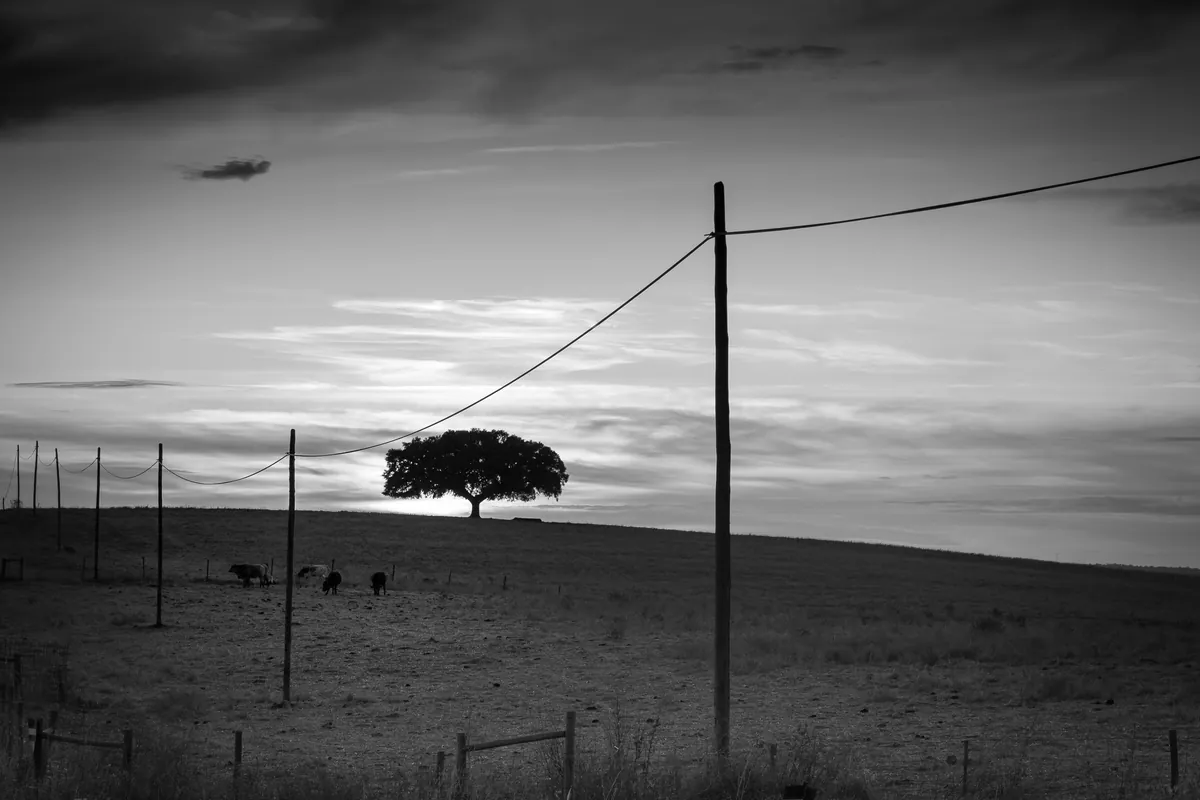
There are no blockbuster monuments – only the 16th-century Manueline portal of the parish church earns an official listing – yet the place organises itself like a piece of minimal music. At 131 m above sea level the eye is given licence to roam: wheat stubble, black-and-white cattle, drystone walls that vector towards a horizon liquefied by heat. Six registered guesthouses dot the map like punctuation marks in an otherwise unbroken paragraph of plain. You don’t come for postcard views; you learn to read the slow syntax of soil colour shifting from ochre to rust, the way shadows rearrange themselves on a whitewashed barn between 11 a.m. and noon.
The ballast of ordinary time
Demography dictates cadence. Of the 761 residents, 223 are over 65; the village keeps time by chores, not clocks. Mid-morning, someone’s grandfather wheels a barrow of pruning clippings; the bakery – operating since 1978 – releases a yeasty exhale that drifts across the square. Children (113 of them, under 14) provide the only staccato: a bicycle bell, a football thudding against the church buttress. Tourism has not arrived; Póvoa still belongs to the working calendar. António opens the single café-cum-restaurante, O Pátio, only when he judges hunger has reached critical mass, rarely before 12:30.
What the earth tastes like
Food is what the land permits, elevated by repetition into ritual. Lamb carrying the Baixo Alentejo IGP stamp grazes these fields, its flavour freighted with dried rockrose, thistle and the resinous breath of summer thyme. Queijo Serpa DOP, custard-yellow and gently bitter, appears at every table, cut into wedges that sweat gently in the heat. On 29 September the feast of São Miguel turns the churchyard into an open-air kitchen: Mr Joaquim, 82, still tending 150 ewes, oversees a cauldron of migas – breadcrumb porridge folded with shredded lamb and his own olive oil, the taste of an entire year’s daylight condensed into a single plate.
Light as building material
Alentejo light is a construction material here, poured rather than shone. By midday it is white, almost corrosive, turning whitewashed façades into reflecting boards that make your pupils contract. Come late afternoon the alloy changes: gold floods the plain, revealing ridges and folds invisible at noon. Walking the municipal road 509 you feel heat radiate from tarmac, see the horizon dissolve into a mercury mirage. When the church bell tolls – a dry metallic clang that travels kilometres without impediment – you realise the village needs no justification for existing. It persists, spare and self-defined, indifferent to the world’s haste. What lingers afterwards is not a view but a physical memory: the weight of silence, the rasp of lime against fingertips, the scent of dry earth that clings to cotton long after you have driven away.