Full article about Santo Aleixo: where dawn glows on lime-washed hunger stones
In Moura’s high Alentejo plain, 783 souls keep rosemary-scented silence beneath 1778 bell-tower.
Hide article Read full article
Before the Sun Finds the Wall
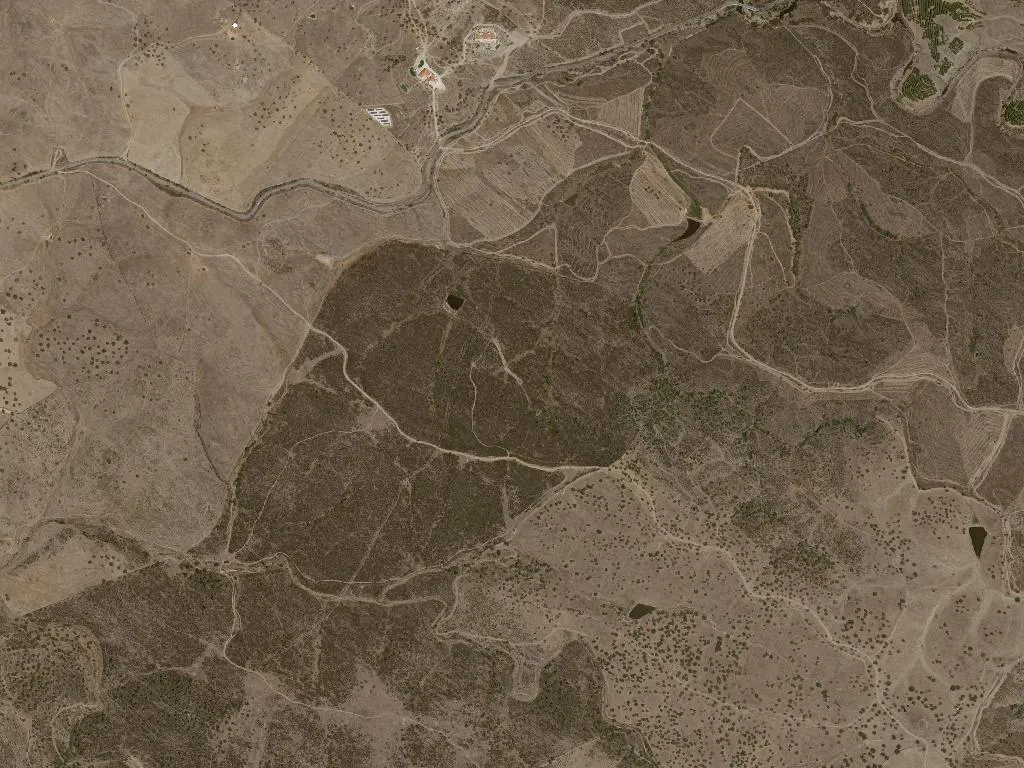
The lime-washed façades of Santo Aleixo da Restauração begin to glow long before sunrise. At 272 m above sea-level, the air is still cool enough to carry the smell of cracked earth and bruised rosemary across a territory the size of Guernsey, yet home to only 783 souls. A chair scrapes across a doorstep; the day starts with that single, deliberate note rather than any cock-crow. By dawn the temperature curve will already be rising steeply—this is the Alentejo, where heat is a second geography.
Horizontals rule here: the ochre of freshly turned soil, the silver-green flicker of olive saplings, the relentless white of walls that bounce back light like a challenge. Distances are measured in silence. For every child kicking a ball down the calcada there are three pensioners in the shade, and the parish archives record 252 residents over 65 against just 85 under 14. The mathematics of departure is written in disappearing doorways.
Stone Memory
The settlement’s name commemorates the 1640 uprising that ended sixty years of Spanish Habsburg rule. A modest obelisk in the square—easily missed if you’re checking your phone—marks the spot where local militias mustered against Philip IV’s garrisons. Alongside it, the Igreja de Nossa Senhora da Assunção stands as Monumento Nacional, its bell-tower rebuilt in 1778 after lightning split the earlier spire. Walk a kilometre east and you’ll find the smaller Capela de Santa Ana, classified merely of “public interest” yet older by two centuries, its Manueline portal still carrying the mason’s chisel marks.
Domestic architecture is parsimonious: single-storey houses, balconies just deep enough for a chair, windows the size of a tabloid sheet to keep August at bay. Schist shoulders the lower courses; above, lime wash is reapplied each spring in an unbroken ritual older than the border with Spain, barely 15 km away.
Tastes Regulated by Drought
The menu is dictated by what the land will endure. Lambs of the protected Baixo Alentejo IGP graze the sparse pastures; their meat, roasted over holm-oak in clay ovens, carries the faint sweetness of wild thyme. Serpa DOP cheese arrives oozing, its centre almost liquid after months of maturation in humid cellars. Both products pre-date any tourist board: they are what drought, sheep and cardoon thistle made necessary. Order them at O Meia Bola on Largo Luís de Camões and the waiter will bring a spoon, not a knife—correct etiquette for cheese that collapses under its own velvety weight.
Where to Drop Anchor
There are precisely two places to stay. Herdade da Negrita, a 3,500-hectare working farm five minutes out, offers five rust-styled rooms, a pool distilled from the same aquifer that feeds the olive groves, and dinners arranged around whatever the tractor brought in. Closer to the nucleus, a single town-house rental faces the church; its thick walls keep the interior a constant 19 °C without air-con. Both options assume you are content with night skies rinsed clean of light pollution and a data signal that flickers like a faulty bulb.
Walking the Horizontal
Stride out at 5 pm, when the sun finally loosens its grip. The sendero that skirts the Monte da Contenda cork estate is marked by white-and-yellow blazes; it leads you past Neolithic dolmens and abandoned threshing circles where storks now nest. With no vertical feature higher than a watchtower, every footstep is amplified: your shadow extends 20 m, the crunch of gravel sounds like someone else walking. You understand, physiologically, what it means to live where the nearest neighbour may be two cornfields away and the horizon is drawn with a ruler.
Dusk brings the return of acoustic space. A chair scrapes again—same doorway, same occupant. Temperature drops 12 °C in as many minutes; walls exhale the heat they have hoarded all day. Somewhere a radio switches on, then thinks better of it. In Santo Aleixo da Restauração, silence is not absence but presence distilled, a heritage more carefully protected than any monument.