Full article about Vila Nova de Milfontes
Salt-stung fortress town of spring-fed dunes, corsair scars and compass-rose cobbles
Hide article Read full article
The first thing that greets you is the scent — a briny snap of Atlantic salt braided with the resinous sweetness of rockrose. It is neither fully sea nor fully land, a fragrance that exists only where river and ocean negotiate. Then comes the sound: the River Mira slapping the fibreglass flanks of moored fishing boats, an arrhythmic echo that merges, somewhere beyond the cliffs, with the Atlantic’s heavier percussion.
You reach Vila Nova de Milfontes by the single road that slices through the Southwest Alentejo and Vicentine Coast Natural Park. For kilometres the topography is a low, stubborn scrubland of heather, cistus and strawberry tree, until the horizon fractures into two blues — river on the right, ocean on the left — and the town spills down a 70-metre ridge in a cascade of white walls trimmed with indigo or ochre. From the mirador you can simultaneously watch the estuary curl inland and the open Atlantic flex its muscles.
A thousand springs, one fortress
The name is literal. Freshwater springs once dotted the dunes and still seep through the sand today, a geological quirk that drew Palaeolithic settlers whose megaliths lie toppled in the surrounding hills. John II granted the settlement a royal charter in 1485, but the silhouette that defines Milfontes was forged by fear. In 1590 a Moorish corsair raid left the village in cinders; Philip II of Spain ordered the construction of Forte de São Clemente, completed in 1602. The fortress rises from the right bank of the Mira like an extension of the schist itself, walls blackened by four centuries of salt and time. Stand on the waterline and the bastion appears to grow out of the rock; climb to the Praça da Barbacã and you’ll discover the Portuguese cobblework cartographers rarely mention — a compass-rose mosaic that traces the fort’s floor plan beneath your feet, trodden daily by locals who barely notice.
On the same square a modest plaque honours Brito Paes and Sarmento Beires, the Portuguese pilots who made the first aerial crossing from Lisbon to Macau in 1924. The memorial is so understated it feels almost shy, echoing the town’s instinctive resistance to self-promotion — census population 5,660, streets narrow enough for afternoon light to pool like liquid marble.
The procession that floats
Milfontes reveals itself most completely on 8 August, the Festa de Nossa Senhora da Graça. The patron saint is removed from her 16th-century church in the old centre and carried downstream on a flotilla of flower-decked fishing boats. Banners flicker on the water, hymns mingle with the screech of herring gulls that follow the procession as if on the parish payroll. Upriver, in the hamlet of Brunheiras, the annual May and August fairs return to terra firma: livestock, sweet-potato stalls, the low murmur of deals struck in the shade of cork oaks.
Lunch at the estuary
The kitchen here is divided by the tide. From the Atlantic come caldeiradas — tomato-based fish stews thick with monkfish and sea bream — and cuttlefish cut into thumb-sized strips, fried until the edges caramelise. From the Alentejo interior come pork cheeks braised with migas, the region’s answer to polenta: breadcrumbs soaked in garlicky fat until they swell into a soft, saffron-tinted bed. The parish sits within three protected denominations: Queijo Serpa DOP, a thistle-set curd with a gentle bitterness; Borrego do Baixo Alentejo IGP, lamb reared on dryland pasture; and the orange-fleshed sweet potato of Aljezur IGP, which roasts to a near-cream. In a district where the nearest maternity ward is 104 kilometres away in Beja, lunch remains one luxury that does not require a journey.
Golden sand, black schist
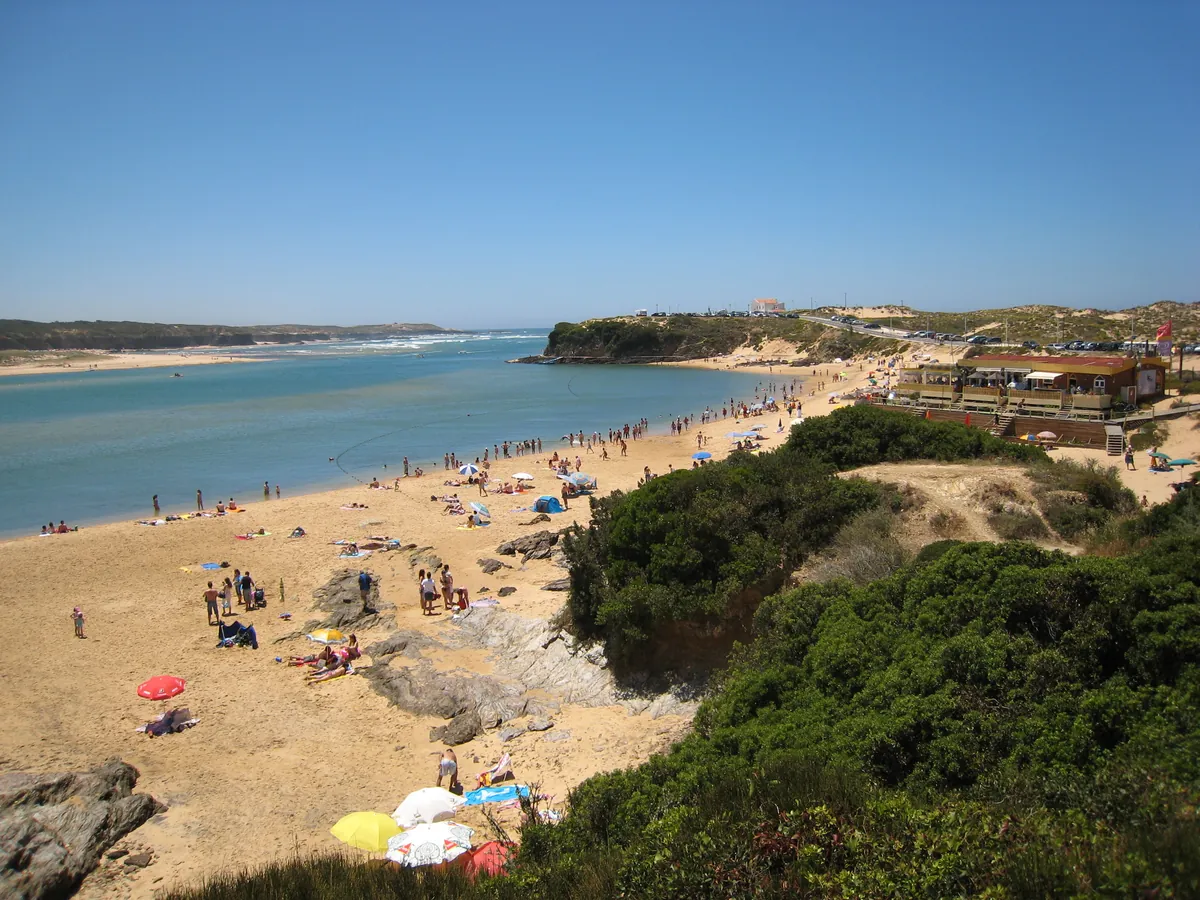
Praia da Franquia, inside the estuary, offers ankle-deep water and sand the colour of raw cane sugar — a kindergarten-safe lagoon where children chase translucent shrimp. Cross by dinghy to the southern bank and you reach Praia das Furnas, a sliver of charcoal cliffs pocked with sea caves the Atlantic has been drilling since the last Ice Age. Further west, Praia do Farol picks up the full Atlantic swell — surf territory, where wetsuited figures wait for the set like dark punctuation marks on an endless sentence. Inland, the Torgal stream has carved Pego das Pias, a gorge where water runs emerald between fern-lined walls of slate. A five-kilometre trail loops upstream to the Rocha de Água de Alto waterfall, a cataract that justifies the park’s extensive way-marked network. Bring binoculars: purple heron, white stork and, if the wind cooperates, the rare black stork that nests on the Vicentine cliffs.
The interval between two waters
At dusk the lighthouse throws a long shadow across the headland and the Mira’s mouth becomes a sheet of beaten copper. High tide stalls the river so completely it seems to hesitate, unsure whether to advance or retreat, as if it too must decide where it belongs. Walk the marginal and the granite paving still radiates the day’s stored heat. What lingers is not a postcard image but that moment of suspension — water neither fresh nor salt — and the almost inaudible rush of a thousand springs flowing somewhere beneath your feet, feeding the estuary, the town and every story told about them.