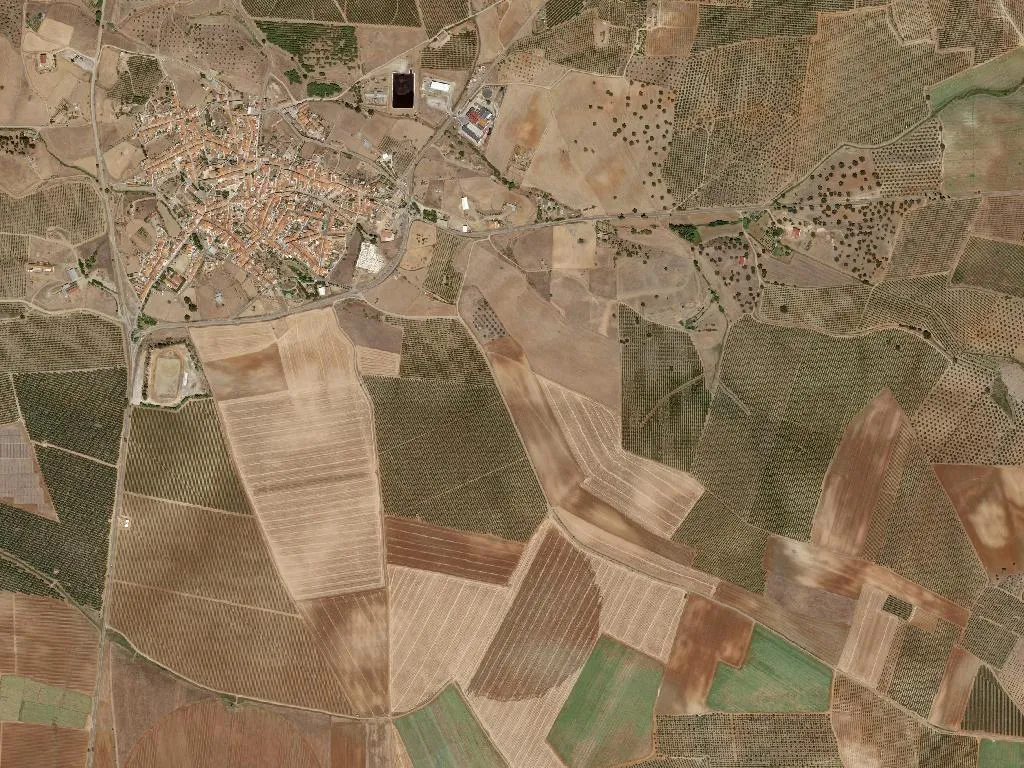
Full article about Brinches: Silence Carved in Cork & Iron-Rich Earth
Whitewashed hamlet inside Guadiana Valley Park where cork groves guard 16th-c. taipa farms
Hide article Read full article
Where the land breathes slowly
The silence of Brinches has a body. On an August afternoon it settles between the cork oaks like a held breath, thick enough to feel against the skin. Light falls in slabs, carving short, dense shadows the colour of burnt umber into the iron-rich earth. The name – from the Latin Brincus, “broken” – makes sense the moment the road begins to dip and rise: gentle tectonic wrinkles that rupture the Alentejo plateau without ever quite breaking it. In the hollows, winter streams leave pale riverbeds of shale; by midsummer they are dry arteries, whispering only when the wind moves the stones.
Oak woods with long memories
At the village centre, the parish church of Nossa Senhora da Conceição keeps the low profile demanded by rural Alentejo taste: whitewash, a single rectangular doorway, a bell that strikes the hours for people who refuse to be ruled by them. Sixteenth-century in origin, reshaped in the 1700s, the interior still gleams with a gilded baroque retable polished each December for the Feast of the Immaculate Conception. Around it, houses repeat the local chromatic grammar – white walls, cobalt-blue skirting – until the midday sun bleaches the palette to near blindness.
Brinches owns six listed buildings: the church, an eighteenth-century olive press at Monte da Quinta, and four fortified farmsteads – Herdade da Vigia, Herdade das Bicas, Herdade de Santa Teresa, Herdade do Juncal – erected after the 1496 expulsions re-ordered landholding in southern Portugal. Their rammed-earth walls – taipa of clay, straw and lime – have aged into geological strata: hairline cracks, lichen freckles, surfaces that exhale cool air at noon and release stored warmth after dark.
Within the Guadiana Valley Natural Park since 1995, the parish records a population density of barely ten souls per square kilometre. Great bustards, little bustards and black-bellied sandgrouse thrive among the cereal steppe and kermes oak scrub; all three demand silence and space, both of which remain in generous supply. The only soundtrack on the dirt lanes is the slow creak of cork trunks and, occasionally, the ceramic clink of a bell tied to the neck of a Merino ewe.
Flock flavours and slow cures
Sheep dictate the table. Lamb from the Baixo Alentejo herds – IGP-protected since 1996 – grazes freely among holm and cork oaks, its flavour steeped in thyme, pennyroyal and rosemary. Wood-oven roast or stewed with potatoes and coriander, it needs nothing more. Alongside comes Serpa DOP cheese, a soft sheep’s-milk round cured for thirty days and scooped, not sliced, onto crusts of durum-wheat bread. The obligatory glass is talha wine, fermented and aged since October in clay amphorae lined with pine resin, still made in the estate cellars.
Açorda – yesterday’s breadcrumbs, garlic, coriander, estate olive oil and a poached egg – arrives in terracotta bowls sturdy enough to survive shepherd and ploughman. Migas, fried bread tossed with pork from the Alentejo black pig, appears in autumn; between October and December the stewing pot holds hare or wild boar, braised with local talha red and bay leaves. These are dishes calibrated for labour that begins at dawn and ends at dusk.
Walking the broken ground
Distance here is measured by agricultural calendars, not watch hands. The Rota do Cortiço footpath (PR1, 8 km) loops through cork farms still stripped by hand every other May-to-August cycle, leaving trunks the colour of rusted iron. It passes the eighteenth-century chapel of São Brás, where until 1980 villagers gathered on 3 February to have their throats blessed against fish-bones and winter colds.
Dawn is the hour for bird-watchers: great bustards glide down to drink between Herdade da Vigia and the Ribeiro de Nossa Senhora, their wings whistling overhead. Binoculars, slow steps, the patience to wait out a little bustard’s metallic call from the stubble – these are the entry fee.
Sunset is less spectacle than chemical change. At 19:30 the light lies almost flat, gilding holm-oak shadows and turning dry-stone walls the colour of copper pennies. Heat drains quickly; night returns the deep hush, interrupted only by a distant guard-dog or the soft pop of cork logs on a hearth.
Carry away the scent of warmed soil, freshly stripped cork, cheese curing on arbutus-wood racks. Brinches is not a sight to tick off – it is a tempo you slip into, chew slowly, finish long after the plate is empty.