Full article about Pias: Where Serpa’s Bell Drifts Across Cork Oak
Morning chimes roll over whitewashed Pias, past Manueline doors and rosemary-laced lamb.
Hide article Read full article
The Bell's First Cry
The sun has not yet climbed high enough to warm the red dust when the bell of Igreja Matriz splits the morning. Sound travels differently on the Alentejo plain: the note leaves the belfry, ricochets off whitewashed walls and rolls out across cork oak until it simply runs out of land. At 163 m above sea level Pias is only a parish of Serpa on the map; in practice it is a place that still keeps its own time.
Stone & Faith in a Medieval Footprint
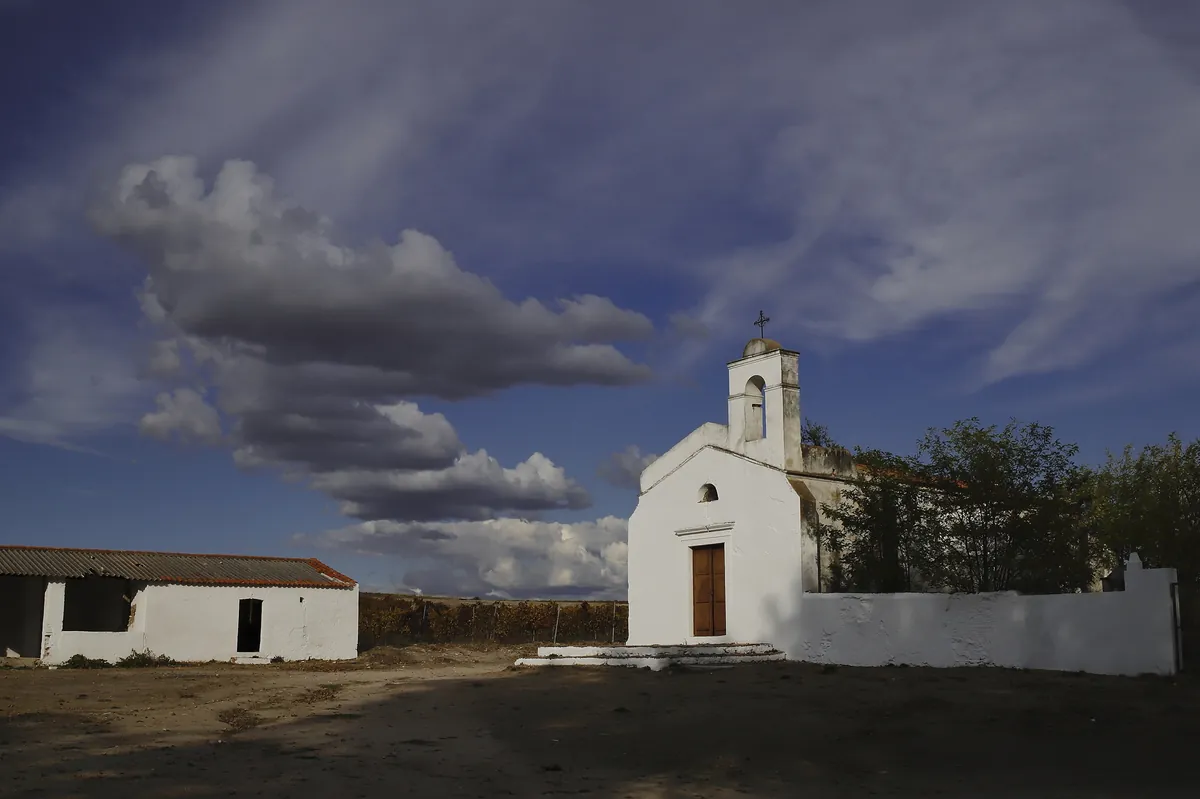
Local etymology claims the name from Latin pia, ‘pious’, but the voice you hear is granite. The Manueline doorway of the mother church looks piped from almond icing, yet it has presided over weddings and funerals since 1532. Inside, low light slips sideways across gilded altars the colour of the tissue Olga in the village shop uses to wrap bolo de mel. Next door, the chapel of São Sebastião is its blunt sibling: thick-walled, single-belled, the sort of building that wears espadrilles to Sunday mass. Together they stand like an elder brother who still presses his shirts and a younger one who never lost the habit of slippers.
Scents of Earth & Flock
The lamb on the table grazed the same montado where I picked níscalos last November. After seven hours in a pot with rosemary and an illicit extra clove it collapses at the sight of a fork. Ask for cheese and you’ll be served Helena’s three-month queijo de ovelha: wrinkled rind, butter-coloured centre, the exact texture of my grandfather’s hands after a morning’s ploughing. Eat it with bread that’s barely cooled, seated in the kitchen because the dining table is reserved for visitors who might still judge a house by its doilies.
Where the Guadiana Draws the Line
The river lies six kilometres east, but its influence pools everywhere. It decides which valleys stay green in July, where the wild boar cross, how high the medronho berries swell before they are spirited away for aguardente. A footpath drifts south from the Roman bridge to Mestre André’s ruined water-mill – four kilometres that take two hours if you pause to startle partridges and pocket sour pomegranates. At the end of the afternoon the low sun turns the soil into a copper bowl; storks on the far bank look suddenly porcelain against it.
Living to the Plain’s Pulse
Of the 2,542 inhabitants, 700 collect a pension and can price a loaf to the cent. Still, someone will rent you a spare room, someone else sets out pumpkin jam on Serpa’s Saturday market, and someone is carefully propping a ceiling that last saw paint under Salazar. Nothing stirs at three o’clock; by six, chairs migrate to doorways and the café fills with talk that stitches São Marcos to São Bento via the cost of diesel. When the bell strikes again everyone knows whether they are bound for the telejornal, the soap, or the terrace where red wine arrives in 200 ml glasses because that, apparently, is the law nobody wrote down.
Night-time switches the houses on one by one. When Sr Nunes’s dog barks at the moon the silence is almost chewable, textured by D. Idalina’s bed springs, the Beja train’s distant whistle, and the Guadiana’s murmur no one hears yet everyone recognises. Pias refuses to fit a brochure: it is tasted in a bowl of bread-thickened lamb, measured in a riverside walk, pocketed like the wax-paper wrap from a stick of Ela gum you find weeks later and still somehow smells of cinnamon.