Full article about Pedrógão: Where Silence Pours Vidigueira Red
Endless schist plains, seven souls per km², lamb roasted in rosemary smoke—Alentejo’s hush distilled
Hide article Read full article
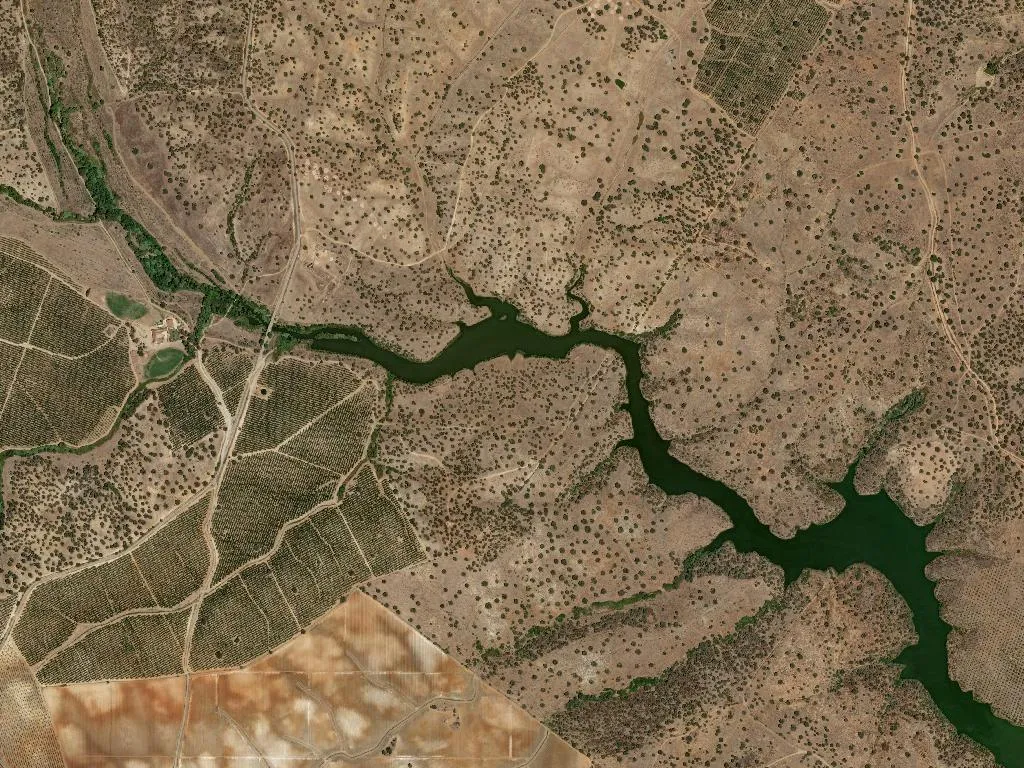
The plain opens like a sun-bleached theatre curtain, 12,000 ha of schist and clay across which barely one person roams for every football pitch of land. At 91 m above sea level, Pedrógão is neither valley nor hill, just a slow tilt of earth that lets the eye run uninterrupted to the Arraiolos-blue horizon. Wind combs the grasses; a skylark drops its silver chain of notes; a gate sighs on rusty hinges. That is the entire soundtrack.
Horizon Country
Seven people per square kilometre is not abandonment—it is acreage. Farmsteads sit so far apart that neighbours calibrate distance by the angle of the setting sun rather than metres. Dry-stone walls, the colour of week-old bread, parcel the land into olive groves, vineyards and cork fields where lambs wearing IGP ear-tags graze beneath holm oaks older than the republic. The parish council keeps the tally: 275 residents over 65, 99 under 25. Yet the hands that still prune, graft and pick know every fault line in the soil, every bend in the single EN road that stitches the properties together.
Come late afternoon, the light turns liquid. Whitewashed façades glow like heated brass; centenary olive trunks twist upward like black-ink calligraphy against a gilded page. Photographers talk of “golden hour”; here it feels more like a golden epoch.
What the Plateau Tastes Like
The menu is a topographical map. Olive oil stamped DOP Alentejo Interior is pressed less than 5 km from the groves you drove past, the mills still fragrant with crushed cobrançosa and madural. Borrego do Baixo Alentejo IGP—milk-fed lamb—spends its short life perfumed by wild rosemary and pennyroyal; after 90 minutes in a wood-fired bread oven it emerges tasting faintly of both. Add Queijo Serpa DOP, cave-aged for 60 days until its rind freckles and the interior relaxes into butter-coloured silk, and you have the region’s protected trilogy. Locals tear dense Alentejo bread, its crust sharp enough to tap like porcelain, and pour Vidigueira reds—Aragonez and Trincadeira grapes that soaked up 3,000 hours of sunshine and remember every one.
Dinner starts when the generator hum fades and finishes when the stars feel close enough to pocket. No one checks a phone; the only rush is the pouring of more wine.
Where Silence Checks You In
There are five places to stay, all private houses converted without surrendering their straw-coloured plaster or blue-striped lintels. Expect cotton sheets dried on lavender bushes, terracotta floors that drink the dawn chill, and swimming pools that mirror constellations undiluted by light pollution. Wake to roosters, not ring-tones; the louliest intrusion is the milk van rattling past at 6 a.m. One guestbook reads: “Finally heard myself think. Didn’t like the conversation, so I listened to the wheat instead.”
A Monument That Whispers
The 16th-century Igreja de Nossa Senhora da Conceição keeps its Manueline doorway low, as if bowing to the vastness outside. Rebuilt after the 1755 earthquake that rattled the Lisbon court 170 km away, it has no attendant, no ticket desk, no explanatory panel—just a key hanging from the presbytery next door. Inside, azulejo panels fade from cobalt to bruised lilac, charting centuries of drought, plague and stubborn continuity. The only other structure of note is the abandoned railway station, closed when the Sines-Beja line was truncated in 1987. Its platform clock stopped at 14:37, a minute that now feels permanent.
Stand there at dusk: the air smells of warm schist and distant woodsmoke; olive shadows stretch like compass needles across the dust. Somewhere a dog barks once, then thinks better of it. Pedrógão does not shout; it accumulates—layer upon layer of light, labour and quiet endurance—until you realise the plain has quietly entered your bloodstream.