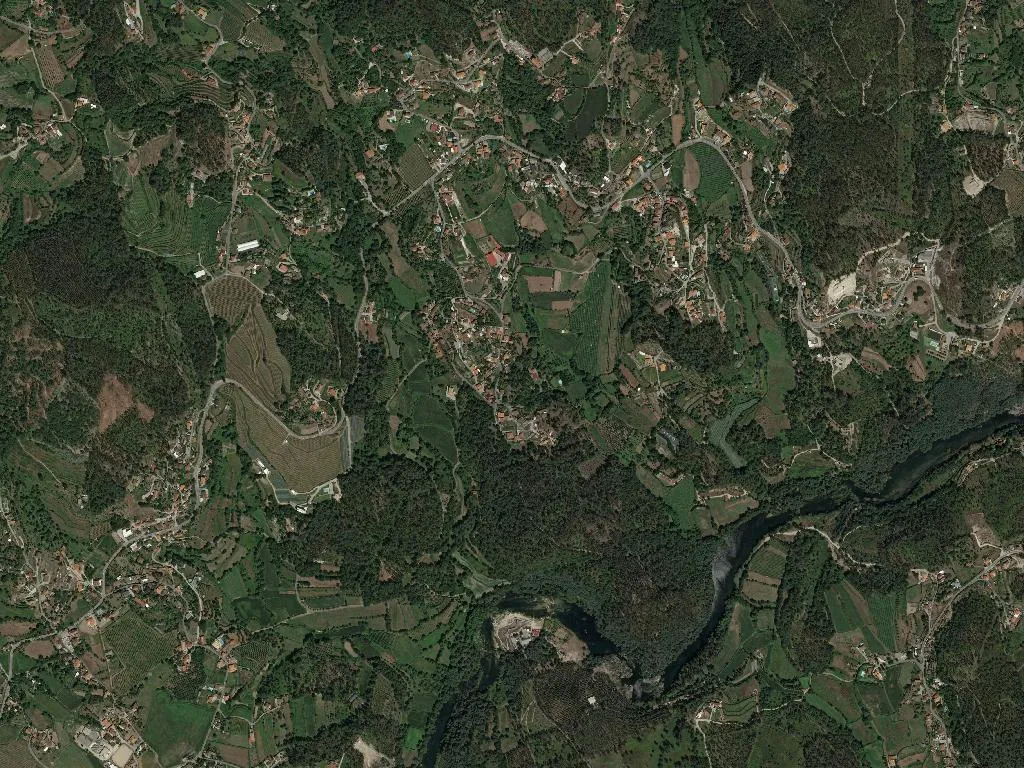
Full article about Goães: Where the Cávado Bends and Bells Echo
Bronze bells, stone bridges and blood-warm Sarrabulho scent this riverside village in Amares.
Hide article Read full article
The bronze bell of Santo António church—cast in 1893 by José Lopes, a blacksmith from the neighbouring hamlet of Rendufe—strikes three short notes at half past seven, its pulse rolling down the valley where the Cávado river bends in a stretch locals still call the “Devil’s Curve”. In 1978 floodwater lapped against the door of the communal granary; today the sluices of Vilarinho das Furnas dam, 14 km upstream, regulate the river’s sleep.
Stone, water and faith
Goães’ single-lane bridge, 68 m long and barely 4 m wide, first appears in a 1515 charter as a “new work of stone”. No devilry is recorded—only three maintenance contracts, signed in Braga in 1512, between the local Misericórdia and the farmers of Carvalheira. On the north parapet a 1742 stone cross marks the spot where villagers once paused to recite a rosary before driving their cattle across to the upland meadows of Carrazedo. On the south bank, the chapel of São Sebastião—rebuilt in 1698 over a medieval hermitage—holds blue-and-white tile panels attributed to the Braga wood-carver António de Oliveira Bernardo; two painted panels of St Blaise and St Sebastian were salvaged from the drowned convent of Vilarinho da Furna when the valley was flooded in 1892.
Green wine and Barrosã beef
Sarrabulho rice is thickened with pig’s blood curdled on the spot, sharpened with apple vinegar from the Fontaínhas estate and scented with riverside mint. Quantities are still reckoned in 12-litre copper pans inherited from October pig-killings; the DOP Barrosã beef—carrying slaughterhouse code 003/Braga—comes from the 28 producers who joined the Goães co-operative in 1996. “Branch wine”, a pale-green Loureiro, is trodden in open stone lagares built in 1947; the first glass is fortified with 52 % aguardiente distilled by Mr Aníbal in Rande.
Between river and ridge
The Goães footpath (PR 3) sets out from the 1953 primary school—boarded up since 1992—and climbs 240 m to the forecourt of Santa Bárbara chapel (GPS 41° 40′ 12″ N / 8° 19′ 45″ W). On 25 April 1974 fourteen tractors idled here for two hours, blocking the EN 308 and forcing the council to tarmac the long-promised lane to Carrazedo. At km 4 the trail crosses the Corgo levada, an irrigation channel built in 1928 and still fed by three working water-mills.
The Craft & Food Fair lands on the second Sunday of August: 72 stalls, 3 500 visitors, 650 kg of sardines trucked in from Matosinhos and gone by dusk. Competition baskets—40 cm mouth, traditional willow—are woven on a 1930s loom restored by the Oficina do Tempo after the death of Dona Emília, last of the home-based Goães basket-makers, born in Rande 1921.
Goães is absent from every guidebook. Its 490 inhabitants share 112 houses, and the Central café unlocks at 7 a.m. to dish out corn-bread from Caldelas before the 7.25 bus departs for Braga.