Full article about Airó: Bell Tolls Over Vine-Root Smoke
In Barcelos parish Airó, maize tunnels hide granite crosses and vinho verde vines
Hide article Read full article
Three tolls above the vines
The bell of Igreja da Exaltação da Santa Cross clangs three times, brittle iron notes that roll downhill and dissolve among the pergolas. It is May, and the air is laced with candle-wax dripping onto granite crucifixes set every few paces along the lanes. Airó—population 883, elevation 172 m—has spent the year shrinking, but for Festa das Cruzes the diaspora comes home. Heels clack on uneven cobbles, murmured litanies braid with the spit-crackle of kid roasting on vine-root embers.
The cross that christened the hill
Local etymology swears the village name is a fragment of Latin aerium, “high place”. Stand on the red-dust track outside the parish church and you will grant the Romans their point. Inside, the 17th-century Senhor da Santa Cruz—smoke-blackened, polychrome almost gone—waits for his annual procession. While the band strikes up, women drape family altars with wool bedspreads whose patterns arrived with their grandmothers from Brazil, France, the Gloucester construction sites of the 1970s. The rest of the year chapels such as São Sebastião stay locked; damp granite holds the ghost of last summer’s incense until the priest drives over from Barcelos, parks his Renault by the fountain, and remembers who married whom.
Between maize and vine
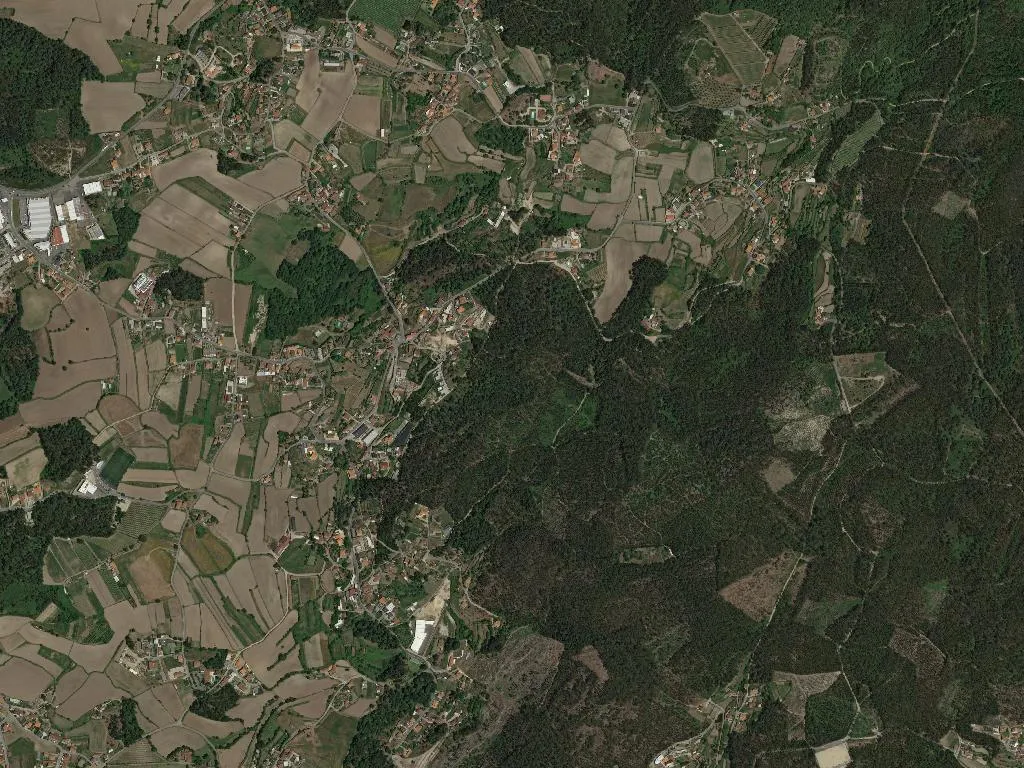
The hamlet sits in a bowl of smallholdings that supply quintas further north with Loureiro and Pedernã grapes for vinho verde. Dirt lanes climb to Oliveira and Tamel through schist walls quilted with moss. By June the maize is head-high, forming chlorophyll tunnels that hiss when the Atlantic breeze sneaks inland. The Portuguese Central Way of St James cuts across the parish, but waymarking is erratic; walkers pause at the churchyard spring, fill bottles, ask hopefully about coffee, discover there is none, and march on towards Barcelos with soles dyed ochre.
A grandmother’s lunch, not a menu
There is nowhere to book a table. Instead, a nephew rings the changes on the church bell at eleven, and by half-past the wood-fired oven behind the house releases a joint of kid whose crackling has the colour of vintage Madeira. Sarrabulho—pork-blood porridge shot through with cumin and lemon—arrives in clay bowls hot enough to brand fingers. The red on the table began life in the same valley, ferried in former Fanta bottles, topped up from a demijohn that rattles in the back of a 1995 Transit every Wednesday. For pastries you drive fifteen kilometres to Barcelos courthouse square where Pastelaria Popular still pipes queijinhos do céu from a recipe Sister Lucília copied out for the owner in 1958.
Silence reinstalled
When the last brass chord dies and the bunting sags, Airó contracts again. Granite houses painted Ministry-of-Agriculture blue are shuttered, their front doors sealed with corrugated iron. Yet memory persists in the hinge that squeals exactly a semitone lower than the bell, in the mongrel that barks only at diesel engines, in the wine stain on beaten earth that refuses to wash away. Someone has to stay behind to notice.