Full article about Alvelos: May arches, marigolds & Loureiro clay bowls
Pilgrims’ footfalls echo past 1753 stone crosses, green-festooned church arches and sizzling Barcelo
Hide article Read full article
A yellow arrow painted on a granite wall at the corner of Rua do Cruzeiro points north. Halfway down the lane a pilgrgrim pauses, re-tightens his rucksack, then lets the staff tap out a slow rhythm across the uneven slabs. The sound drifts between dry-stone walls and the trellised vines of Quinta do Outeiro, then dissolves into the May-morning hush. Alvelos greets walkers bound for Santiago with the same discretion it greets dawn: no fanfare, only low light grazing the churchyard and the 1753 cross where someone has laid a fistful of wild marigolds.
Green arches and May crosses
On 3 May the parish changes tempo. Men haul leafy branches to the door of Igreja Matriz da Senhora das Dores—rebuilt in 1727 after fire gutted its predecessor—and bind them into a living arch. The Festa das Cruzes begins: bass drums from the local filarmónica answer the piped cadences of Domingos Araújo, a bagpieter from neighbouring Tamel. The procession slips down Rua da Igreja, past the Casa do Morgado (once the tithe collector’s seat) and up to the granite cross. Smoke from chouriça de Barroso curls around the vines just coming into flower. The following Sunday Father Fernando Lima, parish priest since 2018, traces the lane between farmsteads to bless the fields, walking from the chapel of São Bento to the Loureiro vineyard at Quinta da Veiga, a route mapped out long before barbed wire.
Loureiro in a clay bowl
The village has two taverns worth knowing. O Cantinho keeps Thursday to itself; the action is at Tasca do Zé Manel on the corner of Rua da Fonte and Rua do Outeiro, open since 1987. Loureiro grapes, picked from the Gomesplot that borders the stream, arrive in rough clay bowls made in nearby Vilar de Nolias. Dona Alda rules the kitchen: rojões à moda de Barcelos laced with smoked belly from Quinta do Outeiro, sarrabulho rice darkened with January pig’s blood, and rice black pudding from Sr. António’s counter. On the football pitch behind the co-operative, the Residents Association lights a November magusto: chestnuts from Serra da Franqueira, jeropiga drawn straight from Lagar do Outeiro, three generations circling the embers.
Stone, water and open sky
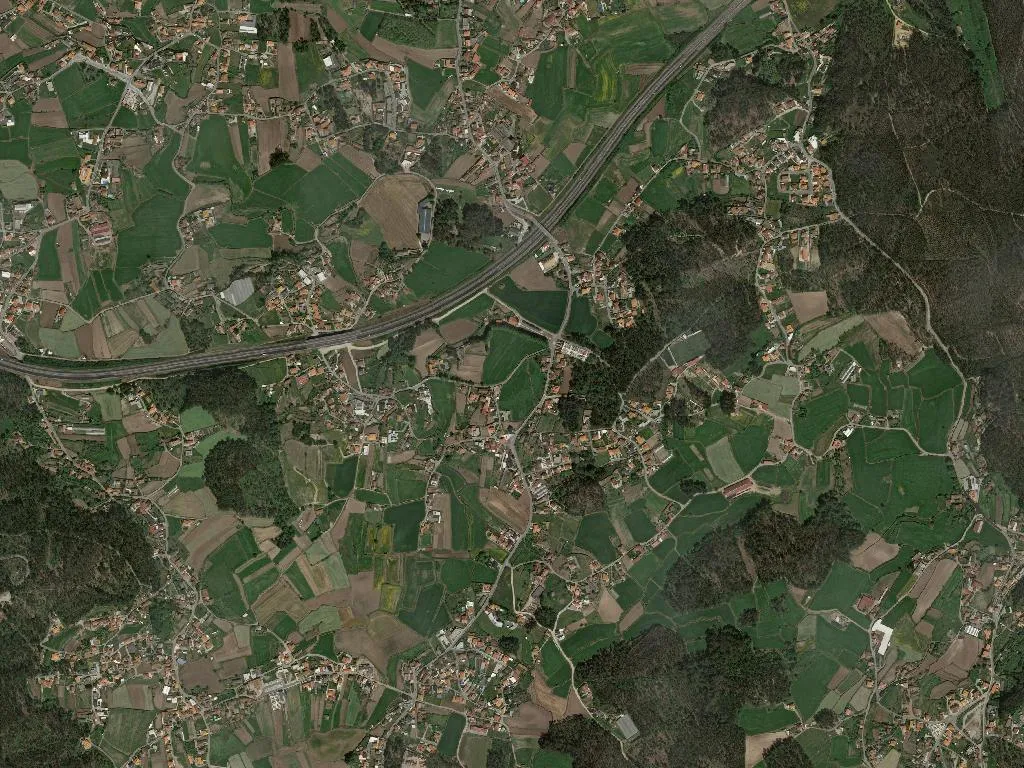
The Três Moinhos footpath drops to the Alvelos stream and the broken watermills that once ground local maize until 1963. Water slides over rounded granite, pooling long enough for willows to admire their own reflection. The climb continues through eucalyptus planted on Serra da Franqueira in the 1970s, then breaks out onto a balcony above the Cávado valley: Gerês on the horizon, maize rectangles stitched by dry-stone walls raised between 1850 and 1920, ancient oaks still marking the boundaries fixed in King Dinis’s 14th-century charter.
Tools that outlived their makers
Inside the 18th-century granary restored by the parish council in 2019 you’ll find a domestic museum of sorts: Maria da Conceição’s spinning wheel (1887-1978), ox-yokes from Sr. Albino, forged mattocks from the Barral smithy in Vila Verde. Together they catalogue the labour that shaped these 338 hectares lying only 72 m above sea-level. In the parish archive the place surfaces as “Alvellos” in a 1527 baptism, “Alveos” in a 1741 deed when the Morgado sold land to Vilar de Frades monastery. Scholars trace the name to the Latin alveus—riverbed—yet older locals still say “Álvélos”, stressing the first syllable.
When darkness settles and the last pilgrim’s staff has vanished beyond the cross at Rua do Outeiro, Alvelos keeps a quiet pulse: the stream whispering between the Veiga and Outeiro farms, the iron gate of Casa do Morgado giving its habitual groan, Bobi the mastiff announcing every shadow across the Costa threshing floor. Somewhere a tinny rattle drifts down the lane—Américo’s handmade waymarks, nailed up in 2014 when the council way-signed the Portuguese Caminho. The little yellow arrows glint beneath the moon, insisting that routes may pass through a village without rubbing it off the map.