Full article about Cossourado: mist, vines & footfalls in Barcelos
Granite lanes breathe Atlantic mist as pilgrims pass silent vineyards in Cossourado, Braga.
Hide article Read full article
The damp cobbles of early morning mirror a pewter sky over Cossourado. Footsteps clap against whitewashed walls, the only punctuation in a silence so thick you can hear the granite breathe. Somewhere below the lane the Covas stream mutters, and Max – Sr Arménio’s Labrador-cross – fires off a half-hearted volley at a sparrow. Atlantic mist clings to the vines, carrying the scent of turned earth and the faint, sweet smoke of oak that still feeds the village’s remaining salamanders; open fires were outlawed decades ago, but nobody told the salamanders.
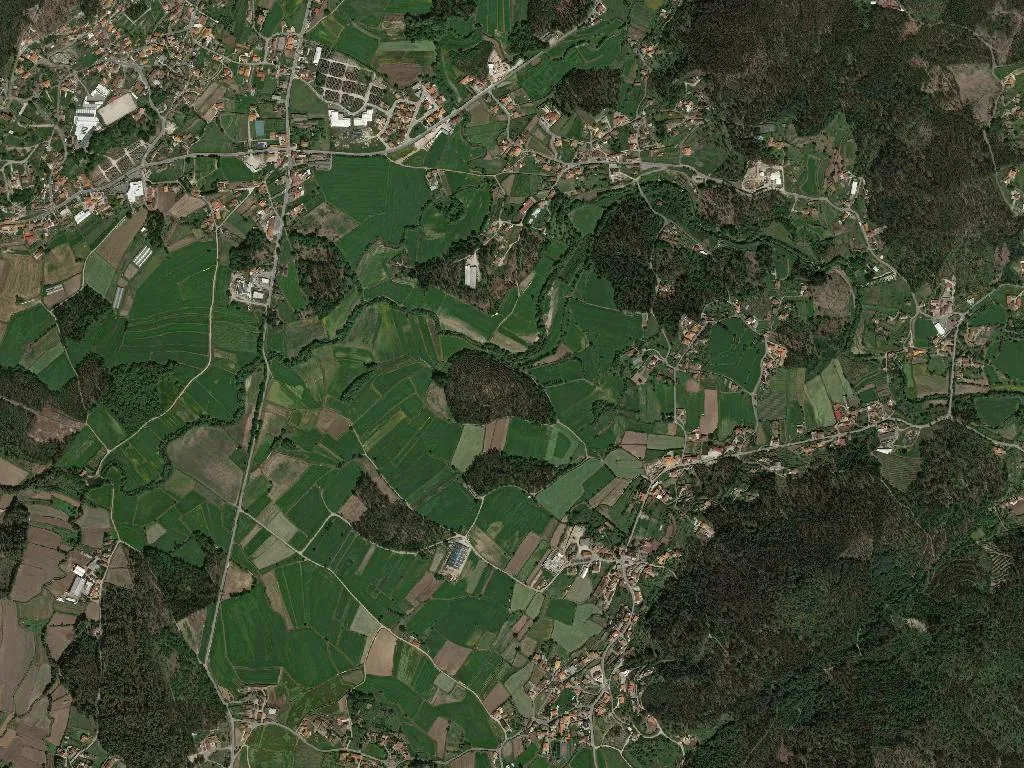
Cossourado is a parish of 758 souls spread across barely six square kilometres. The density looks reasonable on paper, yet between the houses lie cow-clearings, marshes and pergola-trained Vinho Verde vineyards that insist on breathing space. At only 66 m above sea level, the village sits on a climatic seesaw: maritime humidity drifts inland from the coast 35 km away, but is already surrendering to the minerality of the Cávado valley.
The path that passes through
The Central Portuguese Way of St James cuts straight through, funnelling hikers northwards towards Ponte de Lima and, eventually, Santiago. There are no souvenir stalls here; just a granite trough where pilgrims fill plastic bottles, and the parish hall’s porch that offers five minutes of shade before the next 12 km. Irregular cobbles and a faded yellow arrow guide them past plots of kale and geese that eye the rucksacks with professional suspicion. Overhead, the vines form green tunnels – a living pergola system invented so fieldhands could work without wilting. One tunnel belongs to Sr Augusto, whose grandchildren now live in Bordeaux; the grapes still ripen, but no one harvests them.
Crosses and the calendar
Every 3 May the Festa das Cruzes re-anchors the village to its own heartbeat. Hand-painted wooden crosses – paper dahlias in spring, hydrangeas in summer – appear at lane intersections, stone niches and garden gates. It is less procession, more collective housekeeping: the same families carry the crosses, the same alto voice intones the litany, the same lightly-carbonated Vinho Verde is poured at trestle tables under mulberry trees. Alzira still bakes the parish’s folar, an anise-scented loaf, though she now drives to Barcelos for yeast; the village shop closed when Dona Rosa retired.
The weight of age
Demographics here are brutally legible: 170 residents are over 65; 91 are under 14. The primary school shut in 2012; at 07:00 a single bus ferries the children to Barcelos, and not all of them come back. Those who stay prune vines, keep a pig or two, and patch the roofs their grandparents tiled. Four officially registered guest rooms absorb the overflow from overbooked Ponte de Lima – usually walkers grateful for a mattress and a clothes-line. You are eight kilometres from Barcelos’ Wednesday market, far enough for the sound of amplified folk music to arrive only when the wind is wrong.
The stuff of the place
Granite is the local vernacular: terrace walls, cottage foundations, 18th-century calvaries the colour of stale honey when dry, gun-metal when wet. Roofs are scaled with small, red ceramic tiles that have turned north-facing slopes into slow-motion meadows of sulphur-yellow lichen. In vegetable plots, Galician kale stands to attention; in smoke-blackened sheds, chouriço darken over smouldering pine needles. Sr Albano still fires the communal bread oven every Friday, but you must order your corn loaf by Thursday noon or go without.
Late afternoon, when the sun lies sideways across the trellises and every clod of earth casts a shadow twice its length, Cossourado reveals its contract with time: the essential remains – stone, vine, path – while the incidental quietly retires. You hear Carlos’ hammer repairing a wine press; you smell dinner climbing the chimneys – bean rice or turnip broth, depending on the month – and you understand why no one here has ever needed a watch.