Full article about Fragoso: Where the River Cracked the Valley
Bronze bells echo above terraced vines in this Barcelos hamlet threaded by pilgrims' paths.
Hide article Read full article
The valley that cracked open
The bell of São Pedro strikes six, and its bronze note rolls down the limestone amphitheatre, ricocheting off Loureiro terraces before dissolving in the bend of the Fragoso. On the granite steps of the 16th-century cruzeiro, Zé locks his adega for the night, lights a cigarette and watches the last gilt slip from the alluvial fields. Oak smoke and grape must mingle in the air; at 60 m above sea-level, time is calibrated by the harvest, the December pig-killing and processions that have kept their own unhurried tempo since the thirteenth century.
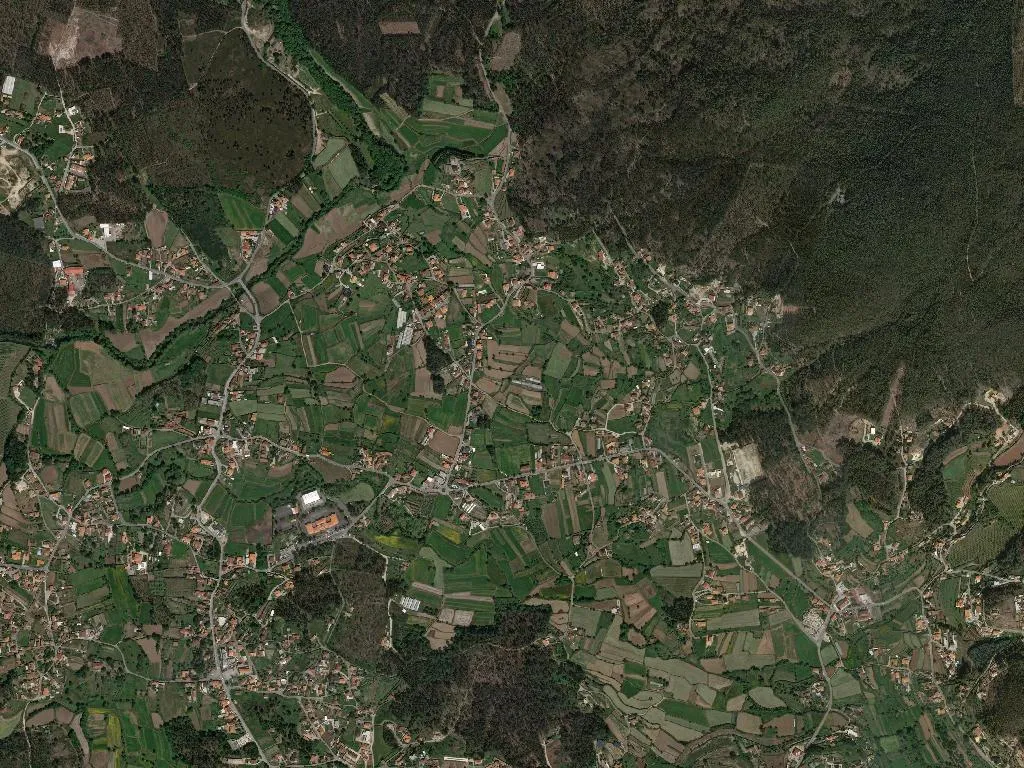
The name Fragoso derives from the Latin fractus – broken – and a glance at the ordnance map explains why. The river has sawn the valley into a staircase of fertile shelves, then sheered upwards to the 180 m ridge of the Serra da Quintela. Settlement clung to the church recorded in 1220, and the baroque façade erected two centuries later still carries a gilded rocaille retable that catches the low winter sun. The 1740s bell tower counts the hours for 2,069 souls spread across 1,258 hectares of minifundios whose vines supply some of the lightest, most aromatic Vinho Verde in the demarcated region.
A single-arch medieval bridge, its granite blackened by moss, carries a 1623 Latin inscription that anathematises anyone who levies tolls on passing Santiago pilgrims. Reading it aloud is thought to guarantee safe passage to Compostela; walkers still pause, fingertips tracing the worn seriphs, before following the 4.5 km way-marked stretch that zig-zags between schist walls and cork oaks older than the route itself. Seven stone crosses, erected between 1550 and 1750 to deflect hail and plague, punctuate the parish; village women still cross themselves as they pass.
Smoke, wine and sung poetry
On the third Sunday in May, the Festa das Cruzes turns the parish into an open-air theatre. Flowered crosses are shouldered to the wheeze of concertinas, bonfires flare in the lanes and skewers of chouriço are handed round with scalding kale soup. At dusk the Cântico das Vinhas – a call-and-response chant in Latin and Portuguese, inscribed on the municipal heritage list in 2018 – rises from the threshing floor where men stamp out the circle-dance and women flick white embroidered scarves. In late June, the Romaria de São Pedro stages an outdoor mass followed by a flotilla of boats decked with laurel and paper garlands; afterwards, the parish council auctions the finest blood-pudding or longest-cured salpicão to raise funds for the fire brigade.
During the winter matança, communal barbecues glow through the night. Kid goat, basted with Loureiro and slow-roasted over oak, shares the table with sarrabulho – a mahogany-coloured rice stew thickened with pig’s blood, lard and home-smoked sausage. In October, chestnut soup sweetened with port takes the chill off foggy afternoons, and the local meringue kisses called suspiros, scented with lemon zest, appear beside the first bottles of green wine. Knock on Sr Joaquim’s door in Rua da Igreja; he will wipe the cobwebs from the Riedel glasses his wife reserves for guests and pour a vintage whose acidity tastes like bottled lightning.
Between vines and pilgrims
The signed Fragoso–Quintela trail climbs eight kilometres of mule track, passing manor houses built from honey-coloured granite with timber balconies and gall-oak woods where lesser horseshoe bats hawk above the trellises. From the ridge, the Cávado valley unrolls in a patchwork of malachite and umber, spiked with bell towers and thin plumes of wood smoke. Binoculars may pick out great bustards or azure-winged magpies among the eucalyptus, or the blunt head of a water buffalo wallowing in the river’s inside bend.
On Thursdays, Dona Alda fires the communal bread oven, teaching visitors to mix maize and potato-flour broa with a sour-dough started in the 1950s. Kayaks can be rented for the three-kilometre paddle to the confluence with the Cávado; pack a chilled bottle of Loureiro and a disk of transhumant goat’s cheese wrapped in chestnut leaves. In the pottery atelier, Sr Alfredo throws clay dug from the riverbank and fires it in a kiln fuelled by vine prunings; the scent of baked earth drifts across the lane. Official opening hours are Wednesday and Friday, but tap on the blue door any afternoon and mention this article – he will wipe his hands on his apron and let you in.
When the low sun grazes the bridge and the bell tolls again, someone always pauses to read the Latin curse aloud, testing the old superstition. The echo lingers, as though the valley hoards every voice that has ever passed through – pilgrims, vineyard labourers, conscripts who sailed for Angola and never came back. Below, the Fragoso keeps its own counsel, carrying away vine leaves and unwritten histories on its slow slide to the sea.