Full article about Dawn footfalls & floral crosses in Negreiros e Chavão
Negreiros e Chavão parish wakes with pilgrims, Loureiro grapes and flower-dressed crosses on the Central Portuguese Way
Hide article Read full article
Pilgrims at First Light
Dawn over the Lima valley arrives with footsteps. Not the scrape of tourist boots, but the soft, measured cadence of someone who has already walked thirty kilometres since Vitorino dos Piães. His scallop shell clicks against the zip of a canvas pack; the sound drifts through the lanes of Negreiros e Chavão like a metronome keeping time for the entire parish.
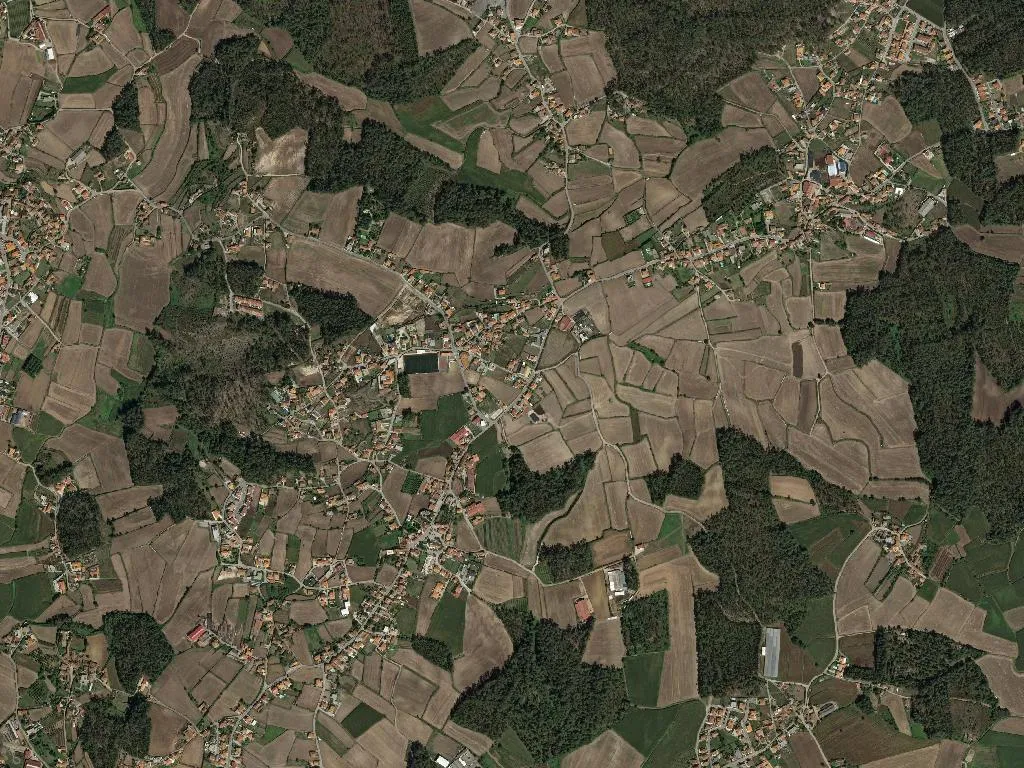
The Central Portuguese Way cuts a quiet diagonal across these 696 hectares, stitching together two settlements that were merged in 2013 yet have shared the same granite breath for centuries. Locals still call them separately—Negreiros first, Chavão second—because habits here are older than municipal maps. The name Negreiros itself is a palimpsest: medieval Latin documents speak of “Nigrolarium”, later softened by Moors and then by wine traders who needed a single syllable to shout across a tavern. Etymologists argue; the soil keeps the secret.
Altitude is a modest 124 metres, enough to lift the Atlantic breeze over the ridge and spill it into the vineyards. Loureiro and Arinto occupy the lower terraces, their canopies trained on high pergolas so that maize or potatoes can still grow underneath—a Roman trick re-legalised in the eighteenth century when the Marquis of Pombal demarcated Vinho Verde. The resulting wine is almost transparent in the glass, with a prickle of CO₂ that makes Portuguese sommeliers call it “green” in colour, not flavour. Acidity is razor-bright, built for the region’s other constant crop: salt cod, hung in open-air lardies after Easter and shaved into caldo verde soup at every festa.
When Crosses Dress Up
On the first weekend of May the parish council loans out boxes of artificial dahlias and lengths of crimson ribbon. Overnight, granite calvaries along the lanes transform into floral exclamation marks. The Festa das Cruzes began in 1783 after a spring drought ended the moment a wooden cross was carried from Chavão to the river; the rain arrived before the procession returned. The modern version is smaller—2203 inhabitants, 288 under the age of fourteen—but the logistics remain medieval. Every household contributes: one trims hydrangeas from the garden, another lends an embroidered linen tablecloth to drape over the pedestal, the bakery supplies massa folhada pastries that pilgrims wolf down with tiny cups of sour espresso.
By ten o’clock the brass band from Barcelos has marched up the N203, drums echoing off schist walls. They pause at each crossroads long enough for the priest to spritz holy water and for the children to launch another volley of petals. The density—316 people per square kilometre—means front doors become theatre boxes: grandmothers in black wool cardigans, toddlers clutching plush sardines, a teenage trumpeter checking WhatsApp between hymns.
Texture of Time
There is no single postcard view, and that is the point. History here is granular: the way a threshold has been worn into a smooth saddle by four centuries of boots; the faint smell of diesel on a farmer’s jacket that still carries the 1950s parish coat of arms. The municipal tourist office in Braga lists no museums, no interpretative centre. Instead, you are directed to a 1:25,000 topographic map and invited to walk.
Start at the thirteenth-century pillory in Negreiros—its granite phallus carved with the Portuguese shield—and follow the red-and-yellow scallop shells painted on electricity boxes. After two kilometres the tarmac surrenders to a dirt track that smells of crushed fennel. On the left, an irrigation tank glints like polished pewter; on the right, a row of pollarded willows marks the boundary of a quinta whose wine is sold only to restaurants in Porto. You will meet no one, yet the landscape is conversational: a tractor idling in neutral, a nightingale rehearsing scales, the low hum of a refrigerated lorry taking grapes to the cooperative press in neighbouring Barcelinhos.
Dusk is the loudest silence. The sun tilts, and every vine row becomes a fibre-optic cable of light. Wood smoke rises from chimneys built too wide for modern stoves; someone is burning old pergola posts, the resin popping like chestnuts. A pilgrim passes beneath the window, head-torch off now, relying on the after-glow. His rucksack squeaks once—adjustment of hip-belt—then the lane swallows him. The parish has resumed its default rhythm: inhalation of cool Atlantic air, exhalation of history that refuses to be archived.