Full article about Bells & blue bunting still bloom in Vila Frescainha
A vanished parish that keeps baptising children, dressing crosses and pouring Loureiro
Hide article Read full article
The bronze bell of São Pedro strikes the hour and the sound rolls across low vineyards and waist-high maize. It is early May, the month when every wayside cross in Vila Frescainha is dressed—cotton bunting in kingfisher blue and sunflower yellow, jars of wild margarids wedged into the stone. Administratively the parish vanished in 2013, absorbed into a larger municipality, yet the bells still ring and the crosses still bloom, as if cartography were a trivial detail.
When a parish disappears but refuses to leave
A royal charter of 1220 granted these lands to the Benedictines of Tibães; for the next eight centuries Vila Frescainha São Pedro baptised its children in the same granite basin. The merger merely turned the parish council into a parish assembly—same church, same priest, same baroque retable glittering in candle-light. Manueline rope moulding winds around the south door; inside, cherubs balance on gilded brackets, their cheeks flushed with 18th-century varnish. Sunday mass still ends with the congregation spilling onto the steps, blinking in the bright Minho sun.
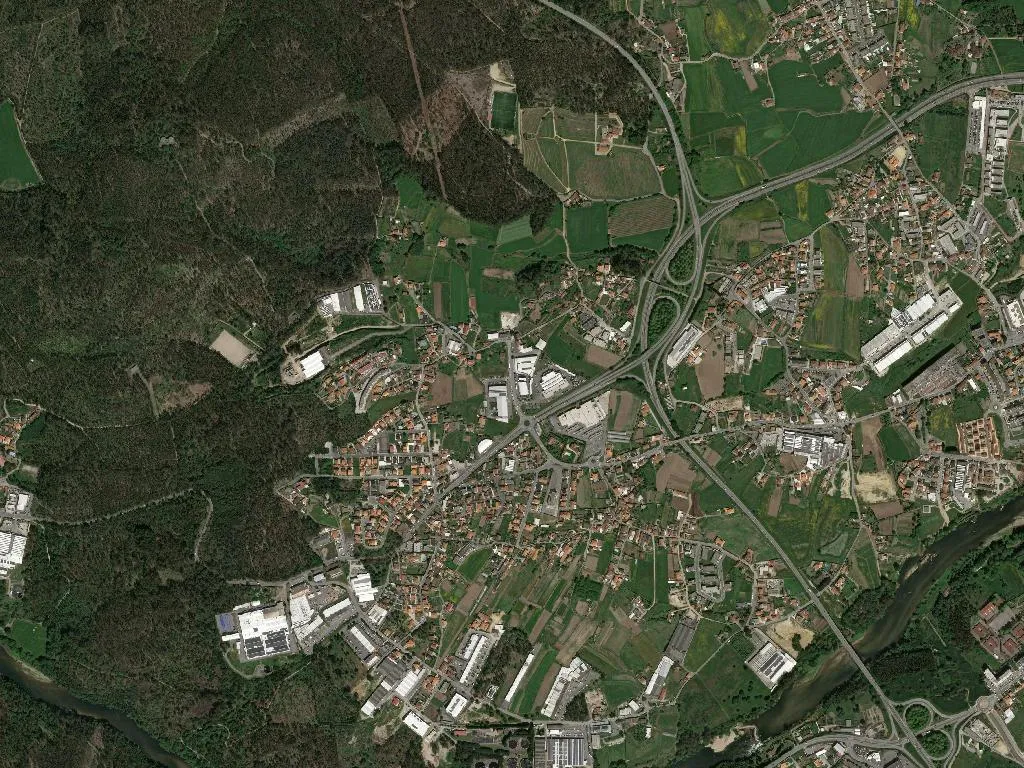
The land lies only 53 m above sea level, a fertile saucer between the Cávado and its tributaries. No granite massifs here, just an orderly checkerboard of vinhos verdes plots, maize stripes and orchards of late orange. Along the lanes, pilgrims on the Central Portuguese Way refill plastic bottles at 17th-century fonts before continuing westward between trellised rows of Loureiro grapes.
Sarrabulho rice and the sharp white of Loureiro
Kitchen logic is rural algebra: every part of the pig must equal a plate. Sarrabulho—rice simmered in pork blood, cumin and a splash of red Vinhão—arrives the colour of wet terracotta. Caldo verde glows olive-green in terracotta bowls; crackling-roasted kid appears on feast days. Dessert follows the conventual rule of yolk and sugar: queijinhos do céu, little cheese-clouds that dissolve on the tongue. The wine, poured short in tumblers, is either white Loureiro (lime zest and laurel) or the inky Vinhão whose tannins taste of iron and wet slate. In sideboard drawers, bottles of bagaço brandy and home-grown herb liqueur wait for the espresso cup.
Festa das Cruzes and wooden-masked Entrudo
May’s Festa das Cruzes turns the lanes into an outdoor nave. After the procession, the village band strikes up a vira; smoke from chouriço skewers drifts across the churchyard. At Entrudo—the pre-Lenten carnival—hand-carved mahogany masks appear, some with cow horns, others painted with gaping grins. The tradition predates confetti; anonymity is protection against small-town memory, and the drums echo the same syncopation recorded by 19th-century ethnographers.
Walk the tracks between quintas at dusk and you trespass on a cultural landscape that needs no UNESCO badge. The gilt of São Pedro’s retable catches the last light; May fabrics flutter like prayer flags above the maize. Vila Frescainha may be gone from the atlas, yet its coordinates remain fixed in stone, soil and the sharp, green taste of wine that bites the back of the throat.