Full article about Woodsmoke & basil in Escudeiros e Penso
From Roman road to chestnut São João fires, Braga’s twin villages live by bell, vine and procession
Hide article Read full article
Woodsmoke and Cornbread at 11 o’clock
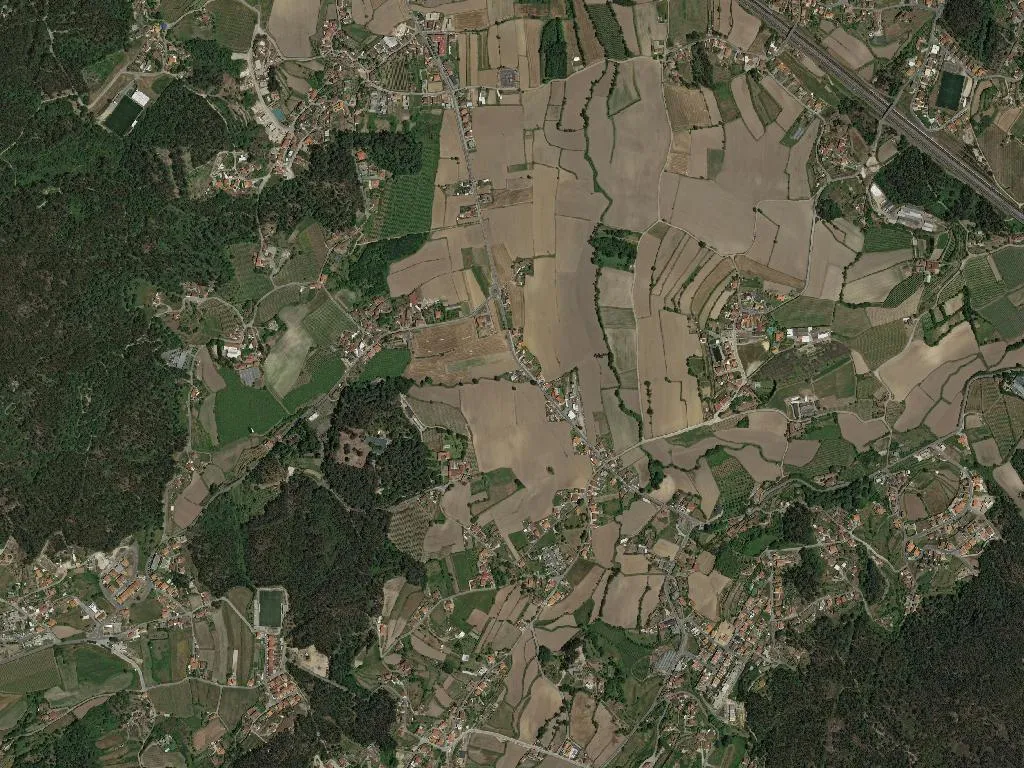
The drift of woodsmoke meets the hot exhale of cornbread as the bell of Santo Estêvão strikes eleven. On terraces that tilt down to the Cávado valley, granite walls wear a skin of moss and fuchsia-pink bougainvillea, and the twin settlements of Escudeiros and Penso keep time by farming calendars: the grape harvest in September, the night-long blaze of São João on 23 June, the procession of St Vincent that inches down Rua do Monte every 22 January.
Knights, charters and a 13th-century paper trail
“Scutarios” first appears in King Afonso III’s 1258 royal inquest – the squires who rode escort for Braga’s archbishop. Penso, recorded as “Pencio” in 1220, kept its own parish council until the 2013 merger that clipped its autonomy. The church facing Escudeiros’ small square was rebuilt in 1727, yet its Manueline cross still marks the vanished graveyard; documents reach back to 1151. Across the lane, Penso’s Igreja de São Vicente, cited in the 1515 town charter, shelters parish registers that open in 1703 with spidery brown ink.
The parish road that threads the two settlements overlays a Roman line from Bracara Augusta to the Atlantic. No interpretation boards announce the fact; you read it in the two-metre drop between Rua da Igreja and Rua do Cruzeiro, in the chestnut rails that divide vineyard plots, in the worn cubed stones surviving on the final bend of the EM-1337.
Fires, basil and processions measured in metres
On 20 June the Irmandade de São João gathers in Escudeiros’ community hall to stack the twelve bonfires that will burn three nights later. The tallest – 3.5 m – is built from chestnut logs stored since January. The following afternoon someone drives to Braga market for manjerico, the potted basil sold with paper flags: “Para o meu amor”, “Lembra-te de mim”. At 15:30 on 22 January the clergy of Penso shoulder the statue of St Vincent and walk 800 m to the Espírito Santo chapel on the hillock of Outeiro, where fields are blessed before spring sowing.
August belongs to the Festival da Broa. In 2023 the parish council sold 800 corn loaves on the opening evening – each 400 g, 45 minutes in the wood oven of Restaurante O Brasão. The local brass band, founded 1887, strikes up the “Hymn to Cornbread” composed by Penso-born José Maria Costa in 1956; the tune is mercilessly catchy.
Lunch is late if the kid hasn’t crisped
José Barbosa lights his kiln at eight. By noon the kid goat emerges, skin blistered to bronze, scented only with garden rosemary and sea-salt. “Never open the oven in the first three hours,” he warns, though every cook in the room already knows. Wild-boar rojões arrive in the same copper pot his grandmother used for sarrabulho – a porcine blood stew thickened with cornmeal. The green wine poured alongside is from Quinta da Levadia, two kilometres away: 11 %, 2022 harvest, bottled last February.
At Padaria Silva, in business since 1942, Albertina rises at 04:30 to coax 80-year-old natural leaven with maize ground at Escudeiros’ own watermill and water from Penso’s spring. One hundred and twenty broas leave the oven by seven; they cost €1.20 and are normally gone by tea-time. The toucinho-do-céu – a rich yolk-and-almond tart – is made with eggs bartered for a bag of muscovado from the neighbour’s hens, while honey from the high Minho arrives via the Amares co-operative.
Way-markers for walkers and a cast-iron bandstand
The Portuguese Coastal Camino enters over Penso’s single-arch Roman bridge, crosses the EM-539 and climbs the boulder-strewn footpath signed “Penedo”. Pilgrims pause at Escudeiros’ 1928 fountain – “Água potável” still legible on the granite – to refill bottles and tighten the straps of sandals cut from car-tyres. Last year the volunteer fire brigade logged 2,847 walkers; the nearest dormitory is 12 km away in Barcelos, so house number 47 on Rua do Castanheiro keeps a plastic jug of cold water on the step and a handwritten note: “Keep straight, turn at the Senhora da Saúde chapel.”
Evening brings the municipal bus up from Braga. Twelve passengers step into the square: three returning from hospital, two laden with supermarket carrier bags, seven day-shift workers from the Caldas das Taipas textile plant. The cast-iron bandstand – a gift from parish priest Américo in 1903 – is the obvious rendez-vous. Albino walks the same terrier at 19:30, Rosa waters her vegetable rows before lunch, Carlos closes the café at 22:00 sharp, except on Fridays when there’s football on the television.