Full article about Abadim: Dawn on Granite, Smoke in the Air
São Bartolomeu’s lone bell rolls over 739 m of moss-softened stone, calling 472 villagers to porridg
Hide article Read full article
Dawn slips in sideways through chinks in the granite, igniting quartz flecks and throwing the moss that colonises every north-facing wall into vivid green. At 739 m, Abadim wakes to the single toll of São Bartolomeu’s bell – a sound that knows every one of the 472 souls here and refuses to hurry them. The air is sharp enough to scrape the throat; it tastes of wet schist and of oak smoke curling from chimneys built long before insulation was imagined.
Stone that remembers
The parish church, erected in 1751 on the footprint of a 1270 chapel, still forms the village’s centre of gravity. Around it, a constellation of smaller shrines – Nossa Senhora dos Remédios (1852), stone calvaries smothered in lichen – maps out a devotional geography older than any road sign. Opposite, Casa do Outeiro keeps watch with its nineteenth-century bell-tower, a relic of the rural manor system that survived here until the 1974 land reforms. No interpretation boards interrupt the walls; you read the place through texture instead: midnight-blue slate, once-white limewash now the colour of old pearls, and timber doors split by decades of mountain freeze.
Feasts that still pull people home
Three times a year the hamlet reassembles its diaspora. On the Sunday closest to 20 January, the Festa das Papas fills the lanes with the smell of smoked sausages and the clatter of ladles in iron pots of salty corn porridge. In early September, eight bearers shoulder the painted throne of Nossa Senhora dos Remédios down the lane from her chapel to the mother church, singing a chant answered only here. On 24 August, farmers arrive clutching straw hats for the “benediction of the helmets” before the maize harvest – a rite that feels half-agrarian, half-military. There are no stages, no neon; just a pair of accordions, green wine poured into thick glass, and voices that know the words because they learned them in cradle Portuguese.
Flavours that carry the altitude
Barrosã and Maronesa beef, both DOP-protected, appear as charcoal-seared steaks whose flavour carries the resin of high-alture pastures. Honey from the twelve registered beekeepers is almost amber-solid, perfumed with heather and broom. Sarrabulho – rice simmered for four hours with pig’s blood and cumin – is still stirred in December after the traditional matança, when families cure their own chouriço and salpicão in kitchens turned smoking chambers for six winter months. The recipes are logged by ADRAP, the Barrosã breed society, as living cultural archives rather than gastronomy.
Walking the unmarked map
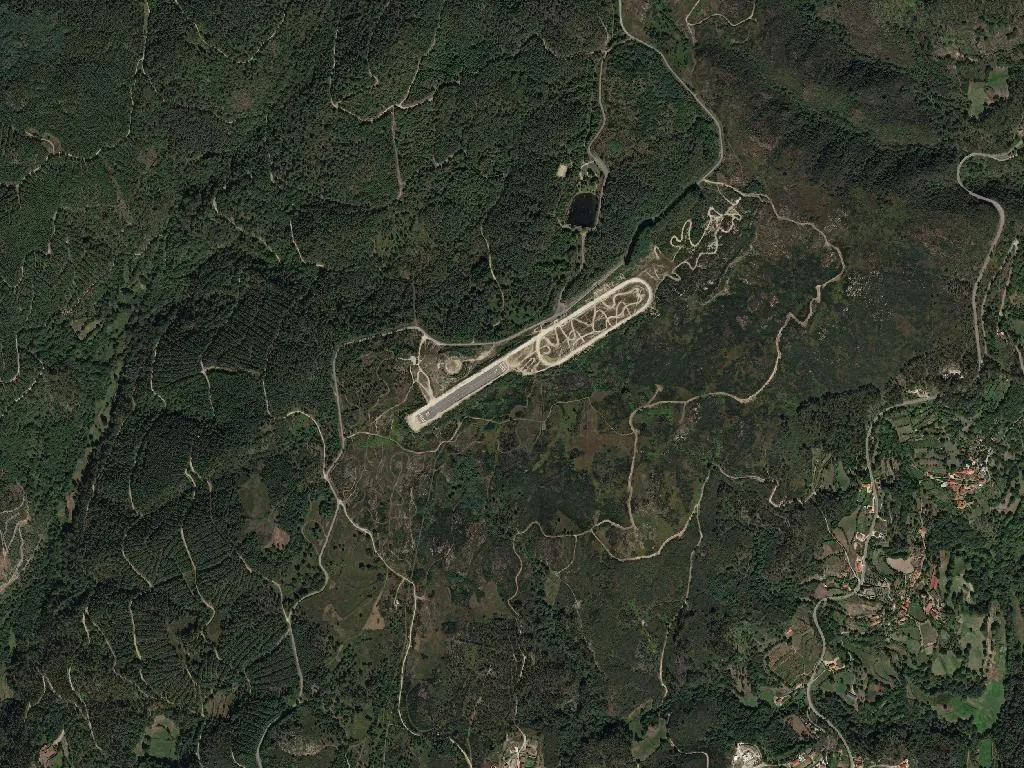
Abadim spreads across 1,513 ha of broom, oak and pine, threaded by the Abadim stream that rises at 900 m and tumbles to the Tâmega. With barely thirty people per square kilometre, silence becomes a physical presence – broken by wind combing the pines or the abrupt fluting of a blackbird. Paths exist but resist signposting: climb the earthen track behind the church to the hamlet of Cavez (1.2 km), follow the mule stripe that links Outeiro to the lonely Capela de São Sebastião (800 m), or continue the tarmac spiral to Corno de Bico at 953 m. Where the CM-1070 meets the Vale Pereiro track, no platform announces a viewpoint – yet on a clear evening you can trace the ridgeline thirty kilometres north to the granite battlements of Peneda-Gerês.
The bell sounds again at dusk, not to tell time but to confirm continuity. Smoke keeps rising, thin and white against a sky that turns ink-blue fast. Abadim offers no promises, no postcards; it simply endures, grave and consoling as the stone that shapes it.