Full article about Painzela’s Smoke-Scented Granite Ridge
Winter chimneys, terracotta soil & bell-timed life above the Verdes vines
Hide article Read full article
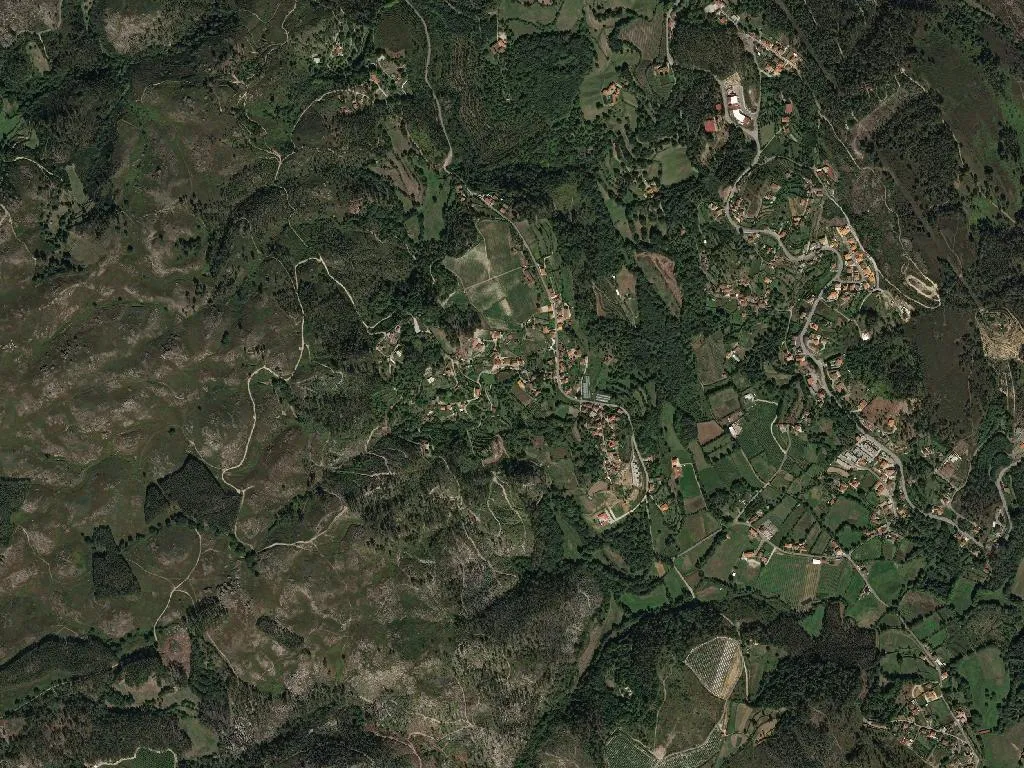
Smoke curls from granite chimneys in thin spirals. On winter mornings, when the Serra da Cabreira still bites, oak-wood smoke mingles with the damp-earth scent of turned soil. Painzela sits 394 m above sea level on a ridge between two folds of the valley; below, the Minho’s Verdes vineyards stripe the hills in acid-green, while newly-ploughed parcels show the colour of wet terracotta. Life here is choreographed by two metronomes: the agricultural calendar and the bell in the single-aisled Igreja Matriz—rhythms that never fall out of step.
The architecture of everyday life
Granite is the default building material, hewed and stacked without mortar in boundary walls that have outlasted every land registry. Houses rise two storeys, their walls half a metre thick to hold the heat of the salamander, windows tapered to slits to mislead the north wind. Dark-stained balconies still serve as drying racks for maize cobs; purple hyacinth beans hang like earrings from the railings. In the village centre the 18th-century church—formally an Imóvel de Interesse Público, locally just “a Igreja”—is no architectural jewel, yet lose it and you lose the pump-primer of every baptism, wedding and funeral, the entire hydraulics of community memory.
Population density tops 200 inhabitants per km², yet the settlement feels uncluttered: houses are spaced exactly at the distance a dog thinks it owns. Walk to your cousin’s for dinner, return on foot after three glasses of your father-in-law’s cherry firewater; no one is isolated, no one is crowded. Each household keeps its orchard, its vegetable patch and a mongrel that barks at the neighbour but will never rat out the spot where the matança cheeses are buried in ash.
When the calendar dresses up
The liturgical year doubles as the social diary. On 20 January the Festa das Papas honours St Sebastian with cauldrons of slow-stirred maize porridge eaten outdoors even if the thermometer is stuck at 4 °C. Bring your own spoon and you will be side-eyed: the mother-in-law squad has already counted cutlery and concluded you are not family. On 15 August Nossa Senhora dos Remédios processes through fields of flowering ginger, followed in quick succession by São Bartolomeu de Cavez (24 Aug) and São Miguel (29 Sept). Each festa is a full-parish rehearsal of togetherness: recipes for sarrabulho rice are traded, accusations of unpaid ranch quotas fly, teenagers drift between burger vans practising flirtation techniques unchanged since their grandparents’ day.
These are not tourist spectacles; they are adhesive. With 306 residents under 25 and 407 over 65, cohesion is not theoretical—it is measured in plastic chairs. The same benches that supported António’s post-wedding nap in 1963 now seat his granddaughter’s boyfriend, scrolling Instagram between fireworks.
Flavours that come from hill and field
The pantry is geography you can eat. Carne Barrosã DOP and Carne Maronesa DOP arrive from shaggy native cattle that graze the upper slopes; the beef is so densely flavoured it can make a committed vegetarian inhale twice before politely refusing. Mel das Terras Altas do Minho DOP, harvested from chestnut and heather blooms, is argued over on grounds of lunar phase—“Bees are Catholics, they prefer Fridays,” insists one beekeeper. In kitchens smoke-cured sausages hang like burgundy bats: chouriça, salpicão, presunto slow-tanned over oak fires. Recipes live in muscle memory—how many garlic cloves in the pork belly? Enough for the husband not to smell of it at vine-distance.
Life at 400 metres
There are no hotels, only ten rooms or cottages rented by people who will loan you their son’s France-returned bedroom. Breakfast is yesterday’s broa de milho, toasted and anointed with the same honey that was on your pillow’s welcome saucer. You wake to a neighbour’s rooster—or, on Saturdays, to the neighbour himself improvising a rooster after too much bagaço. By day you follow footpaths where tarmac yields to compacted earth and the standard greeting is “So, where do you come from? I don’t know your face.” By night the silence is so complete you can hear the river two valleys away.
At sunset the west-facing granite glows the colour of Madeira cake; dogs suspend their alarm when they clock the ham in your rucksack. On the horizon the serration of the Cabreira ridge stands guard, reminding you that this parish has always negotiated life between the cultivated and the wild, between the farewell “saudades” and the welcome-back “when are you returning?”