Full article about Fervença: Honeyed Granite Mornings in Minho Uplands
Oak smoke drifts over vineyard pergolas where Barrosã cattle graze and elders keep slow time.
Hide article Read full article
Morning light on granite
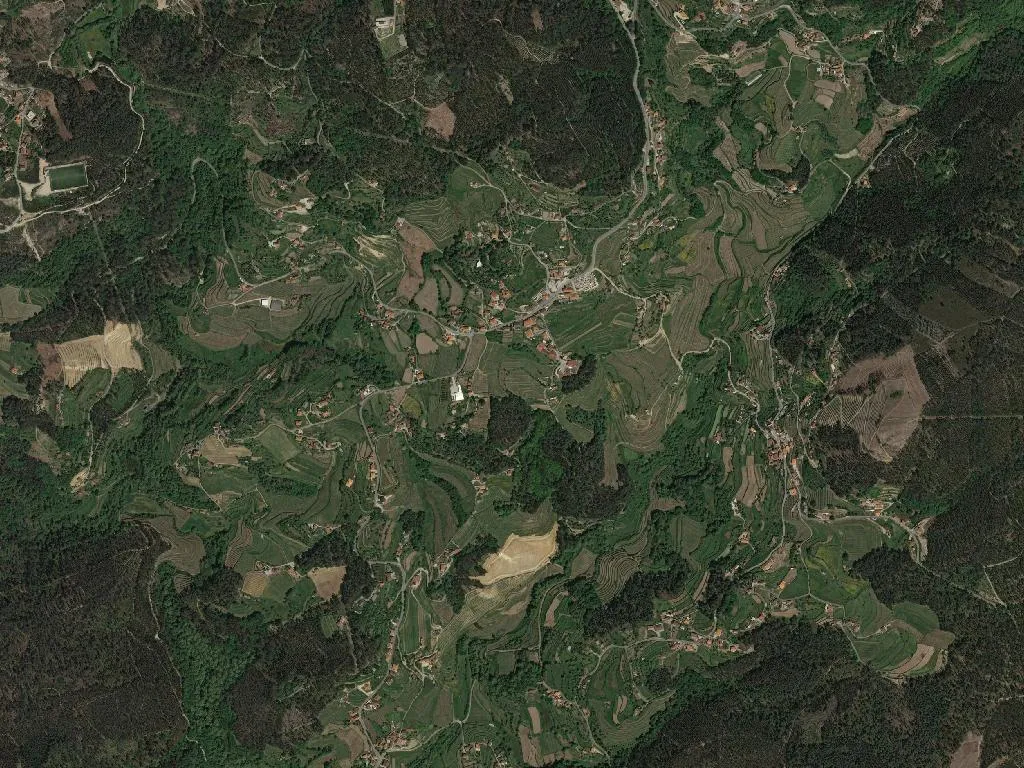
Sunlight slips through the wooden shutters and stripes the granite floors just after seven. In Fervença the day begins with the tang of oak smoke curling from bread ovens – the scent drags me straight back to my grandmother’s kitchen in January – and the low gossip of water running off the high Minho uplands. The parish unrolls across twelve square kilometres of gentle slopes at almost four-hundred metres, where the pergola wires of Vinho Verde vineyards alternate with meadows grazed by Barrosã cattle. Officially 1,057 people live here; it feels like fewer, or perhaps the landscape simply enlarges everyone.
Time is kept by the vineyard, the beehives parked on neighbouring ridges and two summer fixtures: the municipal festival for St James and the pilgrimage to the hilltop shrine of Nossa Senhora do Viso. Come July, the lanes fill with romeiros following packed-earth tracks to the chapel. Most are returnees rather than outsiders, though a handful of day-trippers lose their self-consciousness and end up at paper-covered trestles eating sardines as if they had always belonged. Census sheets note 264 residents over 65 and only under-18s in triple figures; you do not need the spreadsheet to sense that the clock ticks differently here.
Two protected pleasures
Local gastronomy rests on two pillars the EU has wrapped in DOP seals. Barrosã beef, from cattle reared on these high pastures, reaches tables in long, unhurried Sunday roasts. Minho Highland honey, amber-dark and mountain-aromatic, is gathered from hives parked among heather and chestnut blossom. In kitchens the old assembly line still operates: wood-fired bread, hot slices brushed with rendered pork fat, honey tipped from clay bowls – the sort of breakfast that refuses to be shortened to “toast”.
Vines are trained high on pergolas or low on modern wires, depending on the grower’s generation. My friend Zeca, who farms a slope opposite the village, claims the secret is “stop fiddling”. Harvest happens in mid-September when the canopy just starts to yellow. The wine needs no back-story: it is light, faintly spritzy, tastes of lime peel and demands nothing more than a grilled fish or a shady porch.
Borrowing a valley
Fervença offers no baroque façade, no interpretive board, no gift shop. Instead it lets you lease, for a week or a month, a working agricultural landscape that tourism has not yet saturated. Two stone houses take guests: one belongs to Dona Rosa, now installed with her daughter in Porto; the other to António’s son who left for Switzerland and never closed the door behind him. You wake to roosters, follow dirt paths between vegetable plots, learn the difference between pruning shears and grape hooks. At 87 inhabitants per square kilometre the silence is comprehensive, but it is not the empty hush of abandoned villages – it is a silence that answers back with bee-hum and cow-bells.
Summer afternoons stretch like elastic. Heat lingers in the granite until the sun drops behind the Marão range, then kitchen lights click on and the scent of chouriço blistering on chestnut embers drifts into blue wood-smoke. Fervença promises no adrenaline, no hashtags. It offers ballast: the mineral certainty of a place that will remain, between vineyard and pasture, long after the visitor has coasted downhill towards the coastal plain. As Zeca says while tightening a wire: “The stones know where they belong. Everything else is chatter.”