Full article about Salt-laced Apúlia: vines, dunes & dawn brine
Walk Camino boardwalks above tawny dunes where Vinho Verde vines hug sandy soil
Hide article Read full article
Where the cobbles taste of salt
Dawn condenses on the granite setts of Rua da Igreja, turning them black as ink. Before you have seen a single wave you taste the Atlantic: brine caught in the throat, a fine film on bicycle frames, the metallic tang that clings to café cutlery even when the sea is a kilometre away. Apúlia sits only nine metres above the surge, close enough for winter storms to rattle the window catches of the 19th-century farmhouses that line the main road.
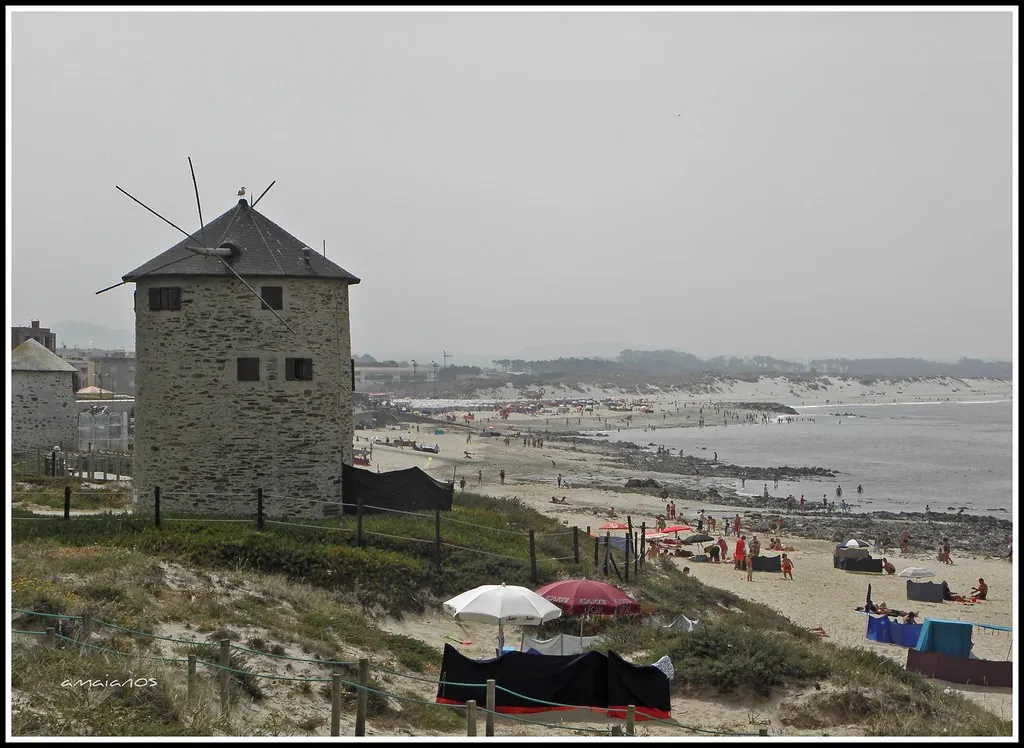
The parish is a narrow strip within Portugal’s Northern Littoral Natural Park, its shoreline a run of tawny beaches stitched to the land by low dunes of sea-grass and convolvulus. Behind the dunes, smallholdings survive on sandy loam, the vines of Vinho Verde trained barely a metre high so the ocean gales can pass overhead without snapping the canes. Look inland and the rows of wire-trained vines resemble a shallow green reef above the earth.
Pilgrims on the boardwalk
The Coastal Camino enters Apúlia along a wooden walkway that creaks like a ship’s deck. Hikers following the Lisbon–Santiago route have the Atlantic on their left for 8 km, yet the ocean is rarely out of earshot. There are no Baroque façades to pause at, only the cadence of surf and the shifting mercury of the water. Way-markers lead past 1950s fishermen’s houses—flat-roofed, whitewashed, with curious outdoor stone staircases that once gave access to loft storages for nets.
Of the 3,924 residents, a growing contingent now commutes south to Porto’s tech parks or Braga’s service sector; the fields are tended in spare hours. Half a dozen brightly painted saveiros still launch from the southern beach using the age-old arte xávega technique—circular nets hauled by tractor at dusk—yet seafood concessions, not fish sales, keep the boats registered. Drive along Avenida dos Pescadores and street names—Rua do Cavalo Marinho, Travessa da Sapateira—read like an inventory of what the tide once delivered.
June nights, Atlantic light
Festivities here are horizontal. During the eve of São João (23 June) three streets in the low village are closed to traffic; families set up trestle tables, sardines blacken on makeshift grills, and rockets arc over the breakers before fizzing into the dark. Visitors book one of the 119 local bedspaces precisely because prices stay well below those in neighbouring Esposende, yet the beach is equally walkable.
A wooden staircase every 200 metres drops you onto 4 km of continuous sand. At low tide the beach is wide enough for a Cessna to land; at 17.30 the Atlantic reclaims half of it, dissolving children’s moats in minutes. Lifeguards patrol only from mid-June to early September; outside those months swimmers gauge the rip themselves. Surfers favour the northern end where a small river jetty sculpts a workable right-hander, while locals stick to the southern cove protected by a line of schist rocks.
Parking beside the football pitch is free and fills by 11 a.m. on July weekends; out of season you simply nose the car against the dunes. Café Marés unlocks at seven for the crews heading out to sea and stays open until eight, dispensing galão in glass tumblers for €0.90 and turning a blind eye if you bring your own Tupperware for takeaway soup. Sit on the terrace, fingers wrapped around hot ceramic, and you realise the ocean here is not scenery—it is the parish’s second hearth, always lit, always breathing.